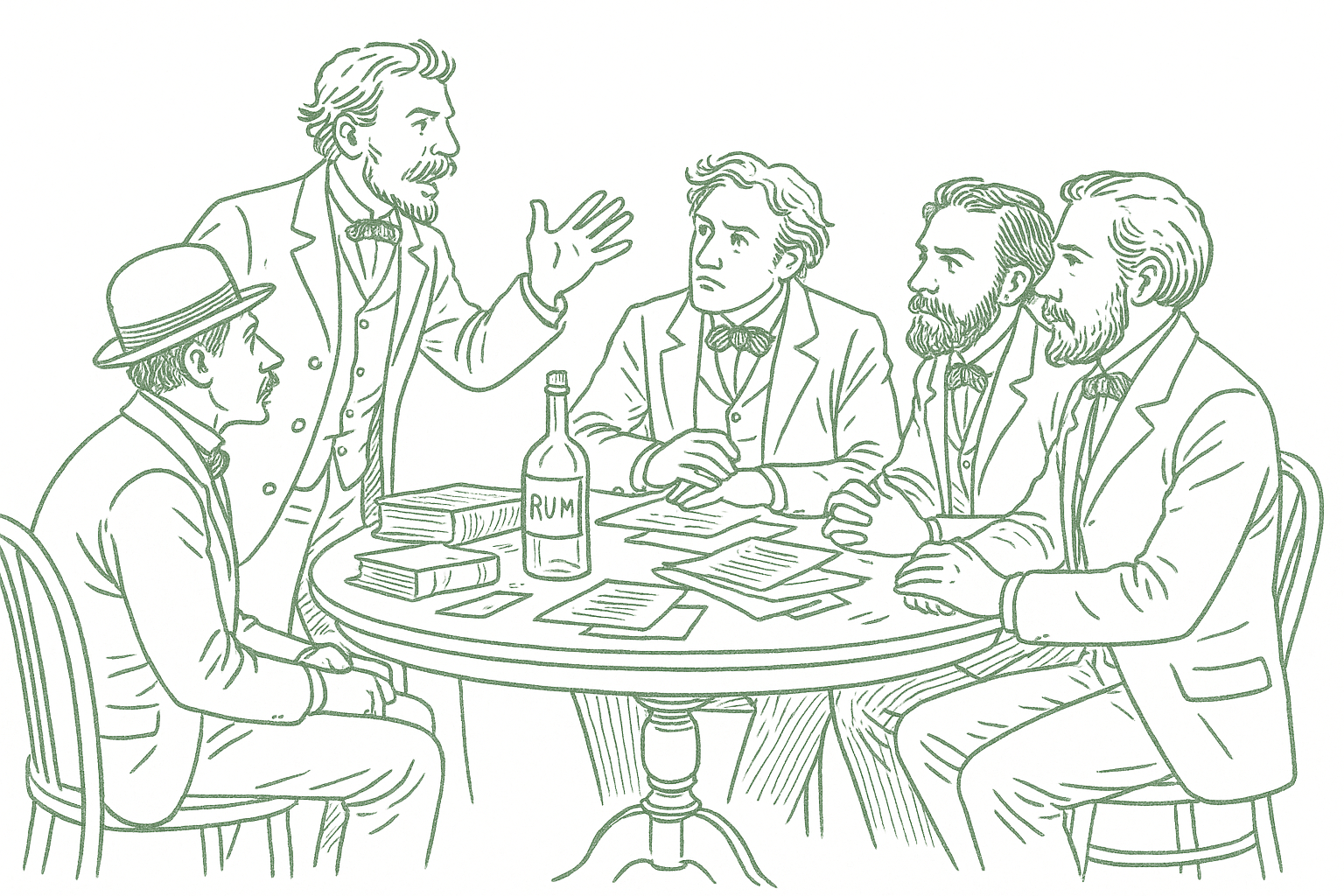
They met at 8:30 in the evening, usually at Oliver Wendell Holmes Jr.'s house in Cambridge, Massachusetts. There was a bottle of rum. There were no bylaws, no minutes, no agenda. About a dozen men — all Harvard-educated, most of them under thirty-five — showed up to argue about the meaning of life, which, as Louis Menand noted in his Pulitzer Prize-winning account of the group, "is something people did in 19th century Cambridge."
The club probably formed in January 1872 and dissolved by December of the same year. Nine months. No records survived. Charles Sanders Peirce, the group's most eccentric member, named it the Metaphysical Club — almost certainly as a joke, since the philosophy the group would produce was the opposite of metaphysics. His friend William James's brother Henry captured the general mood when he wrote to a friend: "My brother has formed a metaphysical club; it gives me a headache just to know it."
The headache-inducing discussion group produced exactly one thing: an idea about ideas. That idea — that beliefs are not fixed truths to be discovered but tools to be tested against experience — became pragmatism. It rewrote American law, reshaped education, redefined psychology, and remains the most significant original contribution the United States has made to world philosophy.
Nine months. A bottle of rum. A dozen people in a room. The pattern keeps showing up.
The people in the room
What made the Metaphysical Club unusual was not its format — informal discussion groups were common in nineteenth-century Cambridge. What made it unusual was the specific collision of people, each carrying a different kind of damage from the same historical event, all looking for the same thing: a new way to think about certainty in a world that had just demonstrated, in the most violent way possible, what happens when people are too certain.
Oliver Wendell Holmes Jr. had enlisted in the Union Army at twenty. He was shot above the heart at Ball's Bluff. Shot through the neck at Antietam. Shot in the heel at Chancellorsville. By the time he returned to Cambridge, he was a different person. "I started in this thing a boy," he said. "I am now a man." The war had burned out of him every trace of the idealism he had carried into it. Absolutes — moral, philosophical, political — struck him as the exact kind of thinking that gets hundreds of thousands of people killed. He enrolled in Harvard Law School looking for a discipline rooted in evidence rather than abstractions.
William James was the son of a wealthy, eccentric moral philosopher and the brother of the novelist Henry James. He had studied medicine, traveled to the Amazon with Louis Agassiz, suffered from chronic back pain and depression, and was, in 1872, a thirty-year-old instructor of physiology at Harvard who was slowly migrating toward psychology and philosophy. He brought to the club an obsession with the practical consequences of ideas — not what beliefs are, but what they do.
Charles Sanders Peirce was a logician, a scientist, a founder of semiotics, and by all accounts the most brilliant and difficult person in the room. He worked at the U.S. Coast Survey computing longitudes by day and thought about the foundations of knowledge by night. He would coin the term "pragmatism" and formulate its foundational principle — the pragmatic maxim. He would also spend the second half of his life in poverty and obscurity, dying in a farmhouse in rural Pennsylvania, his manuscripts bought after his death by Harvard for five hundred dollars.
The other members mattered more than later accounts usually credit. Chauncey Wright, a mathematician and occasional Harvard lecturer, served as the group's intellectual anchor — a rigorous empiricist who kept the discussion grounded. Nicholas St. John Green, a lawyer, insisted on the practical import of the Scottish philosopher Alexander Bain's definition of belief as "that upon which a man is prepared to act." That definition — belief as a readiness to do something, not a mental state — became the seed from which Peirce grew the pragmatic maxim. John Fiske, Francis Ellingwood Abbot, and Joseph Bangs Warner filled out the roster.
None of them were famous yet. Holmes was a decade from publishing The Common Law. James had not yet founded the first psychology laboratory in America. Peirce's landmark essays — "The Fixation of Belief" and "How to Make Our Ideas Clear" — would not appear in Popular Science Monthly until 1877 and 1878. Every one of them was still forming the ideas that would define their careers. They were forming those ideas together.
What they were arguing about
The Civil War had discredited a way of thinking. Before the war, American intellectual life was dominated by what Menand called the "culture of certainty" — a conviction that moral truths were self-evident, that right and wrong could be deduced from first principles, and that the universe operated according to an order that human reason could access. The abolitionists were certain slavery was wrong. The secessionists were certain it was their right. Both sides were certain enough to send 620,000 people to their deaths.
The members of the Metaphysical Club were not trying to resolve the specific moral questions of the war. They were trying to address the deeper structural problem: what happens when two groups of absolutely certain people produce catastrophic outcomes? How should you think about belief itself after watching absolute conviction produce absolute destruction?
Their answer, refined across months of argument, was radical in its simplicity. Stop asking whether beliefs are true in some abstract, correspondence-to-reality sense. Start asking whether beliefs work. Judge ideas by their consequences. Test them against experience. Treat them as tools for navigating reality, not as mirrors reflecting an invisible metaphysical order.
Peirce formalized this in his 1878 essay "How to Make Our Ideas Clear," writing what became the pragmatic maxim: "Consider what effects, which might conceivably have practical bearings, we conceive the object of our conception to have. Then, our conception of those effects is the whole of our conception of the object." In plainer language: the meaning of an idea is the sum of its practical consequences. If two ideas produce the same practical effects, they are the same idea regardless of how different they sound in the abstract.
This was Darwin applied to philosophy. As Menand put it: "Pragmatism is Darwin's theory of natural selection applied to philosophy." Ideas, like organisms, survive if they are adapted to their environment. They are not eternal truths descended from heaven. They are instruments generated by human beings trying to solve human problems. And like organisms, they should be judged not by their pedigree but by their fitness — by whether they work.
What the group structure made possible
None of the Metaphysical Club's members could have produced pragmatism alone. This is not a statement about their intelligence — several of them were among the most formidable minds of their century. It is a statement about the nature of the idea itself.
Pragmatism required the collision of law, science, psychology, and philosophy. Holmes contributed the legal insight that the law is not a logical system deduced from principles but an evolving body of experience shaped by social needs. Peirce contributed the logical framework — the formal machinery for evaluating beliefs by their consequences. James contributed the psychological dimension — an understanding of how beliefs actually function in human minds. Wright contributed the scientific rigor that prevented the conversation from drifting into the kind of speculative metaphysics the group existed to challenge.
And Green — the lawyer whose contribution is usually a footnote — provided the spark. It was Green who kept pressing Bain's definition of belief: that belief is not a mental state but a disposition to act. Peirce himself credited this intervention. In a later recollection, he wrote that Green's "insistence on the importance of applying Bain's definition of belief, as 'that upon which a man is prepared to act,' gave rise to the pragmatist movement."
The idea needed the room. It needed a lawyer pushing a definition, a logician formalizing it, a psychologist testing it against human experience, and a scientist refusing to let anyone cheat. A dozen people — not two, not two hundred. Enough diversity of perspective to prevent tunnel vision. Enough intimacy to produce genuine argument rather than polite seminar discussion.
The long afterlife of a short group
The Metaphysical Club dissolved after nine months, but its members spent the rest of their lives working out the implications of what they had discussed.
Holmes went on to become the most influential Supreme Court justice of the twentieth century. His 1881 book The Common Law opened with a sentence that reads like a pragmatist manifesto: "The life of the law has not been logic; it has been experience." His jurisprudence — the idea that law evolves through social need rather than descending from abstract principles — reshaped American legal thought and gave rise to legal realism, the dominant framework in American law schools to this day.
James published The Principles of Psychology in 1890 — a twelve-year project that established psychology as an empirical science in America. His 1907 lectures on pragmatism, published as Pragmatism: A New Name for Some Old Ways of Thinking, turned the philosophy the club had incubated into a popular movement. He credited Peirce publicly and often, and spent decades amplifying an idea that Peirce himself had difficulty communicating to a broad audience.
Peirce founded a second Metaphysical Club at Johns Hopkins University in 1879, this one with official records. He continued developing the logical foundations of pragmatism, semiotics, and the theory of inquiry until his death in 1914. He is now recognized as one of the most original thinkers in American intellectual history — a polymath whose work anticipated developments in logic, statistics, and the philosophy of science that would not be fully appreciated for decades.
John Dewey, who was not a member of the original club but studied under Peirce and became a close friend of James, carried pragmatism into education and public life. His philosophy of learning by doing — the idea that education should be an active, experimental process rather than the passive absorption of fixed truths — transformed American schools and remains the theoretical foundation of progressive education.
The 1919 Supreme Court case Abrams v. United States brought the story full circle. Holmes, now seventy-eight years old, wrote a dissenting opinion that articulated the modern doctrine of free speech. "The best test of truth," he wrote, "is the power of the thought to get itself accepted in the competition of the market." That sentence — truth as something tested in an open marketplace of ideas, not handed down from authority — is pure pragmatism. It is the Metaphysical Club's argument, formalized into constitutional law, still governing how Americans think about free expression a century later.
The structural pattern
The Metaphysical Club is one of the purest examples in intellectual history of what a small group can produce that individuals cannot. Not because the individuals lacked talent — they had more of it than any reasonable group should expect. But because the idea they produced was, by its very nature, a collaborative artifact. Pragmatism says that ideas are tools produced by groups, tested against experience, and refined through dialogue. The philosophy was itself a product of the process it describes.
Menand captured this when he wrote that the pragmatists "believed that ideas were tools — that they were produced by groups and were dependent on human carriers and on the environment, like germs." Ideas do not emerge in isolation. They emerge in conversation. They need friction, challenge, and the specific kind of pressure that only comes from sitting across from someone who thinks differently than you do and being forced to articulate why you believe what you believe.
Founders who work alone face the same structural problem the Metaphysical Club solved. Not a lack of intelligence. Not a lack of motivation. A lack of the specific social conditions under which ideas get stress-tested, refined, and made actionable. The pragmatists understood this at the philosophical level: beliefs are not private mental events. They are social practices. They exist in the space between people, not inside individual heads.
The advice paradox shows up here too. The Metaphysical Club was not a group of mentors dispensing wisdom to protégés. It was a group of peers — all roughly the same age, all grappling with the same post-war intellectual crisis, none of them in a position of authority over the others. The power dynamics were flat. The arguments were genuine. Nobody was performing expertise. They were all genuinely uncertain, and the uncertainty was productive.
Nine months. No records. A bottle of rum and a group of people who took each other seriously enough to argue honestly. The product was an idea that reshaped law, education, psychology, and the American theory of free speech. The product was also, not incidentally, a proof of concept for the process itself. Ideas are tools. They are produced by groups. They get better when tested.
The Metaphysical Club knew this before it had a name for it. They were practicing pragmatism before they called it that.