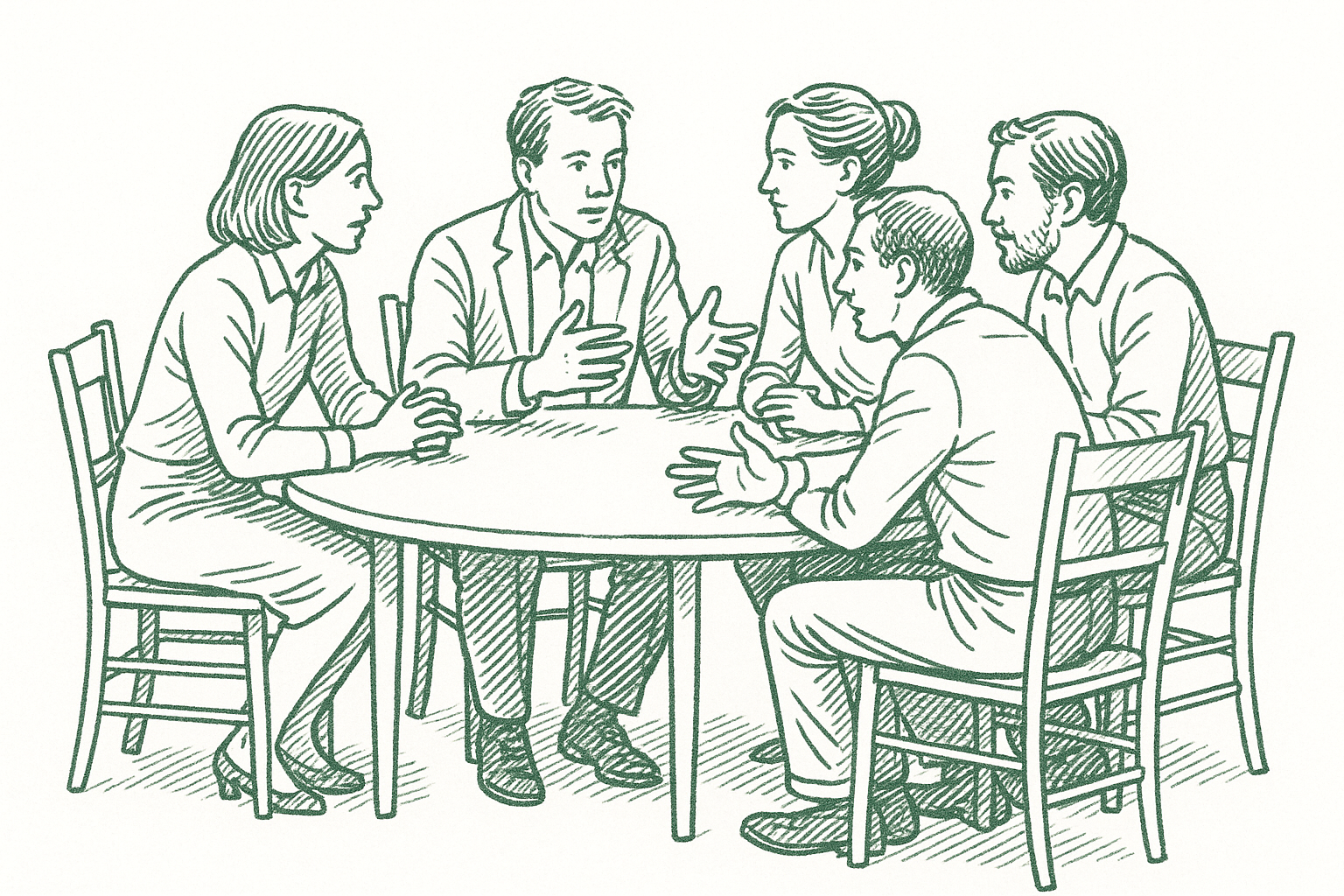
Every major leap in human history — scientific, creative, political, commercial — traces back to a small group of people who met regularly, challenged each other honestly, and held each other accountable to doing the work.
Not conferences. Not networking events. Not online communities with thousands of members and zero depth. Small groups. Consistent meetings. Real conversation.
The modern business world has a word for this: mastermind groups. But the concept predates the term by centuries. Before Napoleon Hill wrote about it, before Silicon Valley fetishized it, before it became a line item on a coaching invoice — people were already doing this. And it was working. One of the clearest proofs is Renaissance Florence — where the Medici built a small circle of scholars and artists that produced the intellectual foundation of the modern West.
1727 · Philadelphia
Benjamin Franklin's Junto Club
Benjamin Franklin was 21 years old, running a struggling print shop in Philadelphia, when he had an idea that would quietly shape American history: gather twelve people in a room every Friday night and make them talk honestly about what they were building.
He called it the Junto — derived from the Spanish junta, meaning assembly. Others called it the Leather Apron Club, after the working-class trades of its members. It wasn't a social club for elites. The original twelve included a printer, a surveyor, a glazier, a cabinetmaker, a cobbler, a clerk, and a bartender. They had nothing in common except ambition, curiosity, and a willingness to be honest with each other.
Every meeting followed a structure Franklin designed himself. Members took turns posing questions on morals, politics, and natural philosophy. Every three months, each member had to present an original essay. The rules were explicit: no "fondness for dispute or desire of victory." Just honest inquiry. Franklin banned the words "certainly" and "undoubtedly" from discussions — a 21-year-old's attempt to enforce intellectual humility three centuries before anyone had a word for it.
Franklin wrote 24 standing questions for the Junto. They are remarkably modern:
"Have you met with any success since our last meeting?"
"Do you have anything to ask the advice of the group about?"
"Has any member of the group been wronged in any business transaction?"
"What new knowledge or information have you gained recently?"
That's an accountability framework. In 1727.
The Junto met for over thirty years. During that time, its members founded Pennsylvania's first lending library, its first volunteer fire company, the University of Pennsylvania, and the American Philosophical Society. Franklin himself attributed much of his success — diplomatic, scientific, literary — to the relationships and ideas that came from those Friday evenings.
He was so convinced of the model that he encouraged Junto members to start their own groups, creating what he called "sub-Juntos" — essentially the first franchise of peer advisory groups in American history.
1919 · New York City
The Algonquin Round Table
At the Algonquin Hotel in midtown Manhattan, a group of writers, critics, and performers started eating lunch together. Every day. At the same table. For nearly a decade.
Dorothy Parker. Harold Ross. Robert Benchley. Alexander Woollcott. Harpo Marx. George S. Kaufman. Edna Ferber. They called themselves the Vicious Circle — and they meant it. The wit was cutting. The criticism was brutal. The standards were impossibly high.
It was also one of the most creatively productive groups in American cultural history.
Harold Ross launched The New Yorker magazine, directly inspired by the conversations at that table. Parker became the most quoted woman in America. Kaufman won the Pulitzer Prize for drama. Ferber won it for fiction. The group collectively shaped American humor, journalism, and theater for a generation.
They didn't have a facilitator. They didn't have an agenda. What they had was a commitment to showing up, a shared intolerance for mediocrity, and the kind of honesty that only comes from people who respect each other enough to say what they actually think.
1914–1924 · The American Countryside
The Vagabonds
Between 1914 and 1924, four of the most powerful men in America loaded up a caravan of cars and went camping together. Every summer. For weeks at a time.
Henry Ford. Thomas Edison. Harvey Firestone. John Burroughs. Later joined by President Warren G. Harding. They called themselves the Vagabonds, and their trips through the Adirondacks, Great Smokies, and Green Mountains became the stuff of legend — not because of the camping, but because of what happened around the fire.
These were the men building the modern American economy. Ford was revolutionizing manufacturing. Edison was inventing the future. Firestone was putting rubber on every road in the country. They didn't need to network. They needed to think — and they did their best thinking together.
The trips were deliberately unplugged from their daily operations. Edison would challenge Ford on business strategy. Ford would press Burroughs on the natural sciences. Firestone would talk supply chains and global trade. They argued. They debated. They sharpened each other's ideas against the friction of genuine disagreement.
Napoleon Hill later studied these men extensively for his research on success. He noticed something: individually, they were brilliant. Together, they were something more. That observation became the foundation of the Mastermind Principle.
1925–1937 · The Framework
Napoleon Hill and the "Master Mind Principle"
When Napoleon Hill interviewed Andrew Carnegie — then the richest man in the world — and asked for the secret of his success, Carnegie didn't talk about steel. He talked about people. The full story of that encounter — and what historians later found out about it — is worth reading separately.
Carnegie said his fortune could be traced to the "sum total of the minds" of his associates — his managers, chemists, accountants, engineers. He called this combined brain power a "Master Mind" and credited it as the true source of his empire.
Hill spent the next twenty years studying this idea. He interviewed hundreds of successful people — Ford, Edison, Firestone, Wrigley, Woolworth — and found the same pattern everywhere. The most successful people didn't operate alone. They operated in small, trusted groups where ideas were tested, challenged, refined, and made real.
He first published the concept in The Law of Success in 1925, and expanded it in Think and Grow Rich in 1937. His definition:
"The coordination of knowledge and effort of two or more people, who work toward a definite purpose, in the spirit of harmony."
Hill believed that when minds came together in genuine harmony, something new was created — a "third mind" that was greater than any individual contributor. You can take or leave the mysticism. But the underlying observation holds: people think better together than alone, if — and only if — the conditions are right.
The conditions he identified: a shared purpose, genuine harmony, and a commitment to giving as much as you receive. Sound familiar? Those are the same principles Franklin baked into the Junto two centuries earlier.
1933–1949 · Oxford, England
The Inklings
C.S. Lewis and J.R.R. Tolkien were colleagues at Oxford. They became friends. Then they became something more useful: honest critics of each other's work.
Their group, the Inklings, met in Lewis' rooms at Magdalen College on Thursday evenings and at a local pub — the Eagle and Child, which they called the "Bird and Baby" — on Tuesday mornings. The group included Charles Williams, Owen Barfield, and a rotating cast of writers, poets, and thinkers.
Over pipe smoke, tea, and beer, members would read aloud from their work-in-progress — The Screwtape Letters, The Hobbit, The Lord of the Rings — and the others would respond with what Lewis called "hard-hitting criticism." Not polite encouragement. Not empty praise. Real feedback from people who understood the craft deeply enough to be dangerous.
Lewis said of the group: "We meet theoretically to talk about literature, but in fact nearly always to talk about something better. What I owe to them all is incalculable."
Consider the output: The Chronicles of Narnia. The Lord of the Rings. The Screwtape Letters. The Space Trilogy. Some of the most beloved works in the English language were refined, challenged, and improved in a small room at Oxford because a group of friends committed to showing up and being honest.
The Inklings met for sixteen years. The Thursday meetings ended in 1949, the year Tolkien finished The Lord of the Rings. The Tuesday pub meetings continued until Lewis' death in 1963.
The Inklings weren't the only English literary group of the era to produce output vastly disproportionate to their size. A few decades earlier and a few miles east, in a Bloomsbury drawing room, Virginia Woolf, John Maynard Keynes, E.M. Forster, and Lytton Strachey were doing the same thing for modern literature and economics. The Bloomsbury Group's story is worth reading in full.
1901–1909 · Washington, D.C.
Theodore Roosevelt's Tennis Cabinet
When Theodore Roosevelt entered the White House, he was 42 — the youngest president in American history — and he was bored by the old men who filled the halls of government. So he built his own advisory group, drawn from friends, diplomats, military officers, and outdoorsmen. He called them the Tennis Cabinet.
They hiked. They climbed cliffs. They rode horses. They swam in the Potomac in early spring when there was still ice in the water. And while they exercised, they discussed and debated the pressing issues of the day — not in a formal briefing room, but in the kind of unguarded conversation that only happens when people trust each other completely.
The Tennis Cabinet included Major General Leonard Wood, conservationist Gifford Pinchot, and the grandsons of Generals Lee and Grant. A friend of Roosevelt described it simply: "For that once in our history, we had an American salon."
Roosevelt understood something that still trips up leaders today: the best advice doesn't come from people who report to you. It comes from people who will tell you the truth because they have nothing to lose by doing so.
1950–Present · The Formalization
The Modern Peer Advisory Movement
In 1950, a 27-year-old named Ray Hickok inherited a 300-employee belt manufacturing company in Rochester, New York, after his father died. He had just returned from World War II. He was overwhelmed. And he had no one to talk to about it.
So he found other young company presidents in similar situations and started meeting with them regularly. That group became the Young Presidents' Organization — YPO. The full origin story is more specific than most people know — and the structure Hickok built is the same structure that 38,000 CEOs are paying $15,000 a year to access today.
Seven years later, in 1957, a Milwaukee businessman named Robert Nourse had the same insight from a different angle. He saw that CEOs were making decisions in isolation — big decisions, with nobody to pressure-test them against. He founded what would become Vistage, now the world's largest CEO peer advisory network with 45,000 members.
The Entrepreneurs' Organization, Strategic Coach, the Abundance 360 community — the list goes on. The modern peer advisory industry is now worth billions. And every organization in it traces its intellectual lineage back to the same insight: leaders make better decisions when they have a small group of trusted peers to think with.
What's changed since Franklin's Junto isn't the principle. It's the price tag. Traditional peer advisory now costs $15,000 to $50,000 per year. The format — monthly meetings, professional facilitation, vetted membership — remains powerful. But it's locked behind a gate that most founders and operators will never walk through.
The Pattern
Three hundred years of evidence. Different centuries, different industries, different continents. The same structure producing the same results. The Fabian Society took eleven people in a London drawing room and reshaped modern government — using nothing but pamphlets, dinners, and patience.
Here's what every successful mastermind group in history has in common:
Small size.
Franklin had 12. The Inklings had 6-8 regulars. The Vagabonds had 4. Depth requires limits.
Consistent meetings.
Regularly. On a cadence. Never "when we get around to it." The Junto met every Friday for thirty years. The Inklings met every Thursday for sixteen.
Diversity of perspective.
Not diversity for its own sake — diversity that creates friction. A glazier and a printer see problems differently. That's the point.
Radical honesty.
The Algonquin Round Table was called the Vicious Circle. The Inklings gave "hard-hitting criticism." Politeness kills progress.
Accountability to action.
The Junto required essays. The Inklings read work-in-progress. Carnegie's inner circle had deliverables. Ideas without execution are just conversation.
Harmony of purpose.
Not agreement — harmony. These groups argued constantly. But they were all pulling in the same direction: mutual improvement.
That's it. Six principles. They worked for Franklin in 1727. They worked for Tolkien in 1937. They work now.
What This Means for You
You don't need another LinkedIn connection. You don't need another online course. You don't need another conference where you collect business cards and forget everyone's name by Tuesday.
You need what Franklin needed. What Edison needed. What Lewis and Tolkien needed.
A small group of people who understand what you're building. Who will tell you the truth when you need to hear it. Who will hold you accountable to the commitments you make. Who will show up, consistently, because they're as invested in your progress as you are in theirs.
That's what mastermind groups have always been. And that's what GoodGrowth is building — not a new idea, but a very old one made accessible to the people who need it most.
The most recent proof: 1957. Eight semiconductor researchers walked out of William Shockley's lab together, made a collective bet on each other, and built the companies that created Silicon Valley. Read the full story of the Fairchild Eight.