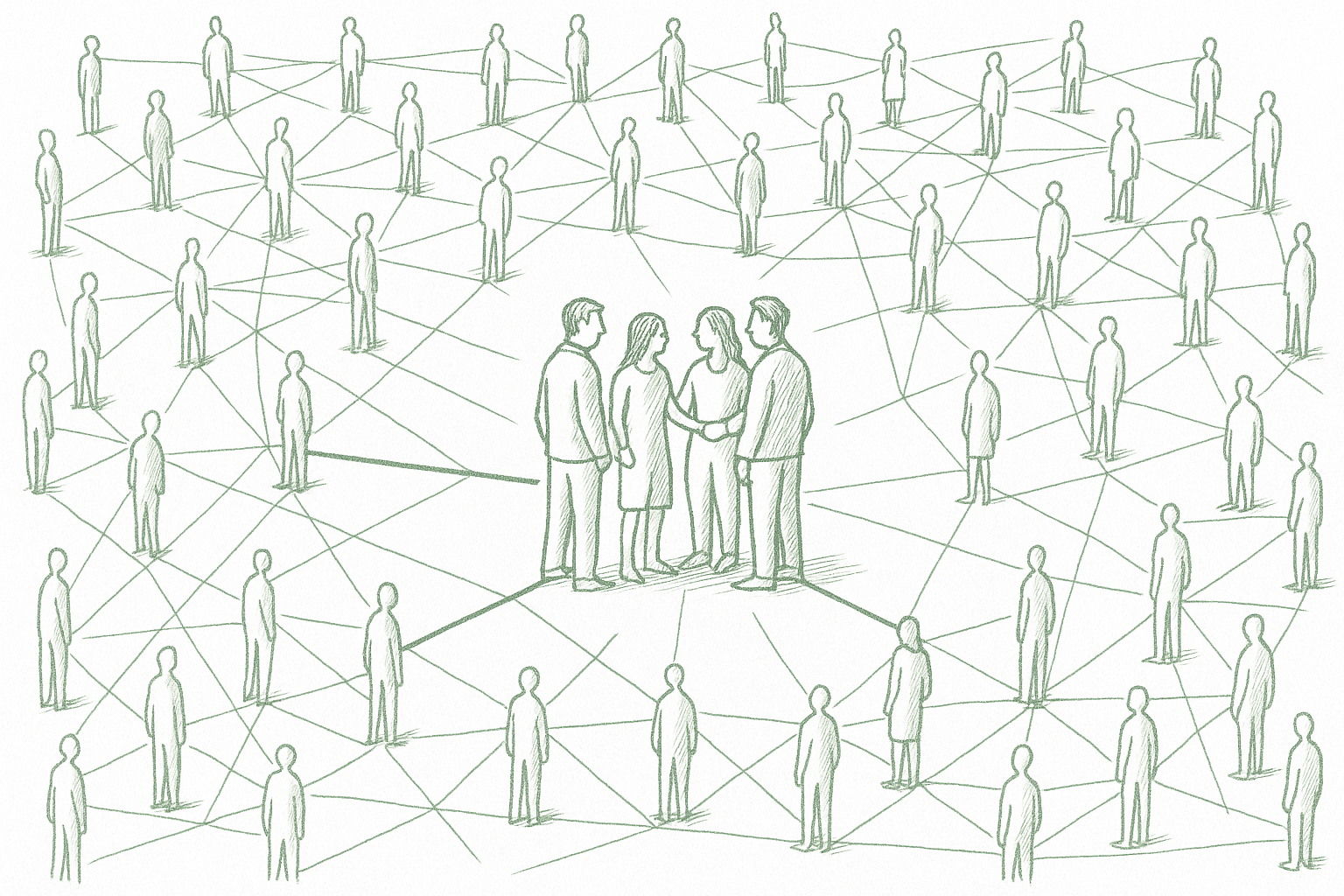
You have 2,000 LinkedIn connections. You're in 14 Slack communities. You attend two conferences a year and come home with a stack of business cards that go into a drawer and never come out.
You call this a network. Science calls it noise.
The Number
In 1993, British anthropologist Robin Dunbar was studying primate brains. He found a tight correlation: the bigger the neocortex, the bigger the social group the species could maintain. He plotted the data, drew the regression line, and plugged in the human brain.
The answer was 150.
That's the maximum number of stable social relationships a human can maintain — relationships where you know who each person is and how they relate to each other. Dunbar described it informally as "the number of people you would not feel embarrassed about joining uninvited for a drink if you happened to bump into them in a bar."
But 150 is just the outer boundary. Dunbar's research revealed something more important: the layers underneath.
The Layers That Matter
Your social world isn't a flat list. It's a set of concentric circles, each roughly three times the size of the one before it:
5 people — your innermost circle. The people you'd call in a genuine crisis. The ones who get the unfiltered version of how things are going.
15 people — your sympathy group. Close friends whose death would be genuinely devastating. You trust them and see them regularly.
50 people — your close social network. People you'd invite to a group dinner. You know their situations and they know yours.
150 people — the full Dunbar number. People you have a genuine social relationship with. Beyond this, you're just recognizing faces.
Here's what 30 years of research has confirmed: the inner layers are where all the value lives. The outer layers feel productive — you're "networking," you're "building relationships" — but the people who actually change your trajectory are the 5 to 15 closest to the center.
Why This Wrecks Founders
Most founders do exactly the wrong thing with their limited relationship capacity. They spread it thin.
They optimize for breadth: more introductions, more coffees, more events, more followers. Every new connection feels like progress. But Dunbar's research shows that every relationship you add costs cognitive and emotional bandwidth — and the budget is fixed. Meanwhile, Granovetter's research on weak ties shows that the most valuable information flows through the connections you invest the least in — a paradox that big networks cannot solve by getting bigger.
Add a hundred casual connections, and you haven't gained a hundred allies. You've diluted the attention available for the five people who could actually help you solve the problem keeping you up at night.
The Hutterites — a communal group Dunbar studied — figured this out centuries ago. When a colony hits 150 people, it splits. Not because of space or resources. Because the social fabric breaks down. People stop feeling accountable to each other. Free-riding increases. The group stops functioning as a group.
The same thing happens in your network. Past a certain size, it stops being a network and starts being an audience. Audiences don't help you make decisions. They help you feel popular.
The LinkedIn Illusion
Dunbar has addressed the social media question directly, and his answer is blunt: platforms don't change the number. You can have 5,000 Facebook friends. You still only have five people you'd call at 2 AM. That number isn't arbitrary — six decades of research explains exactly why five is the number human groups converge on.
His research on social media usage found that the pattern of interaction online mirrors the offline layers exactly. People might have vast follower counts, but they actively interact with the same 150 or fewer. The technology changed the medium, not the biology.
This matters for founders because the illusion of a large network creates a false sense of support. You feel connected. You're not. Connection requires the kind of time and emotional investment that can only be maintained with a small number of people — and the return on that investment follows a steep power law. Your five closest relationships deliver more value than the other 145 combined.
What Actually Works
The research points to a specific structure that maximizes the value of your limited social bandwidth:
Small and stable. Groups of 3 to 5 people, meeting consistently over time. Not rotating panels. Not open-door mixers. The same people, building trust through repeated interaction.
Similar stage, different context. You want people who understand the weight of your decisions but see the world from a different angle. Same stage founders in different industries are ideal — they get the pressure without sharing your blind spots.
Structured, not social. The inner circle works because it's high-investment. Casual happy hours don't build trust. Regular, structured meetings where people bring real problems and get real feedback — that's what moves the needle.
The military has known this forever. The basic fighting unit across nearly every army in history — from Roman legions to modern infantry — is 10 to 15 people. Not because of tactics. Because that's the number where people will risk their lives for each other. The trust ceiling is real.
The Math of Attention
Dunbar's research gives us a framework for thinking about where to invest. Primates maintain social bonds through grooming — it's their way of building trust and alliance. Humans replaced grooming with language (gossip, conversation, storytelling), but the time cost is similar.
Dunbar found that primates spend up to 20% of their time on social grooming. Humans spend a comparable amount on social interaction. But the time is not distributed equally. You spend the vast majority of your social time on the inner layers — and each layer outward gets exponentially less.
If you're a founder spending three hours a week at networking events to maintain 200 surface-level connections, you're making a losing trade. Those same three hours invested in a tight peer group of five people would generate dramatically more trust, better advice, and actual accountability.
It's not even close. The science is clear: depth beats breadth, every time.
The Uncomfortable Conclusion
Your network isn't an asset. Most of it is dead weight — pleasant people you kind of know who will never materially help you, and you'll never materially help them.
The people who will change your business — who will challenge your thinking, hold you accountable, and give you the honest perspective you can't get from employees or investors — are a single-digit number. Finding them and investing in those relationships isn't networking. It's strategy.
Dunbar proved that your brain has a budget for relationships. The question isn't how to increase it. It's how to spend it.
GoodGrowth builds groups of 3–5 founders — right in the center of Dunbar's innermost circle. Not networking. Structured peer support with people who understand what you're building. Read the 300-year history of why this works.