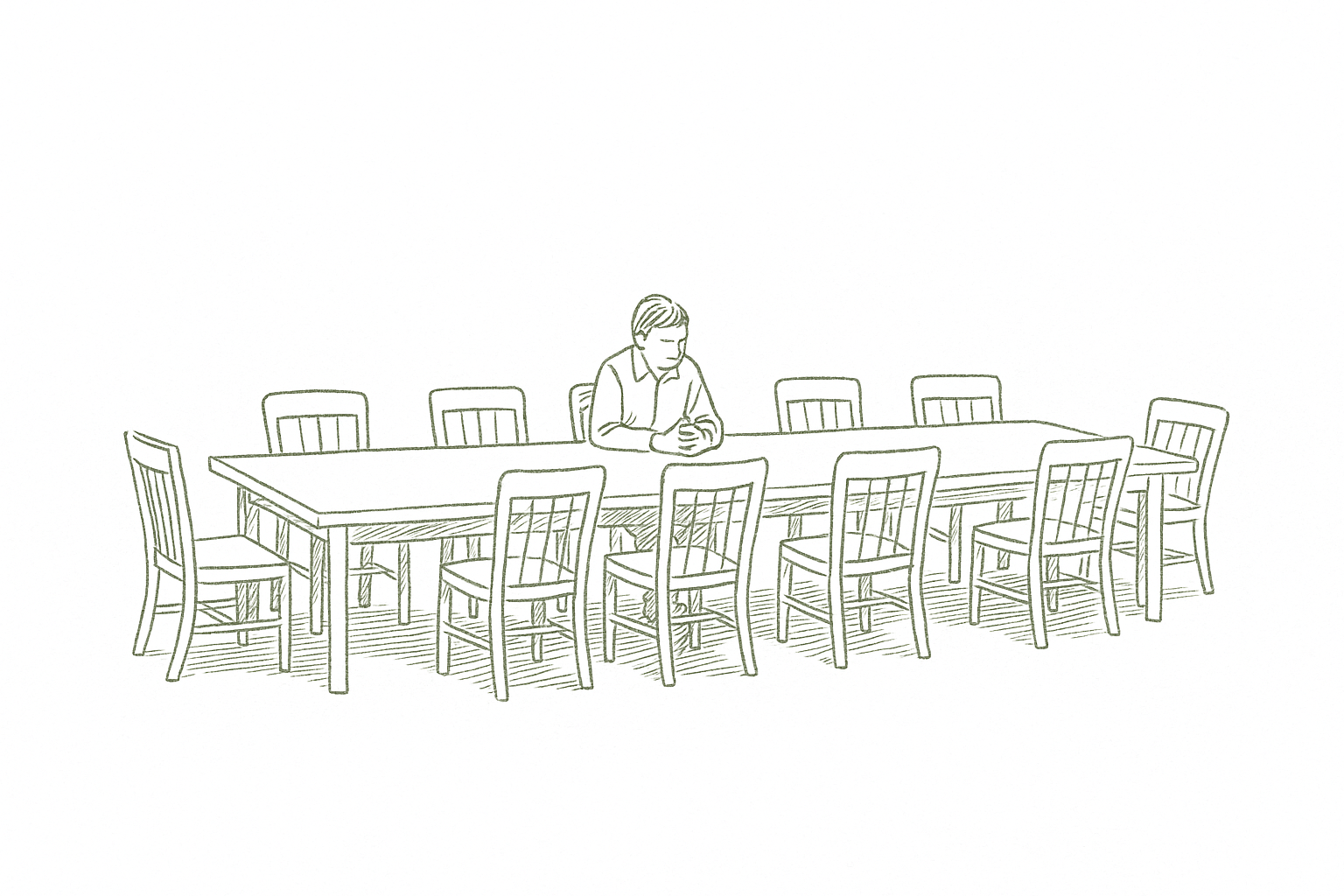
Founders who make decisions alone make worse decisions — not because they lack intelligence, but because the cognitive mechanisms that produce good judgment require social input. Research consistently shows that group deliberation improves decision accuracy, reduces overconfidence, and surfaces information that solo analysis misses.
Here's a number that should concern every founder: over 70% of new CEOs report feeling lonely, according to Harvard Business Publishing. And it's not just uncomfortable — a study cited in the Economic Times found that nearly 70% of first-time CEOs said loneliness negatively affected their performance.
Not their mood. Their performance. The quality of their decisions.
In 2024, 55% of CEOs reported mental health issues including anxiety, depression, and burnout. The higher you climb, the fewer people you can talk to honestly. Your board has an agenda. Your team needs confidence. Your investors want good news. Your spouse is tired of hearing about burn rate. And even when they listen, the people closest to you are structurally incapable of giving you the business advice you need.
So you make decisions alone. And that is where things start to break. Not because you lack an advisory board — but because you lack peers.
The Cognitive Case Against Solo Decisions
Daniel Kahneman and Amos Tversky's foundational research on judgment and decision-making — the work that eventually won a Nobel Prize — showed that human brains are riddled with systematic errors. Confirmation bias. Overconfidence bias. Anchoring. The sunk cost fallacy. The IKEA effect — overvaluing what you built simply because you built it. These aren't character flaws. They're how brains work.
The problem for founders: every one of these biases is amplified when you're alone.
Confirmation bias — the tendency to seek evidence that supports what you already believe — is almost impossible to catch by yourself. That's the whole point of the bias: it feels like clear thinking. You're not ignoring contrary evidence on purpose. You genuinely don't see it.
A 2024 study published in PLOS Computational Biology found something counterintuitive: a moderate confirmation bias can actually improve decision-making — but only when multiple agents learn together in a social context. The bias that hurts you alone helps you in a group, because other people's biases point in different directions and create the friction that surfaces better answers.
In other words: the cure for your blind spots is other people's blind spots. But this only works when the group has genuine psychological safety — when people feel safe enough to share the real blind spot, not the polished version of it.
What Isolation Actually Does
Research on loneliness in leadership identifies several mechanisms that degrade decision quality:
Risk aversion increases. Studies show that high levels of loneliness in leadership predict less perceived self-control, leading to overly conservative decisions. You stop taking the bets that made you successful in the first place.
Echo chambers form. Without trusted outside perspectives, you default to the information that's already in your head. Your team tells you what you want to hear. Your research confirms what you already believe.
Speed suffers. Paradoxically, solo decision-makers often take longer. Without someone to pressure-test an idea against, you cycle through options endlessly. The decision that would take 30 minutes with a trusted peer takes 3 weeks of internal deliberation.
Pattern recognition degrades. Experienced founders are valuable because they've seen patterns before. But patterns are only useful if you can match them to new situations accurately — and that matching process improves dramatically when multiple people with different experiences contribute.
The Fix Isn't More Information
The instinct when you're stuck on a decision is to gather more data. Read another report. Run another analysis. Ask your team for one more market sizing exercise.
But the research suggests the problem isn't information — it's interpretation. You have plenty of data. What you lack is someone who will look at the same data and reach a different conclusion. Someone who will ask the question you're not asking yourself. Someone with no stake in being polite.
Andrew Carnegie understood this in the 1890s. He told Napoleon Hill that his fortune came from the "sum total of the minds" of his associates — not because they had more information than he did, but because they processed it differently. The combined perspective was more accurate than any individual view.
A hundred and thirty years later, the science confirms what Carnegie intuited: diverse perspectives don't just add — they multiply. The "master mind" effect isn't mysticism. It's basic cognitive science. More viewpoints, applied to the same problem, reduce the impact of individual biases and surface solutions that no single person would reach alone. Fifty years of small group research has mapped exactly why and when this works.
What This Means Practically
You don't need a therapist (though that might help too). You don't need a coach who's never run a company telling you to "trust the process." You don't need a LinkedIn network of 5,000 people you've never had a real conversation with.
You need 3 to 5 people who are building something at a similar stage, in a different industry, who will meet with you regularly and tell you the truth. People whose only agenda is being useful — because you're being useful to them in return. The research on why honest feedback disappears as you gain authority explains exactly why your existing team cannot fill this role.
That's not a nice-to-have. Given what the research shows, it's a structural advantage. The peer effect is one of the most documented phenomena in social science — decades of studies showing that the people around you measurably change your behavior, your performance, and your decisions. The founders who have this make better decisions. The founders who don't are operating with a handicap they can't see — because the nature of the handicap is that it's invisible from the inside.
GoodGrowth organizes founders into small peer groups for exactly this reason. Not networking. Not advice. Structured problem-solving with people who understand the weight of the decisions you're making. Here's why masterminds work and networking events don't. Learn more.
If you're building for the first time, the isolation hits differently. Here's why first-time founders need a peer group even more than a mentor.
GoodGrowth is infrastructure for the second opinion founders need but rarely have access to. It places founders into small, problem-matched peer groups — 5 to 12 people working through similar decisions — where the group can challenge assumptions, surface blind spots, and hold commitments accountable. Not coaching. Not a community. A decision-improvement structure.