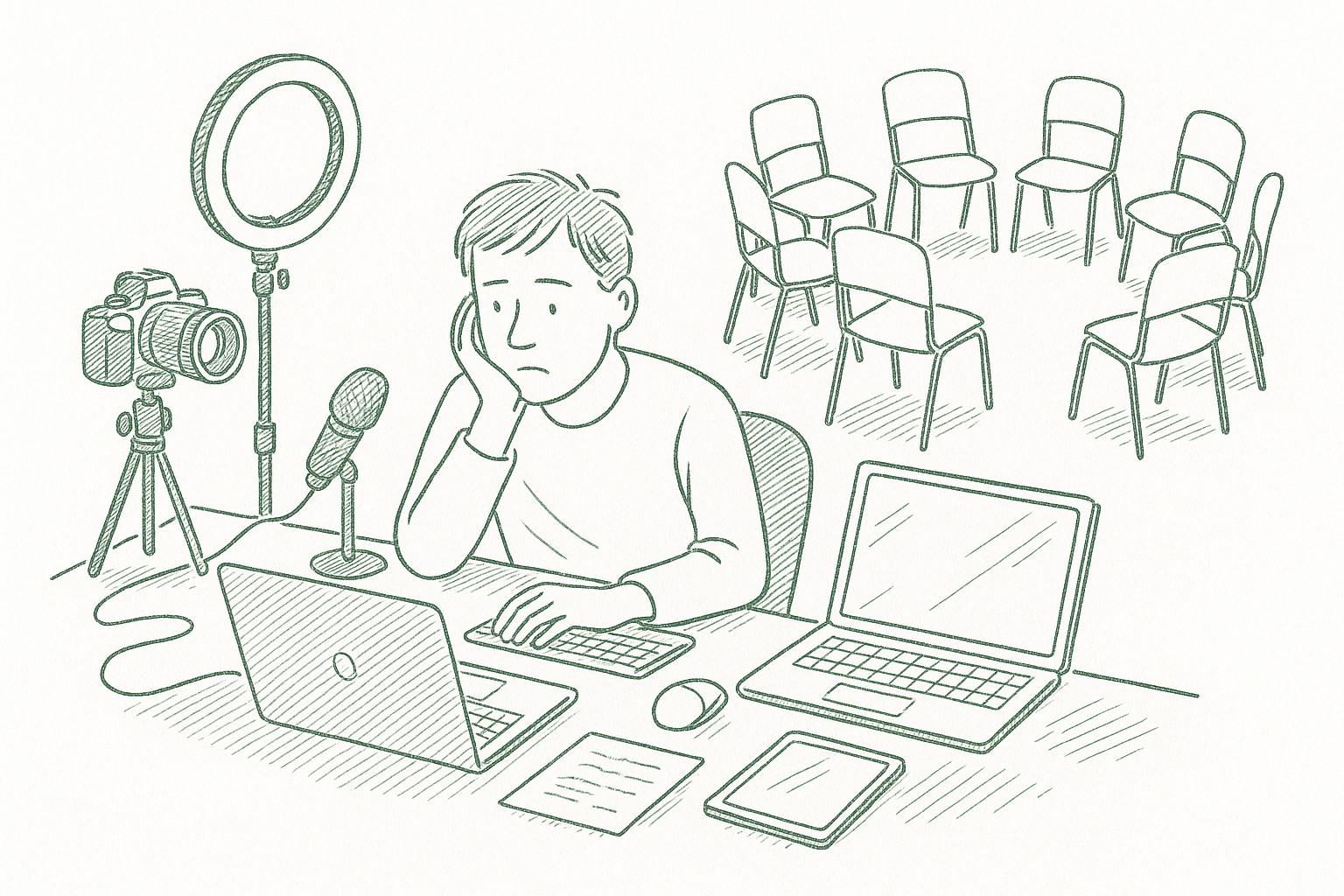
The pitch for the creator economy is simple: build an audience, own your income, answer to nobody. It's appealing enough that roughly 2 million people have made it their full-time job, with another 46 million monetizing content on the side. The global market hit $205 billion in 2024. The growth projections are absurd. Everyone is building.
And yet the Harvard T.H. Chan School of Public Health just completed one of the most thorough surveys of creator mental health ever conducted. Of more than 500 full-time creators polled across North America: 62 percent report burnout. 69 percent experience financial instability. 58 percent say their self-worth drops when content underperforms. Ten percent report suicidal ideation related to their work — nearly double the broader U.S. rate.
The contradiction is worth sitting with. The creator economy promises independence. The data shows it's producing one of the most psychologically isolating professional environments of any career path. The freedom to work for yourself turns out to come with a cost that most people don't anticipate: you're doing it entirely alone.
The Specific Problem with Building an Audience Alone
The creator's version of professional isolation is structurally different from, say, a solo consultant working from home. Creators have enormous public surface area. The comments section is always on. Followers track every upload. There's the illusion of community — sometimes a very loud one — but none of it translates into the kind of honest, peer-level conversation that actually helps someone run a business.
Your audience is not your peer group. They consume what you make. They don't know your margin on that course launch. They can't tell you whether the brand deal you're negotiating is fair or whether you're leaving 30 percent on the table. They can't push back on your pricing strategy or ask why your email list isn't converting. They watch. They comment. They follow.
Meanwhile, you are making every real business decision alone. When to cut a platform and double down on another. Whether to hire an editor or keep grinding through production yourself. Whether to raise prices. Whether the agency pitching you has your interests or theirs in mind. Whether you're burning out or just having a bad month. Research consistently shows that these kinds of decisions — made under pressure, without honest feedback, by a person with too much at stake to see clearly — are systematically worse than decisions made with a small group of trusted peers.
The Business Problems No Creator Tool Solves
The creator economy has spawned an entire software category to help creators manage their work: analytics platforms, scheduling tools, course builders, payment processors, link-in-bio products. All of them solve the production and distribution side. None of them solve the judgment side.
The actual decisions that determine whether a creator becomes a business — or stays a grind — are not software problems. They're strategy problems that require experience, context, and honesty.
Platform dependency. Most creators' income is structurally fragile because it flows through one or two platforms that can change their algorithm, their monetization terms, or their fee structure without warning. The top-earning creators — those making over $100,000 a year — average 3.3 revenue streams. Those making under $500 a month average 2.2. The gap is deliberate strategy, not luck. Knowing which streams to build next, and when, requires seeing what's worked for others operating at the same scale.
Pricing and negotiation. Brand deal rates are opaque by design. Agencies and brand managers know the market rate. Most creators don't — and the asymmetry is expensive. Creators who participate in peer groups where rates are shared openly consistently negotiate higher deals. Not because they got better at negotiating, but because they finally knew what the number should be.
The audience ownership gap. Creators who own their audience — via email list, SMS, direct subscription — are 2.7 times more likely to reach higher income thresholds than those who depend entirely on platform reach. Most creators understand this in theory. Moving from understanding to execution requires accountability. The distance between knowing what to do and actually doing it closes much faster when someone is tracking whether you did it.
Burnout as a business risk. When 62 percent of full-time creators are burning out, the profession has a structural problem. Burnout isn't just a wellness issue — it's a business continuity issue. Creators who disappear for months lose algorithms, lose audience momentum, and often lose the income that made the whole thing work. The ones who sustain do it because they have external mechanisms that help them regulate: collaborators, support structures, people watching.
Why Creator Peer Groups Work Differently
The creator world has communities. Discord servers. Slack groups. Skool cohorts. Every platform has a corner where creators gather. Most of them produce the same outcome as a large networking event: a lot of impressions, not much depth.
The research on network quality is consistent: beyond a certain size, adding connections stops producing value and starts diluting it. A Discord server with 2,000 content creators is not a peer group. It's an audience. Nobody in a server that size knows your P&L, your content strategy, your real churn rate, or what you've actually been avoiding for the past quarter.
A peer group is five to eight creators at similar scale, in non-competing niches, who meet consistently and go deep. The format matters as much as the people: a structured problem-solving session where each member presents a real challenge, the group asks hard questions, and the member commits to specific action. Not a conversation about content trends. A working session where real problems get real input.
The right group for a creator looks like: people who understand the mechanics — algorithm dynamics, audience psychology, sponsorship economics, platform shifts — well enough to give useful feedback, but who aren't competing for the same audience or the same deals. A B2B SaaS content creator and a fitness educator aren't competitors. They share almost every business problem.
The Pattern Among Creators Who Actually Build
Behind almost every creator who has turned a channel into a sustainable business, there's a small group of people who know the real story. Not the audience — the actual peers. The ones they text when a brand deal feels off. The ones they compare numbers with. The ones who told them to raise their prices or cut the platform that was burning them out.
This has been true for as long as people have been solving hard problems together — the mechanism doesn't change just because the medium is digital. What changes is access. Most creators stumble into these relationships if they're lucky. A structured group makes the luck unnecessary.
The creator economy will keep growing. The platforms will keep changing. The algorithm will keep being an unpredictable employer who never shows you a contract. The creators who build something durable inside that environment will be the ones who stopped figuring it out alone.