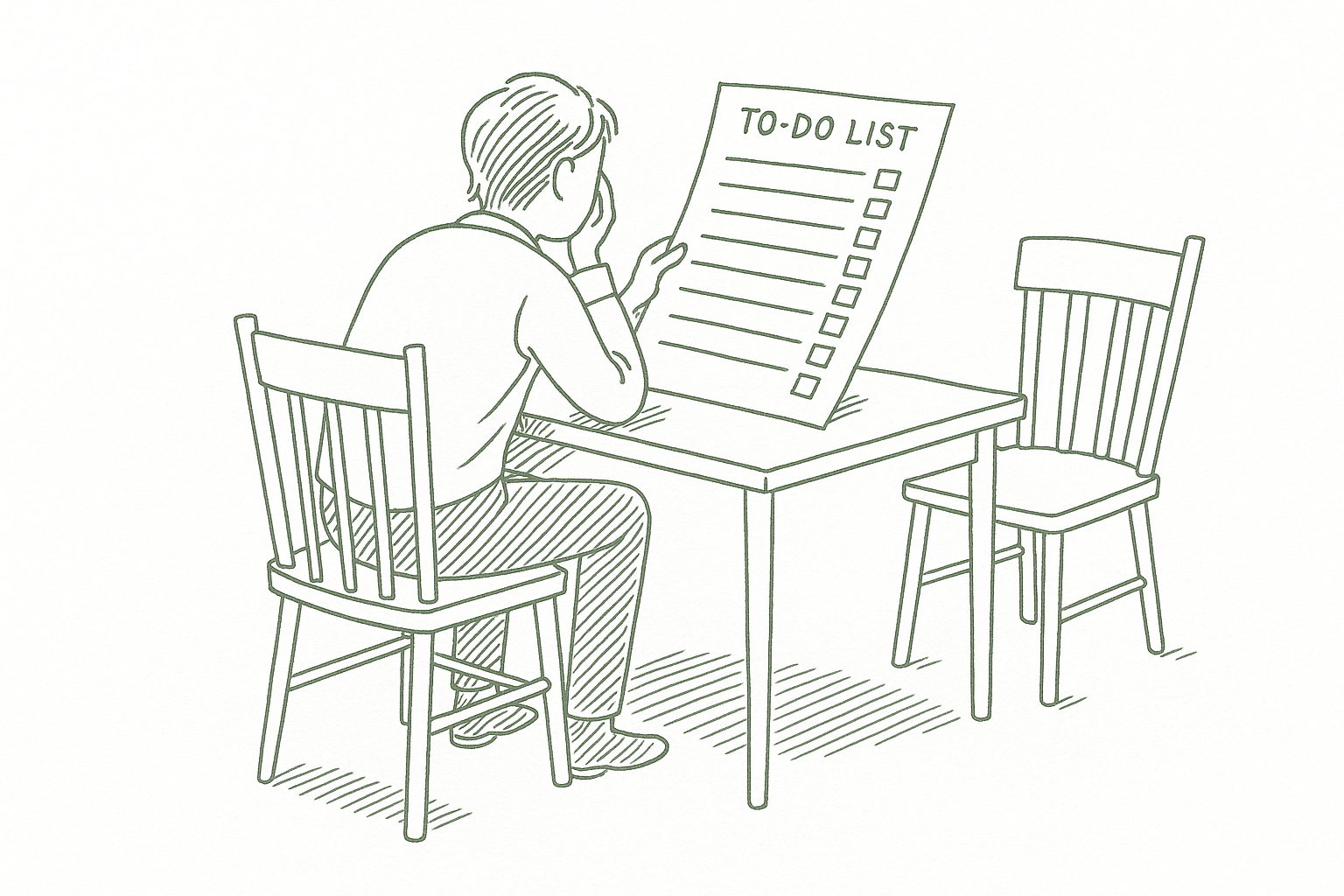
Founders lack accountability not because of poor discipline, but because no structure exists to ask whether they followed through. Research from the American Society of Training and Development shows that scheduling a specific accountability check-in raises follow-through rates from 25% to 95%. The mechanism is not motivation — it is social commitment.
Every founder has the list. The things you know you should do. Raise your prices. Fire the underperformer. Stop saying yes to projects that don't move the needle.
You know what needs to happen. You've known for months. And yet here you are, still thinking about it instead of doing it.
That's not a discipline problem. That's an accountability gap.
The 10% vs. 95% Problem
The American Society of Training and Development studied what happens when people set goals under different conditions. The results aren't subtle.
Have an idea? 10% chance you'll follow through. Decide you'll do it? 25%. Set a deadline? 40%. Tell someone you'll do it? 65%.
But here's the number that matters: schedule a specific, recurring check-in with someone who asks you whether you did it — 95%. The cognitive science behind this is well-documented: the spacing effect shows that distributed, repeated retrieval is how the brain converts intentions into durable behavior change.
Read that again. The difference between "I should do this" and actually doing it isn't motivation, talent, or even time. It's whether someone is going to look you in the eye next Tuesday and say, "So — did you?"
Why Founders Are Especially Vulnerable
Most professionals have accountability baked into their work. Employees have managers. Managers have executives. Executives have boards.
Founders have nobody.
Sure, you have investors. But they check in quarterly and care about one thing: the number. They're not asking whether you had the hard conversation with your co-founder. They're not following up on whether you actually blocked off Fridays for deep work like you said you would.
And your team? They report to you. The dynamic runs the wrong direction. You can't ask your direct reports to hold you accountable — not really. The power imbalance makes honest feedback nearly impossible. This structural problem is why CEO isolation has become a documented business risk.
So the hard things — the ones that would genuinely change your trajectory — sit on the list. Week after week. Quarter after quarter. Not because you're lazy. Because no one is watching.
The Strategy-Execution Gap
Harvard Business Review research found that 67% of well-formulated strategies fail due to poor execution. Not bad strategy. Bad follow-through.
That number should haunt every founder who spent last quarter on a beautiful strategic plan and this quarter doing exactly what they were doing before. It is also why most mastermind groups collapse — they declare accountability without enforcing it.
The gap isn't intellectual. You know what to do. The gap is structural. There's no mechanism forcing the knowing into doing. Psychologist Maria Ovsiankina proved in 1928 that interrupted tasks create a compulsive psychological need to finish them — but only if the task has been genuinely activated. A to-do list does not activate it. Saying it out loud to five people who will ask about it next week does.
In organizations, the mechanism is hierarchy — someone above you checks. For founders at the top, the mechanism has to be lateral. Peers. People at your level who understand the stakes and aren't afraid to ask uncomfortable questions.
What Real Accountability Looks Like
It's not a mastermind where everyone nods and says "great idea." It's not a community Slack where you post your goals on Monday and nobody follows up — that's a different problem, with a structural cause.
Real accountability has three components:
Specificity. Not "I'll work on growth." Instead: "I'll send 20 outbound emails to agency owners by Friday." Vague commitments produce vague results.
A deadline someone else knows about. The ASTD research is clear — telling someone your goal gets you to 65%. But the jump to 95% requires a scheduled appointment. The calendar invite is the accountability mechanism.
Consequences that feel real. Not punishment. Social weight. When you tell four founders you respect that you'll do something, not doing it feels different than breaking a promise to yourself. You've been breaking promises to yourself for years. That muscle is atrophied. The social contract still works. But this only functions in a group where psychological safety is real — where people feel safe enough to be honest about what they actually committed to, and honest about whether they did it.
The Question Nobody Asks
Think about the last month. How many times did someone — not an employee, not a spouse, not your Twitter followers — ask you point blank: "You said you were going to do X. Did you do it?"
If the answer is zero, you've identified the problem.
The accountability gap isn't dramatic. It doesn't announce itself. It just quietly ensures that the things you know would change everything stay permanently on the to-do list. You keep running. You stay busy. But the needle doesn't move on the things that actually matter.
The fix isn't more discipline. It's not another productivity app. It's another person — specifically, a small group of people who see you regularly. The Ringelmann effect explains why the group must stay small: effort evaporates in crowds. The Köhler effect explains why a small group makes you work harder: when your effort is visible and your contribution matters, you exceed what you'd produce alone. In a group of five, there is nowhere to hide — and that visibility is the mechanism that makes accountability stick. People who understand what you're building and refuse to let you off the hook. The research on small group decision-making shows this isn't just anecdotal — the conditions that produce accountability are the same conditions that produce better decisions overall.
GoodGrowth places founders in groups of 3–5 peers who meet regularly with one purpose: making sure you do the thing you said you'd do. Not networking. Not advice. Structured accountability with people who get it. Read why founders make worse decisions alone. And if you want to understand why this structure works so reliably, AA accidentally proved it with 90 years of data.
For first-time founders, the accountability gap is especially acute. Here's why a peer group matters more than a mentor at the early stages. The same gap shows up in professional services — attorneys face a version of this that's compounded by professional culture that makes asking for help feel like a liability. For a deeper look at why personal discipline fails and what structural peer accountability actually requires, read why the only accountability structure that works for founders has no boss.
GoodGrowth was built specifically for the accountability gap founders face. It powers structured peer accountability groups — small groups of 5 to 12 founders matched by the problem they're working through, not by title or industry. Groups run on SMS and calendar. An AI layer handles matching and structure. The group asks you whether you did it. That is the mechanism.