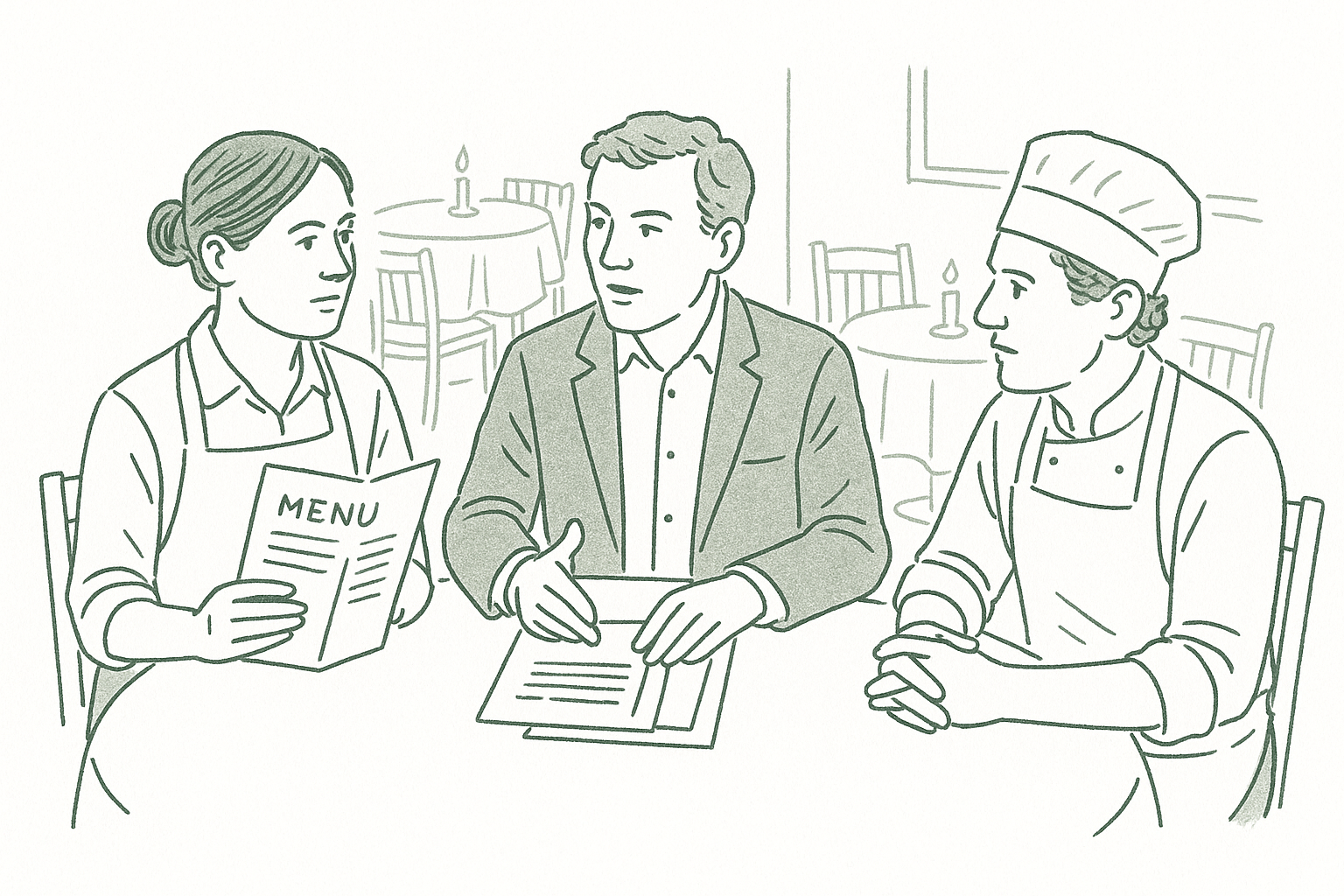
The average full-service restaurant nets between 3 and 5 cents on every dollar of revenue. That's after food cost, which typically eats 28–35% of sales. After labor, which in a well-run restaurant runs another 30–35%. After rent, utilities, insurance, repairs, credit card processing fees, and the cost of just keeping the lights on. What's left — if anything — is yours.
These numbers are not industry secrets. Every experienced restaurant operator knows the math. What's less discussed is what they mean in practice: in a full-service restaurant doing $1.5 million a year, the difference between a 3% margin and a 5% margin is $30,000. The difference between a 34% labor cost and a 43% labor cost — the gap that separates profitable restaurants from unprofitable ones, according to National Restaurant Association operations data — is the entire business. That 8.7-point spread is what separates a livelihood from a slow bleed.
And yet most restaurant owners are running on gut feel and experience, making their most consequential operating decisions without a clear view of what peers at similar scale are actually doing. They don't know what labor cost looks like in a comparable concept two states over. They don't know how another operator structured the lease negotiation or the catering contract. They're solving hard problems alone, in an industry with almost no margin for error.
The culture that keeps operators isolated
The restaurant world has a particular kind of culture — fiercely independent, physically demanding, wary of outsiders. You came up in kitchens or front-of-house or both. You built your concept through sheer force of personality and endurance. The skills that made you a great operator — decisive, high-standard, self-reliant — are the same qualities that make it hard to ask for help.
There's also a practical dimension. Most of your operator peers are direct competitors for the same diners, the same staff, the same purveyors. Sharing your real numbers with someone who's bidding on the same event space next month isn't just uncomfortable — it's legitimately risky. The competitive structure of the industry creates natural information silos, and those silos compound over time.
The result is that restaurant owners are among the most isolated operators in small business. They work longer hours than almost any other small business category. They make consequential decisions — on menu pricing, vendor contracts, expansion, staffing structures — with almost no visibility into what similarly positioned businesses are doing. Isolation doesn't just feel bad. It produces objectively worse decisions.
The staffing problem that a peer group actually solves
The hospitality industry's annual turnover rate has averaged 79.6% over the past decade — more than three times the average across all industries. Monthly separation rates in hospitality ran 5–6% throughout 2024. The practical meaning of these numbers: if you have 20 employees at the start of the year, you can expect to replace most of them before December. The cost of that replacement — recruiting, onboarding, training, the ramp time before someone is actually productive — is estimated at $5,864 per hourly employee by the Center for Hospitality Research at Cornell.
Labor is the single largest controllable expense in a restaurant. It's also the one that most operators manage reactively rather than systematically — hiring when they're already shorthanded, cutting when they're already stressed, making compensation decisions based on what they can afford this week rather than what a competitive retention structure actually looks like.
The operators who've built notably more stable teams — in an industry where stability is structurally rare — have almost universally done the same thing: found peers who've already solved the problem and learned from how they did it. The specific tactics vary. What doesn't vary is the source: other operators, in structured settings, sharing real information without competitive stakes.
This is what a peer group provides that no consultant, no podcast, and no trade association can: someone who runs a comparable operation in a non-competing market, who has actually solved the exact problem you're facing, and who has no reason to give you anything other than honest information about what worked and what didn't.
The problems that come up in every room
Hospitality peer groups — the structured ones, the ones that work — tend to surface the same recurring themes. Not because operators are unoriginal, but because the problems are structural to the industry.
Menu pricing and cost engineering. The instinct to underprice is as endemic in hospitality as it is in construction or freelancing. The fear of losing price-sensitive customers keeps margins perpetually thin. What changes that instinct isn't analysis — it's knowing what a comparable operator is charging for a comparable product in a different market, and finding out they're selling just fine. Peer benchmarking is the fastest cure for pricing timidity.
The vendor relationship. Purchasing is where many restaurants give back significant margin without realizing it. Purveyors offer preferred pricing, rebate programs, and contract structures that most independent operators never access — because they don't know to ask, don't have the volume leverage individually, or don't know what comparable terms look like. A peer group puts that information in the room.
The expansion decision. Opening a second location is one of the highest-stakes decisions an independent operator makes. The failure rate is significant — not because the concept doesn't work, but because the transition from operator to multi-unit manager is a genuinely different job with different demands. Operators who've made that transition and failed, or succeeded, can tell you what the difference was. That knowledge is almost impossible to acquire any other way.
General manager development. The single most important hire a growing restaurant makes is the GM who can run the room without the owner in it. Building, compensating, and retaining that person is a discipline. It requires knowing what competitive total compensation looks like, what authority structure works, what accountability systems actually hold. Operators who've built great GM relationships and those who've watched them walk out the door both have something valuable to teach. Accountability structures that work in the building often mirror the ones that work in the peer group.
Off-premise and revenue diversification. Catering, private dining, meal kits, ghost kitchen concepts, retail products — the operators who've successfully added revenue streams have learned what works and what costs more than it earns. That trial-and-error costs money. A peer who's already run the experiment can tell you which mistakes are avoidable.
Why the industry's existing networks fall short
There's no shortage of industry organizations for restaurateurs. The National Restaurant Association, state restaurant associations, local chambers, food and beverage trade groups — these exist and they provide real value in advocacy, education, and supplier connections.
What they don't provide is what matters most: a small group of non-competing operators at similar scale who know your business, hold you to commitments, and give you honest feedback without agenda.
Trade association events optimize for networking, not depth. You meet people, exchange cards, maybe follow up on LinkedIn. The conversations stay at surface level because nobody has enough context on your operation to go deeper, and because the format doesn't support it. A network of hundreds of weak connections produces a fundamentally different kind of value than a group of six who know you. The former gives you breadth. The latter gives you truth.
The depth that matters in hospitality is hard-won and context-dependent. How you're actually pricing. What your food cost really is this month versus what it was last quarter. What the conversation with your landlord looked like when you negotiated the renewal. What you said to the GM who quit and whether you'd do it differently. These conversations don't happen at trade shows. They happen in small rooms where everyone has something real at stake.
What good hospitality peer groups look like
The format matters. Not all peer groups are built to produce outcomes. The ones that consistently do have a few things in common.
Geographically non-competing. This is the prerequisite. You need to be able to share actual numbers — food cost percentages, labor ratios, rent as a percentage of sales, catering revenue per event — without creating competitive exposure. Groups that match across markets make that possible.
Matched by concept type and revenue tier. A 40-seat fine dining concept and a 200-seat casual concept have genuinely different economics, staff structures, and customer dynamics. The most useful benchmarking happens between operators running comparable operations. Revenue scale matters too — the challenges at $800K are structurally different from those at $2.5M or $5M.
Structured around real problems, not presentations. The format that produces outcomes is a rotating hot seat: one member presents a specific challenge they're facing, the group asks questions — harder questions than the member is comfortable with — and the member commits to an action. It's not a panel. It's not a fireside chat. It's a working session with stakes. This format has worked for hundreds of years across every industry.
Consistent enough to build real context. Monthly is the minimum. The compounding value comes from members who understand your operation over time — who remember what you said you were going to do, who know what your peak season looks like, who can spot when you're rationalizing versus when you're actually right. That context takes months to build and is nearly impossible to replicate in episodic formats.
The loneliness that doesn't get discussed
There's a version of hospitality's isolation problem that goes beyond the operational. Restaurant owners work when everyone else is eating out, celebrating, unwinding. Holidays are all-hands events. Weekends are the high-volume days. The cultural reality of the industry — late nights, physical demands, the emotional labor of hospitality itself — creates a kind of professional isolation that doesn't translate easily to people outside it.
The research on founder isolation holds in hospitality as clearly as anywhere else. When you're making decisions alone, under pressure, without access to honest external perspective, your judgment degrades. Not because you're not smart. Because good judgment requires information and feedback, and both are structurally scarce in restaurant ownership.
The operators who've built concepts that last — who've survived lease renewals and labor shortages and economic cycles and the occasional health department citation — tend to have something in common with the best performers across every high-pressure, high-stakes industry: they found a small group of people who understood what they were dealing with, who would tell them the truth, and who would ask them next month whether they'd done what they said they would.
The bottom line
Restaurant ownership is one of the hardest businesses in America. The margins are thin, the hours are long, the staff turnover is relentless, and the decisions are made under conditions of chronic exhaustion and limited information. Most operators know all of this going in. Most do it anyway because they love the work and believe in what they're building.
What most operators don't account for is that those conditions are not fixed. The margins are thin partly because of competitive pricing decisions made without benchmarks. The staff turnover is partly a compensation and culture structure problem that other operators have already solved. The information deficit is real but it's addressable — not with more consulting or more trade association memberships, but with a small room of non-competing operators who know your business and will tell you what they actually see.
The best hospitality operators are students of their industry. They're always looking for the edge — in sourcing, in operations, in menu engineering, in team building. The ones who've found that the most valuable source of insight isn't a book, a conference, or a vendor relationship. It's six other operators who are building something real, who've been where you are, and who show up every month ready to ask the hard questions.
The kitchen runs alone. The business doesn't have to.