The advice is always the same. You are a founder, you are growing, you need outside perspective. So someone tells you to build an advisory board. You recruit three impressive people — a former CFO, a marketing executive, someone who exited in your space. You give them a small equity slice. You schedule quarterly calls.
Six months later, you have a group of smart people who know your business on paper but do not feel what it is like to run it. They give you strategic guidance. They open a door or two. But when you are awake at 2 a.m. wondering whether to fire your co-founder or kill your best product line, they are not the people you call. They are not even the people you can call.
That gap — between the advice you need for your company and the thinking you need for yourself — is the gap most founders never name. And it is the reason so many end up with an advisory board that looks good on a pitch deck but does nothing for the isolation that is actually slowing them down.
Two structures, two purposes — one is not a substitute for the other
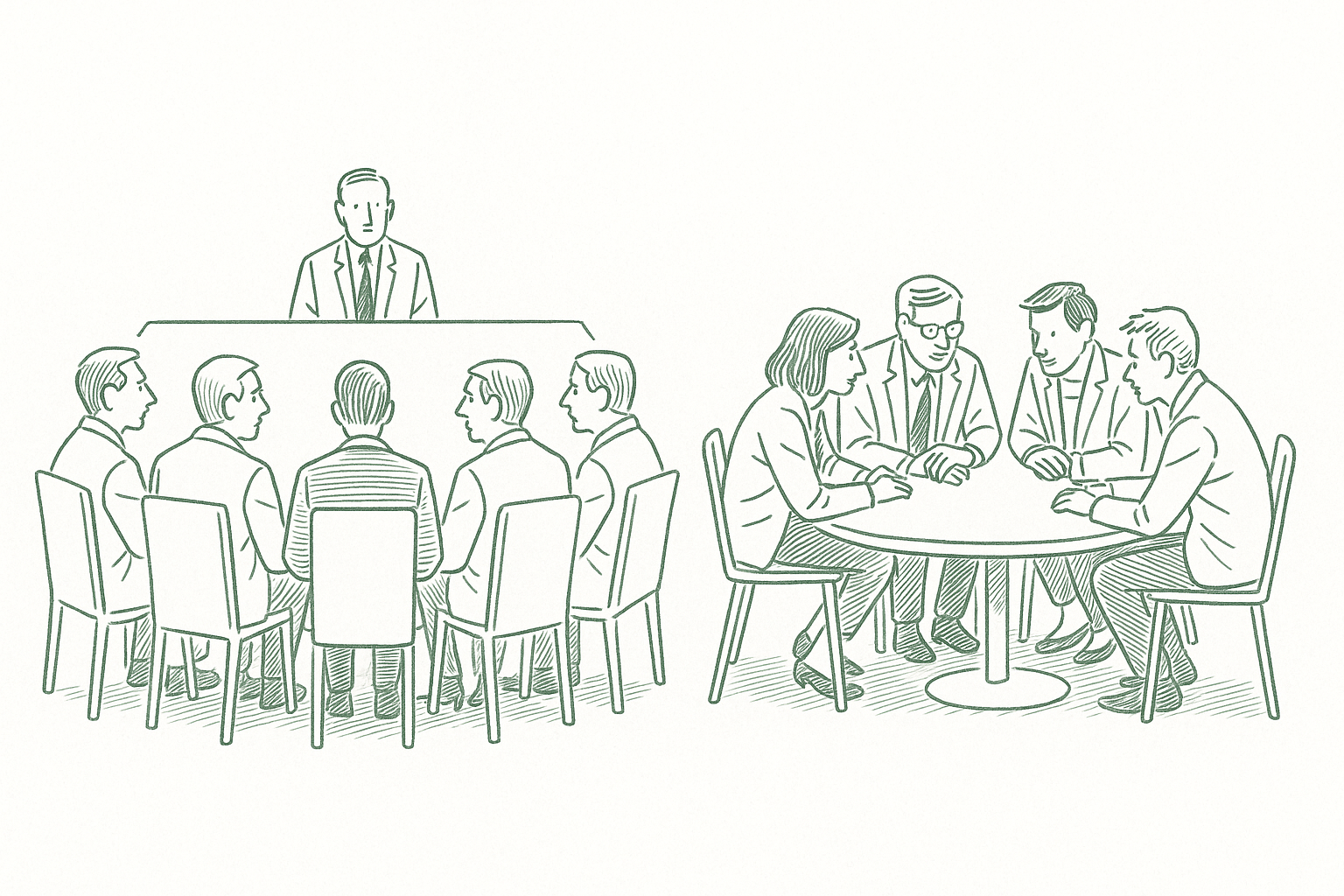
An advisory board is assembled around your company. You recruit people for their expertise, their network, their domain knowledge. The relationship is asymmetric by design: they advise, you decide. They are not running companies alongside you. They are not wrestling with the same operational realities in real time. As Jim Schleckser put it in Inc., an advisory board assembles expertise around one company's needs. It is a panel of specialists convened for your benefit.
A peer advisory group is structured around a different unit entirely: you. A small group of founders or operators — typically five to twelve — from non-competing businesses, meeting regularly to work through real problems together. The relationship is reciprocal. Everyone brings a problem. Everyone contributes to everyone else's. There is no hierarchy. No one is the expert. The collective intelligence of the room is the product.
The difference is not cosmetic. A 2022 dissertation from the University of San Diego studied executive peer advisory groups (EPAGs) and found that their core function is something advisory boards structurally cannot provide: a confidential environment where leaders can be vulnerable among true peers, learn vicariously from each other's live experiences, and generate what participants described as significant financial and personal gains. The vulnerability piece matters. You do not typically call your advisory board to say "I think I am in over my head." But that is often the most important conversation a founder can have.
The accountability problem advisory boards cannot solve
Advisory boards advise. The word is right there in the name. They have no governance authority, no fiduciary duty, no structural mechanism to hold you accountable. As the Elgar Online research review on startup advisory boards noted, the relationship is "collective, non-binding strategic advice." You can take it or leave it. And most founders, under pressure, leave it.
Peer groups operate differently. The American Society of Training and Development found that publicly committing a goal to someone increases the probability of completion to 65 percent. Adding a specific accountability appointment — the kind built into every well-run peer group — pushes it to 95 percent. That is not advice. That is a structural mechanism for follow-through.
The Dun & Bradstreet data reinforces this at scale. In 2020, CEOs who were members of peer advisory groups grew annual revenue by an average of 4.6 percent, while comparable non-members saw revenue decline by 4.7 percent — a 9.3 percentage-point gap during the worst operating environment in a generation. According to the Chief Executive Network's 2026 guide to CEO peer networks, member companies reported average revenue growth rates of 5.1 percent versus an industry average of 1.62 percent, with operating margins more than double the benchmark.
Advisory boards can contribute to these outcomes indirectly — through introductions, strategic input, investor credibility. But the accountability loop that drives consistent execution lives in the peer group, not the advisory board.
Why founders pick the wrong one first
The reason most founders build an advisory board before joining a peer group is simple: advisory boards are legible. They look good on a website. They signal credibility to investors. They are a recognized part of the startup playbook. Stanford research found that nearly 75 percent of CEOs do not receive outside leadership advice — and when they do seek it, the instinct is to recruit experts, not equals.
But legibility is not the same as utility. The decision-making problem most founders face is not a lack of expert input. It is a lack of honest, recurring, structured dialogue with people who understand what it actually feels like to be in the chair. Advisory boards give you answers. Peer groups give you the right questions from the right people.
That is not an argument against advisory boards. It is an argument against treating them as a substitute for peer accountability. The two structures serve different functions, and the founders who grow fastest tend to use both — the advisory board for domain expertise and network leverage, the peer group for the hard conversations, the honest feedback, and the recurring pressure to actually do what they said they would do.
The question that reveals which one you need
If your biggest challenge right now is technical — you need a go-to-market strategy, a CFO introduction, regulatory guidance, IP protection — an advisory board is the right tool. You need specific expertise applied to a specific problem.
If your biggest challenge is that you are making decisions in a vacuum, second-guessing yourself without a sounding board, avoiding hard conversations because there is no one safe to have them with, or consistently failing to execute on the things you know you should do — that is not an expertise gap. That is an isolation gap. And no advisory board, no matter how impressive, is designed to close it.
The founders who get this right understand that advisory boards are about what your company needs to know. Peer groups are about what you need to hear. And the best rooms in the world are the ones where the distinction is clear and both structures are in play.
Build the advisory board for your company. Join the peer group for yourself. Stop confusing the two.