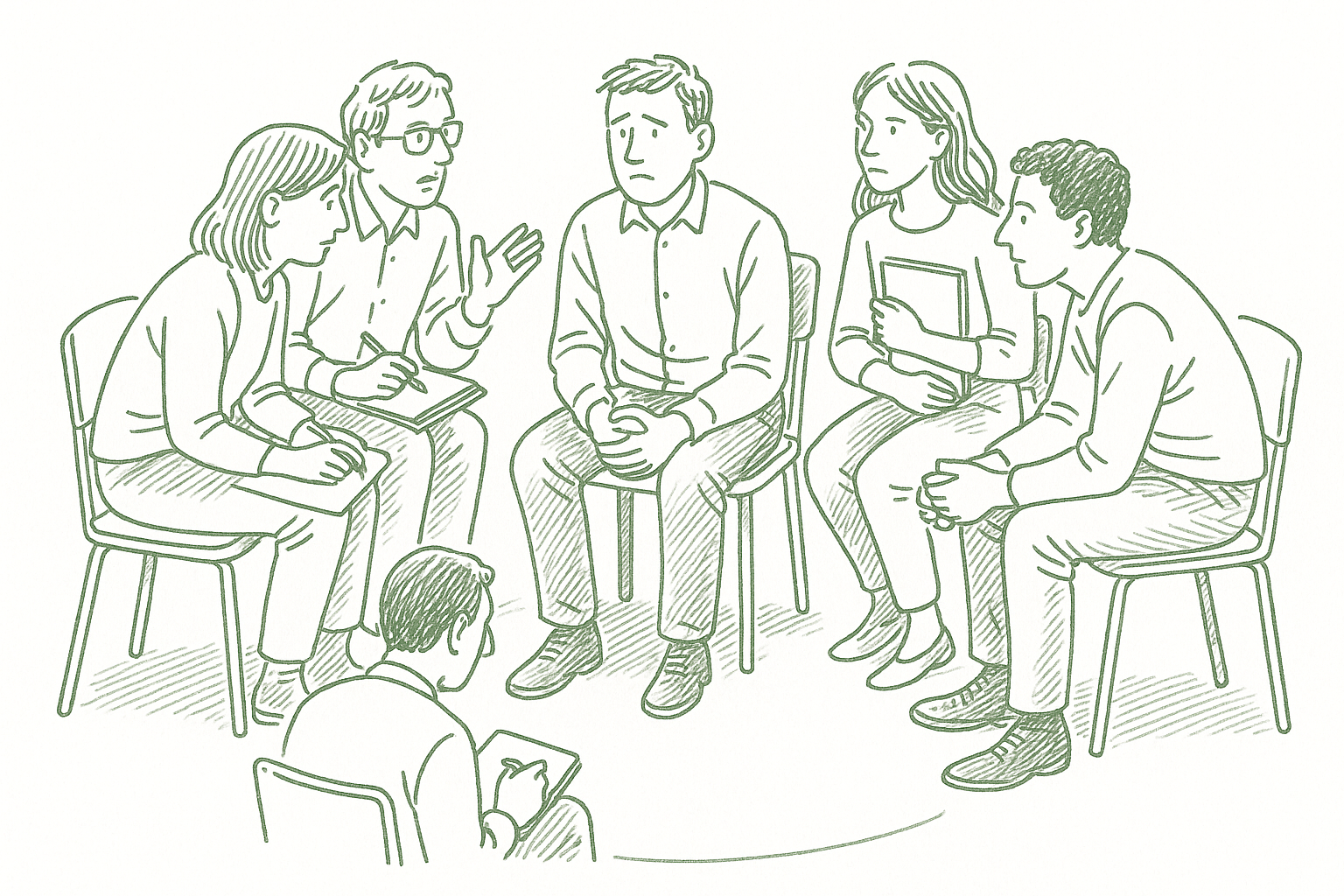
Every peer group has a moment where it either becomes real or stays performative. That moment is the hot seat. One person presents a genuine business problem. The rest of the group stops multitasking, stops being polite, and starts asking the questions nobody else in that person's life will ask.
It sounds simple. It is the hardest thing most founders will do in a professional setting. And it is the single format difference between groups that produce results and groups that fail.
What a hot seat actually is
A hot seat is a structured block of time — typically 20 to 45 minutes — where one member presents a specific challenge to the group. Not a general update. Not a brag. A real, unsolved problem that is actively costing them money, time, or sleep.
The format has variations, but the core architecture is the same across every organization that runs it well. Vistage calls their version "issue processing." YPO and EO call it "forum." The Success Alliance calls it the "hot seat presentation." The name changes. The structure does not.
The person in the seat presents. The group asks questions. The group offers perspectives. The person in the seat commits to a next step. Everyone leaves knowing exactly what was decided and what happens next. That is it. No open-ended discussion. No tangents. No war stories that start with "well, when I was in that situation..."
Why the format matters more than the people
Most founders assume the value of a peer group is the quality of the members. Put smart people in a room and good things happen. This is half right and dangerously incomplete.
Amy Edmondson's research at Harvard on psychological safety found that the most important variable in whether a group produces honest, useful feedback is not the talent of the individuals. It is whether the group's structure makes it safe to be vulnerable. Her 1999 study in Administrative Science Quarterly demonstrated that teams with high psychological safety learned faster, caught errors earlier, and made better decisions — not because they were smarter, but because they were willing to say the uncomfortable thing out loud.
The hot seat is psychological safety made structural. It does not rely on everyone being naturally brave. It creates a container where one person is explicitly invited to be honest about a problem, and the rest of the group is explicitly tasked with helping — not judging, not selling, not performing expertise.
Without that container, even a room full of brilliant operators defaults to the polite version. The version where everyone nods and says "that's tough" and nobody asks the question that actually matters: what are you afraid of here?
The five phases that make it work
Here is how a well-run hot seat operates. The phases are sequential and non-negotiable. Skip one and the thing collapses into an advice free-for-all.
Phase 1: The frame (2 minutes)
The person in the hot seat states the problem in one or two sentences. Not the backstory. Not the context. The problem. "I need to fire my co-founder and I don't know how." "We have 90 days of runway and I can't decide between cutting costs and raising." "My best salesperson is toxic and the team is starting to leave."
The frame matters because it prevents the most common hot seat failure: the 15-minute preamble. When someone spends the first half of their time explaining everything that led up to the problem, the group loses the thread and the feedback becomes generic. The facilitator's job in this phase is to make the presenter get specific before anyone else talks.
Phase 2: Clarifying questions (5–8 minutes)
The group asks questions. Only questions. No advice. No "have you tried..." This is the phase most groups botch, and it is the most important one.
Research on structured problem-solving from MIT's Organizational Learning Lab shows that premature advice-giving is the single biggest barrier to effective group problem-solving. When someone hears a problem and immediately offers a solution, they are solving the version of the problem they understood in the first 30 seconds — not the actual problem. Clarifying questions force the group to understand before they prescribe.
Good clarifying questions sound like: "What happens if you do nothing?" "Who else knows about this?" "What did you try that didn't work?" "What would you tell a friend in this situation?" Bad questions are advice wearing a question's clothing: "Have you considered just firing them?" is not a question. It is a recommendation with a question mark stapled to the end.
Phase 3: The reframe (1 minute)
After questions, the facilitator asks the presenter: "Now that you've heard the questions, what is the real problem?" This is the phase that separates adequate hot seats from transformative ones. Because the real problem is almost never the one that was presented.
The founder who came in saying "I need to fire my co-founder" often discovers, after eight minutes of questions, that the real problem is "I'm afraid of conflict and I've been avoiding this conversation for nine months." The one who said "we need to cut costs" realizes the real problem is "I don't trust my own judgment and I'm looking for someone to tell me what to do."
The reframe is where the hot seat earns its name. It is uncomfortable. It is also the moment where the person stops making decisions alone inside their own echo chamber and starts seeing the situation as it actually is.
Phase 4: Perspectives (10–15 minutes)
Now the group talks. But with a constraint: each person shares their perspective, not their advice. "Here is what I see" rather than "here is what you should do." The distinction matters. Advice assumes the advisor knows the context better than the person living it. Perspective adds a lens without overriding the presenter's judgment.
This is where the diversity of the group pays off. A SaaS founder hearing a perspective from someone who runs a real estate business gets something their board, their investors, and their industry peers cannot offer: a completely different frame of reference applied to the same structural problem.
The research on peer effects shows that cognitive diversity in peer groups — not demographic diversity alone, but diversity of experience, industry, and problem-solving approach — produces better outcomes than groups of people who all think the same way. The hot seat is the mechanism that converts that diversity into usable insight.
Phase 5: The commitment (2 minutes)
The presenter states one specific action they will take before the next meeting. Not "I'll think about it." Not "I'll explore my options." One concrete, measurable commitment that the group will follow up on.
This is the accountability gap closed in real time. The group heard the problem. The group helped surface the real issue. The group offered perspective. Now the group becomes the mechanism that ensures something actually happens. Because at the next meeting, someone will ask: "Did you do it?"
The Köhler effect — the research finding that people work harder when their effort is visible to and consequential for a group — is the psychological engine behind this phase. The commitment is not a to-do list. It is a public promise made to people who will not let you off the hook.
What kills a hot seat
Three things reliably destroy the format. All three are preventable.
No facilitation. Without a facilitator enforcing the phases, the hot seat degrades into an unstructured conversation where the loudest person dominates and the presenter leaves with more confusion than clarity. Every effective mastermind group either has a dedicated facilitator or rotates the role with explicit responsibilities. Someone has to hold the line.
Premature advice. The moment someone skips the question phase and jumps to "you should do X," the hot seat becomes a consulting session. The presenter stops thinking and starts defending. The group stops exploring and starts performing. The real problem stays hidden under a pile of opinions nobody asked for.
No follow-up. A hot seat without accountability at the next meeting is theater. The presenter makes a commitment, everyone feels productive, and nothing changes. The follow-up — the two-minute check-in at the start of the next meeting — is what transforms a one-time conversation into a pattern of execution. Without it, the insight stays theoretical.
The part that nobody writes about
Being in the hot seat is not pleasant. You sit in front of people you respect and say out loud the thing you have been quietly panicking about for weeks. You answer questions that expose the gap between how you present your business and how your business actually operates. You hear perspectives that challenge the story you have been telling yourself.
This is why most groups avoid the format. Round-robin updates are easier. Everyone gets three minutes to share their wins and their challenges, nobody goes deep, nobody gets uncomfortable, and everyone leaves feeling vaguely supported but fundamentally unchanged.
The format of a mastermind meeting determines its output. Round-robin produces pleasant meetings. The hot seat produces changed behavior. The research on structured group problem-solving is unambiguous on this: focused attention on one problem, combined with diverse perspectives and public commitment, produces better outcomes than distributed attention across many problems.
The hot seat is not comfortable. It is not supposed to be. It is supposed to surface the problem you have been avoiding, give you a perspective you could not access alone, and create a commitment you cannot easily break. That is the format that actually works. Everything else is just a meeting.