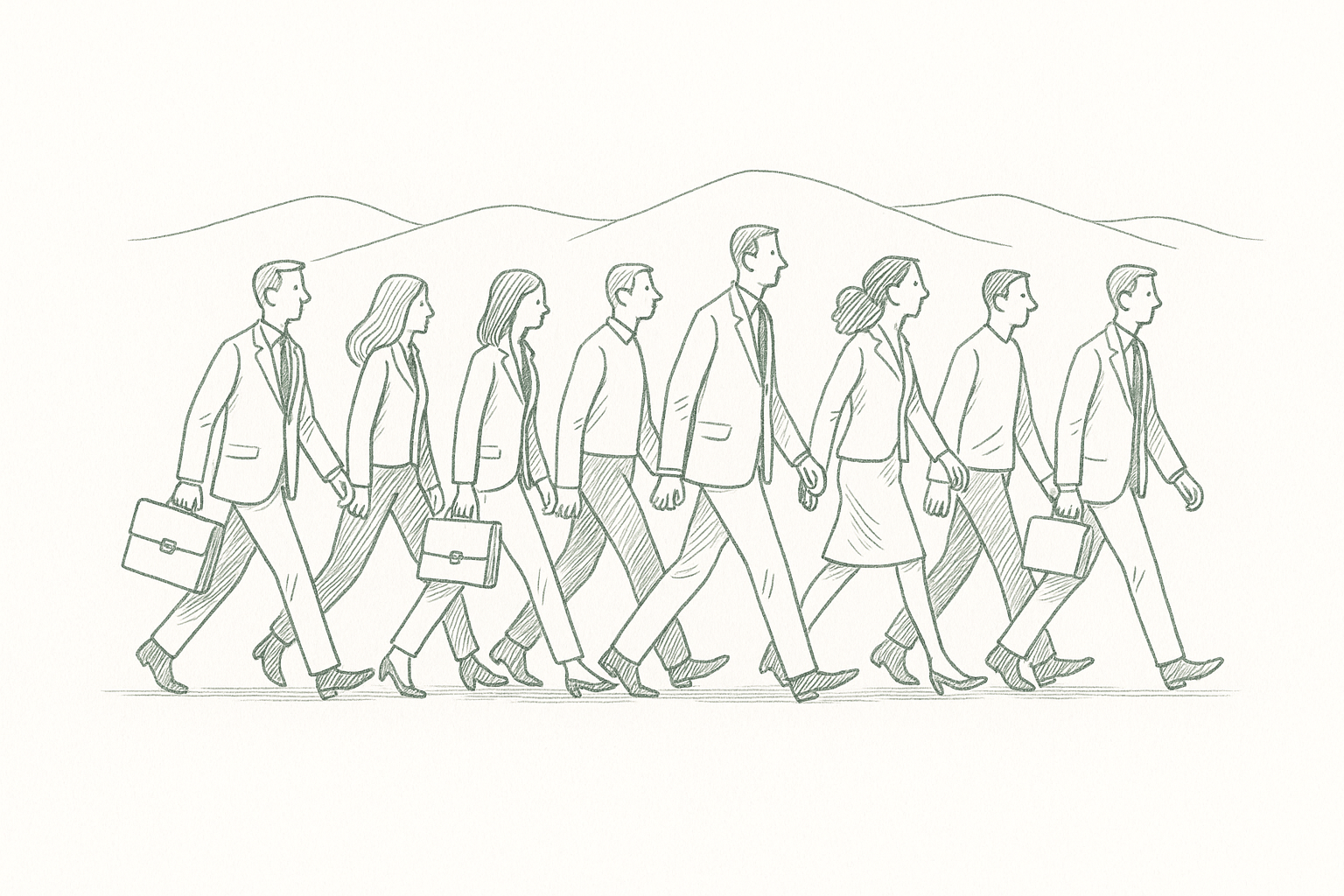
September 18, 1957. Eight men sign paperwork establishing a new semiconductor company in Mountain View, California.
The company is called Fairchild Semiconductor. Their former boss — William Shockley, Nobel Prize winner, co-inventor of the transistor — calls them traitors. He will spend years describing their departure as a personal betrayal. He will never build anything significant again.
They will build Silicon Valley.
Not metaphorically. The semiconductor companies that grew from Fairchild's roots — Intel, AMD, National Semiconductor, Applied Materials, and dozens more — represent over $2 trillion in combined value. The venture capital industry, as it exists today, traces directly to the deal that funded them. The entire modern technology economy runs on the integrated circuit that one of the eight invented while at Fairchild. None of it happens without those eight people making a collective decision to leave together.
That's the part people underemphasize. Not just that they left. That they left together.
The Genius Who Couldn't Lead
William Shockley had every credential. He co-invented the transistor at Bell Labs in 1947 — one of the most consequential inventions of the 20th century. In 1956, the year he founded Shockley Semiconductor Laboratory in Mountain View, he received the Nobel Prize in Physics for that work.
Then he started managing people, and everything fell apart.
Shockley recruited aggressively. He placed ads in the New York Times and the New York Herald Tribune, pulled applicants from three hundred responses, and assembled a team of some of the best young minds in semiconductor research. By September 1956, the lab had 32 employees. Among them: Robert Noyce, a 29-year-old physicist from Philco who would later co-invent the integrated circuit. Gordon Moore, who would formulate the law that governed chip development for half a century. Eugene Kleiner, who would co-found one of the most successful venture capital firms in history.
What Shockley could not do was let them think.
His management style was described, at the time and since, as authoritarian, erratic, and paranoid. He made personnel decisions impulsively. He overruled his researchers' technical judgments on matters where they had more expertise than he did. When a minor lab accident injured a secretary, rather than treating it as an accident, he suspected sabotage and ordered the entire team to submit to lie detector tests. The tests found nothing. The damage to morale was lasting.
The final break came over a technical direction. Shockley had built his lab specifically to work on silicon-based semiconductor devices — a material he believed was the future. Then he pivoted. He decided to chase a different technology: the four-layer diode, a device his researchers believed had limited commercial potential. The eight best people on his team saw it clearly. They were being pulled away from the future to work on a dead end.
This is the version of the story that gets told as a management lesson: don't be a bad boss or your best people leave.
That misses what actually happened.
The Collective Decision
The eight didn't leave one by one, the way talent usually drains from a dysfunctional organization. They left together, after a period of deliberation and mutual commitment. That is not how most people quit jobs.
What happened, in the spring and summer of 1957, was effectively a small group process. The researchers — Robert Noyce, Gordon Moore, Eugene Kleiner, Jean Hoerni, Jay Last, Julius Blank, Victor Grinich, and Sheldon Roberts — began meeting and talking through their situation. They were clear-eyed about what they were facing: a brilliant but erratic boss, a technical pivot they didn't believe in, and the growing suspicion that they would never be allowed to do the work they knew needed doing.
The decision to leave collectively was, in part, practical. Individual defections from a Nobel laureate's lab would be easy to dismiss or suppress. A group departure was different — it was a statement, and it came with a built-in support structure. But it was also something more than tactical. These eight people had developed genuine trust. They had worked through technical problems together. They understood how each other's minds worked. Leaving as a group meant they didn't have to rebuild those relationships from scratch somewhere else. They could take the team with them.
Eugene Kleiner wrote a letter to his father's contact at the New York investment firm Hayden Stone, describing the situation and asking for help finding a new employer willing to sponsor them as a group. The letter landed on the desk of a young banker named Arthur Rock. Rock's instinct was not to find them an employer. It was to help them start their own company — an unusual idea at the time. He approached 35 companies before Sherman Fairchild, heir to a camera and instrument empire, agreed to put up $1.38 million.
Fairchild Semiconductor was founded September 18, 1957. One month later, the Soviet Union launched Sputnik, and the US government suddenly needed silicon transistors for aerospace systems at a scale no one had planned for. The timing looked like luck. It was partly preparation — because the eight had spent months building exactly the kind of company that could respond to that demand.
What They Built
Fairchild Semiconductor's early years were extraordinary by any measure.
Jean Hoerni, a Swiss physicist, developed the planar process — a manufacturing technique that transformed semiconductor production from artisan handcraft into a high-volume industrial process. Where transistors had previously been made one at a time, the planar process made it possible to produce them at scale, with consistency, on a silicon wafer treated like a printing plate. It was a technical revolution that compressed decades of potential progress into a few years.
Robert Noyce took Hoerni's innovation and went further. Noyce realized that the planar process made it possible to put multiple transistors on a single chip and connect them internally — eliminating the rats' nest of wires that had made complex electronic circuits unreliable and expensive. In 1959, Noyce described the concept of the integrated circuit. Texas Instruments' Jack Kilby had arrived at a similar idea around the same time, and both men share credit for the invention. But Noyce's approach, built on the planar process developed at Fairchild, became the basis for how chips are actually made.
By 1960, Fairchild's sales exceeded $20 million. The parent company, Fairchild Camera & Instrument, had exercised its option to acquire all shares — generating a financial windfall for the founders. Gordon Moore, watching the pace of improvement at Fairchild and across the industry, formulated in 1965 what became Moore's Law: the observation that the number of transistors on a chip was doubling roughly every two years, and that this trend would continue. It did, for more than half a century. The entire arc of personal computing, smartphones, and the internet runs on that curve.
The Tree
Fairchild became what historians at the Computer History Museum call "the First Trillion Dollar Startup." But the number that matters isn't Fairchild's own market cap — which never exceeded $2.5 billion. It's the combined value of everything that grew from it.
The companies that spun out of Fairchild came to be called "Fairchildren." Over thirty emerged in the 1960s alone. The family tree extends across six generations of technology ventures.
In 1961, four of the original eight — Hoerni, Kleiner, Last, and Roberts — left to found Amelco, the first spinoff led by Fairchild co-founders.
In 1968, Noyce and Moore left to start Intel Corporation. They recruited Andrew Grove from Fairchild to run operations. Intel went on to become the world's largest semiconductor manufacturer, the company that put a microprocessor in every home computer, and the company that made the phrase "Silicon Valley" mean something beyond geography. Those microprocessors would end up in the hands of the Homebrew Computer Club, the hobbyist group that turned chips into personal computers — and launched Apple in the process.
In 1969, Jerry Sanders and seven colleagues from Fairchild founded Advanced Micro Devices — AMD. It would spend the next five decades as Intel's primary competitor.
Eugene Kleiner became a co-founder of Kleiner Perkins Caufield & Byers, one of the most successful venture capital firms in history. Kleiner Perkins backed Amazon, Google, Genentech, and Netscape, among hundreds of others. Many tech companies whose funding you've heard of — Amazon included — owe their existence to infrastructure Kleiner helped build.
Arthur Rock, the young banker who had found Fairchild its first funding, moved to San Francisco and formed Davis & Rock — one of the first West Coast venture capital firms. He went on to lead funding rounds for Intel and Apple. His career is, in many ways, the origin story of venture capital as an industry.
The pattern continued beyond the original generation. Companies spun out of companies that had spun out of Fairchild. Executives who learned their craft inside Fairchild-adjacent organizations went on to found the next wave. The Computer History Museum's family tree runs six generations deep before you get to social media companies. It is the most consequential corporate diaspora in American business history — arguably in world history, given the dependency of modern civilization on semiconductor technology.
What Shockley Got Wrong
Shockley Semiconductor continued operating after the eight left. It was acquired by a series of companies. It never turned a profit. It was closed in 1968.
Shockley spent his later years pursuing increasingly discredited ideas about genetics and intelligence. His scientific reputation deteriorated. He died in 1989, largely estranged from his family. His own children learned of his death from newspaper obituaries.
The contrast is worth sitting with. Shockley had the Nobel Prize, the technical pedigree, the funding, and the talent. He assembled, by any objective measure, one of the most capable groups of researchers in the world. Then he isolated himself from their judgment, treated their input as threats to his authority, and drove away the only people who could have made his vision real.
The eight who left had no equivalent credentials. At the time of the departure, none of them had won major prizes or founded successful companies. What they had was each other — a group of people who had built genuine trust through shared work, who were honest with each other about what was and wasn't working, and who were willing to make a collective bet rather than individual escapes.
That bet compounded for decades.
The Mechanism Nobody Talks About
The standard telling of the Fairchild story focuses on technical innovation: the planar process, the integrated circuit, Moore's Law. These are real and consequential. But they're outputs. The input was a group dynamic.
Consider what the eight had, inside Fairchild, that they couldn't have had working separately:
Complementary expertise without hierarchy. Noyce was the visionary and communicator. Moore was the methodical researcher. Hoerni was the technical inventor. Kleiner was commercially oriented. These were not competing functions — they were reinforcing ones. No single person in the group could have produced the planar process, the IC, and the business model simultaneously.
A shared frame of reference. They had been through the same crucible — Shockley's lab, the dysfunction, the collective decision to leave. That shared history meant they didn't need to explain the basics to each other. Conversations could start at a much higher level.
Accountability to the group's judgment. When you've made a collective commitment — when your decision to leave was inseparable from seven other people's decisions — you carry a different kind of obligation. The group had skin in each other's outcomes before the term existed.
Trust that survived the exit. The network didn't dissolve when people left Fairchild. Kleiner invested in Noyce's Intel. Former colleagues recruited former colleagues into their new companies. The original eight acted as a gravitational center for decades of subsequent collaboration.
This is how small groups actually work. Not through formal structures or scheduled accountability check-ins, but through accumulated trust, shared context, and the kind of honest feedback that only flows between people who have earned the right to give it.
The PayPal alumni replicated this pattern four decades later, mostly by accident. The same dynamic — shared crucible, complementary skills, trust that transferred from one venture to the next — produced another trillion-dollar diaspora. Different industry, same mechanism.
What Shockley couldn't see, and what both groups discovered empirically, is that genius doesn't compound in isolation. It compounds in small groups where the quality of decisions is elevated by people who know each other well enough to push back honestly.
Shockley had a Nobel Prize. He had one of the most formidable intellects of his generation. He couldn't accept that the people in the room with him might see something he was missing. That refusal cost him everything.
The eight who left understood — perhaps intuitively, perhaps through the specific experience of watching Shockley fail — that the problem they needed to solve wasn't technical. It was relational. They needed a room where honest disagreement was possible, where their combined judgment was more reliable than any single person's, where the group's collective intelligence could be held accountable to outcomes.
They built that room first. Everything else followed.
The Lesson
Most people look at Fairchild and see a story about talent. The right people, in the right place, at the right time. And there's truth in that — Sputnik's launch one month after Fairchild's founding created a demand surge nobody planned for.
But luck doesn't explain the diaspora. It doesn't explain why the Fairchildren kept founding things, kept backing each other, kept treating the network as a living asset thirty years after they'd all gone separate ways. It doesn't explain why Arthur Rock's first instinct was to help eight researchers start a company together, rather than placing them individually at established firms. It doesn't explain why Eugene Kleiner, with $2 trillion worth of companies ultimately tracing back through his partnership, chose to co-found Kleiner Perkins with Tom Perkins — another person he'd met through the Fairchild ecosystem.
The pattern that explains all of this is the same one Benjamin Franklin understood in 1727: small groups of capable people, meeting honestly, holding each other accountable, compound over time in ways that individuals cannot.
The eight weren't running a mastermind group. They weren't using any of that language. They were just eight people who respected each other enough to make a collective bet, and who kept the relationships alive long enough to see that bet pay off across decades.
That's available to anyone. It always has been.
GoodGrowth builds small peer groups for founders and operators — structured, intentional, and matched carefully. The room the eight built by accident. Built on purpose. Start with five people.