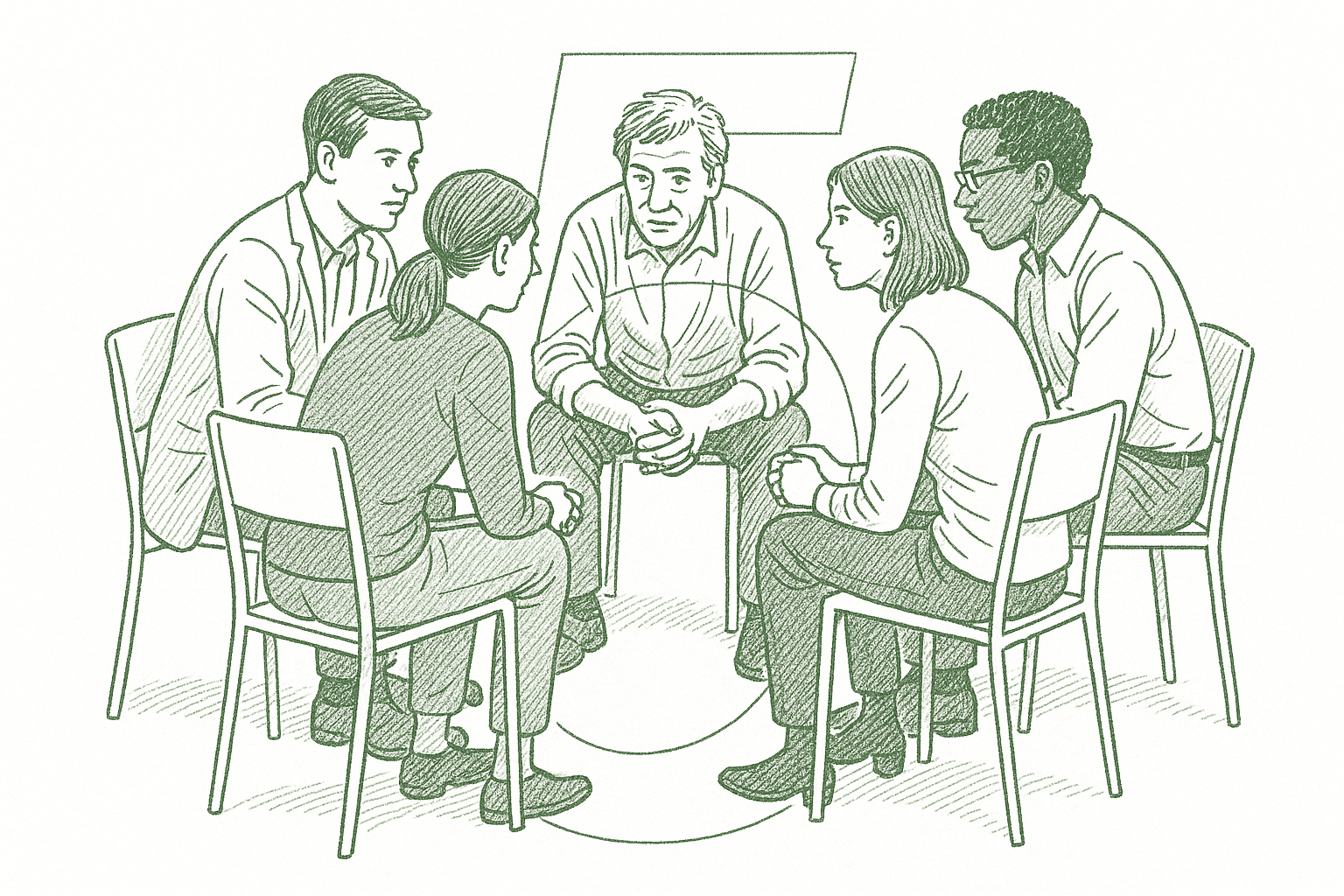
In 1970, two organizational psychologists named Richard Hackman and Neil Vidmar ran an experiment at Yale that should have settled a long-running debate. They gathered groups ranging in size from two to seven members, gave them a series of tasks, and measured everything — satisfaction, comfort, performance, interpersonal tension, perceived overload. When they crunched the numbers, they found that the optimal group size was 4.6 members.
You can't have 0.6 of a person. But the math rounds to five.
That finding — precise to a decimal — has been replicated enough times across enough disciplines that it's no longer a finding so much as a structural feature of human collaboration. Five people keeps showing up as the number where groups are small enough for trust to form and large enough for cognitive diversity to matter. It shows up in the psychology of friendship, in military unit design, in how the most enduring peer advisory organizations in history have structured their rooms. It is, in the plainest possible sense, the number that works.
The question worth asking is why.
The Math of Relationships
There's a formula for understanding why group size matters so much. The number of distinct one-on-one relationships in any group is n(n-1)/2. In a group of five, that's ten pairs. In a group of six, fifteen. In a group of ten, forty-five.
This isn't just arithmetic. Each additional person doesn't add one new relationship — they add one relationship with every existing member simultaneously. At five people, the network of relationships is still navigable by any one member. People can track where tensions exist, who trusts whom, what's unspoken between two specific members. At ten people, that cognitive task becomes genuinely difficult. At fifteen, it's impossible.
Richard Hackman, who spent his career at Harvard studying team performance across cockpit crews, symphony orchestras, and corporate task forces, put it plainly: he never saw a team over ten members that actually functioned as a team. What he saw were subgroups of three to six that formed within larger teams and did the actual work.
This is the first pressure that makes five work. It's the outer edge of human cognitive bandwidth for tracking relationships with sufficient granularity to build real trust.
Dunbar's Inner Circle
Robin Dunbar's research on social brain capacity is usually cited for the number 150 — the approximate maximum of stable social relationships a human brain can maintain. But that headline figure has a more interesting structure underneath it.
Dunbar's layers of social connection don't work linearly. The outermost layer, at 150, contains people you can recognize and track but don't know intimately. Inside that sits a layer of around 50 — genuine acquaintances. Inside that, 15 — people you can call in a crisis. And at the core, a layer of approximately five: the people you rely on for emotional and practical support in the deepest sense. Dunbar calls this the support clique. Research suggests that people devote roughly 40% of their total social time to this inner circle of five, even though it represents a fraction of their broader network.
The support clique isn't a strategic choice. It's an emergent feature of how humans allocate trust and emotional bandwidth. Brains that have been shaped by hundreds of thousands of years of social living have arrived, across cultures and contexts, at the same number. The problem isn't that your network is too small — it's that it's too large to function the way your support clique does.
Five is the number your brain knows how to use.
What Happens When Groups Get Bigger
In 1913, a French agricultural engineer named Maximilien Ringelmann conducted what may be the earliest empirical study in social psychology. He asked men to pull a rope — alone and in groups of varying size — and measured the force each person exerted. The results were counterintuitive: as group size increased, individual effort decreased. A man pulling alone applied his full force. In a group of eight, each person applied roughly half. Ringelmann called this social loafing. The full scope of his discovery — and the century of research it launched — explains why the best groups never grow past single digits.
Subsequent research has confirmed and extended the finding. When groups get larger, individual accountability diffuses. The psychological mechanism is simple: when five people are responsible for an outcome, each person's contribution is visible and identifiable. When twenty people share the same responsibility, no single person's slacking changes the outcome enough to be noticed — not even by the person doing it.
This is the accountability gap in structural form. Larger groups don't fail because people are lazy. They fail because the architecture of the group makes individual accountability mechanically harder to sustain. A group of five, where everyone knows what everyone else committed to last month, doesn't have this problem. The question "did you do it?" has a clear recipient.
Why Peer Groups Converge on This Number
The organizations that have spent the most time optimizing peer group design have all landed in the same place, and they mostly did it through experience rather than literature review.
Napoleon Hill, writing in Think and Grow Rich in 1937, described the mastermind alliance as a coordination of "five or six people." He wasn't drawing on Hackman and Vidmar — they wouldn't publish for another three decades. He was drawing on what he'd observed in the people he studied: that the groups that produced outcomes were small, and the effective ones clustered around five or six members. Andrew Carnegie's inner advisory circle, the model Hill was studying, was structured the same way.
YPO, the most durable peer group organization in history, settled on forums of seven to ten members after decades of iteration. Their own published materials describe the design goal as "six to eight highly influential and successful people" who meet monthly in strict confidentiality. The upper bound of ten exists because the organization is trying to ensure enough diversity of experience; the floor of six exists because the dynamics below that tend toward intensity without breadth. The forum model became the core of how 38,000 executives engage with YPO — and it runs within a range that keeps five in the middle.
Special forces units around the world have also converged on similar numbers. The U.S. Army's basic fire team is four soldiers. A squad — the level at which coordinated tactical decision-making happens — is nine. The operational units in which trust, communication, and mutual accountability must be highest are consistently kept below ten, and often below six. The military didn't optimize for this out of academic interest; it optimized because larger units in high-stakes environments performed worse, made slower decisions, and lost more people.
The Trust Threshold
Five also happens to be the number at which genuine psychological safety becomes achievable without extraordinary effort. Amy Edmondson's research at Google and elsewhere showed that psychological safety — the belief that you won't be punished for speaking honestly — is the single most important factor distinguishing high-performing groups from average ones. But safety doesn't appear because people decide to be safe. It appears because the structural conditions make honesty feel low-risk.
In a group of five, you know everyone. You've seen them handle bad news. You've watched how they respond when someone contradicts them. The sample size is small enough that your mental model of each person is detailed and reliable. You know that when you share something uncomfortable, you can predict, with reasonable accuracy, how each of the four others will respond.
In a group of fifteen, that prediction is impossible. Some of those fifteen are essentially strangers to you. You can't know how they'll react. In the absence of that knowledge, the rational response is to self-censor — to share the version of your situation that is easiest to defend rather than the version that most accurately reflects what you're actually dealing with.
The decisions founders get wrong most often aren't the ones they thought about too little — they're the ones they kept inside too long. The value of a peer group is precisely in providing a room where that material can surface. But it only surfaces when the room is small enough to feel safe.
The Floor
If five is the ceiling that keeps groups functional, it's also worth examining the floor — why not three, or two, or just a single trusted advisor?
The research here is equally consistent. Dyadic accountability — the classic "accountability partner" model, where two people check in on each other — produces meaningful improvements over working alone. But it has two structural weaknesses that a group of five doesn't share.
First, two-person relationships are fragile. When one person misses a meeting, or goes through a difficult period, or just gets busy, the entire structure collapses. A group of five has enough redundancy that it can lose a member temporarily and keep functioning. It's also more robust to the natural divergence in motivation and momentum that affects any individual over time.
Second, pairs produce limited cognitive diversity. Your accountability partner, however good, offers one perspective filtered through one set of experiences and one personality. A group of five brings five distinct pattern-recognition systems — five people who have navigated different industries, made different mistakes, and developed different intuitions about how things tend to go. Research on transactive memory shows that these small groups develop shared cognitive architectures where each member becomes the specialist in different knowledge domains, and the group collectively stores and retrieves more than any member could alone. The research on small group decision-making consistently finds that diverse groups produce better decisions than homogeneous ones, but only up to a size threshold where diversity stops being useful and coordination overhead starts being costly. Five sits comfortably below that threshold.
A Number That Keeps Appearing
What's striking about the convergence on five isn't that the research says it — it's that practice says it too, repeatedly, in fields where the researchers never spoke to each other.
The anthropologist studying hunter-gatherer bands. The Harvard professor studying cockpit crews. The military strategist designing fire teams. The Depression-era writer cataloguing the habits of industrialists. The venture-backed peer group company watching which forum sizes produce the highest retention. They're all looking at different phenomena through different lenses and arriving at the same place.
That convergence is evidence of something real. Not five as a preference or a convention, but five as a structural feature of human collaboration — the size at which the cognitive demands of tracking relationships, maintaining individual accountability, generating trust, and producing diverse perspective all happen to be simultaneously satisfiable. The research on peer effects confirms the mechanism: the people closest to you reshape your norms, your information, and your standards — but only if the group is small enough for each person's influence to register.
Put more simply: five is the number where a group is still small enough to be a group.
Beyond that, you have a crowd.
GoodGrowth builds structured peer groups of five to six founders — small enough for real trust, large enough for real perspective. Groups are forming now.