In 2012, Google launched one of the most ambitious research projects in organizational history. They called it Project Aristotle — a two-year, 180-team study to answer a deceptively simple question: what makes some teams great?
They had access to everything. Performance data, communication logs, personality assessments, educational backgrounds. They could see who worked well together and who didn't. They expected the answer to be something structural — the right mix of introverts and extroverts, engineers and designers, doers and strategists.
The answer had nothing to do with composition.
The single most important factor separating Google's best teams from their average ones was psychological safety: whether team members felt they could take risks, ask questions, and speak up — without fear that it would be used against them.
That finding has profound implications for anyone who's ever sat through a group meeting where everyone nodded politely and nothing real got said.
What psychological safety actually means
The term comes from Harvard Business School professor Amy Edmondson, who coined it in her landmark 1999 paper on team learning behavior. Edmondson defined psychological safety as "a shared belief held by members of a team that the team is safe for interpersonal risk-taking."
That's a clinical way of saying: you don't feel like an idiot for admitting you don't know something. You don't worry that disagreeing will get you frozen out. You can say "I'm struggling with this" without it becoming a liability.
Edmondson's original research found something counterintuitive: the highest-performing medical teams she studied reported more errors, not fewer. Not because they made more mistakes — but because they were safe enough to talk about them. The dysfunctional teams were hiding mistakes. The high-performing ones were learning from them.
The concept is older than Edmondson's framing. In 1965, organizational psychologists Edgar Schein and Warren Bennis described psychological safety in the context of small groups as "an atmosphere where one can take chances without fear and with sufficient protection — a climate that encourages provisional tries and tolerates failure without retaliation, renunciation, or guilt."
That was 1965. The insight is not new. What's new is our collective failure to build it consistently — especially in the professional peer groups and mastermind groups where it matters most.
Why most peer groups don't have it
Join a networking group, a mastermind program, or a peer advisory circle, and you'll quickly notice that everyone is performing a version of their best self. Business is going well. The team is solid. The growth trajectory is up and to the right.
Nobody is lying, exactly. But nobody's telling the full story either.
This is the default state of professional peer groups: cordial, supportive, and almost entirely useless. People share successes. They're vague about failures. They ask for help in the abstract — "looking for advice on hiring" — rather than the specific — "I'm about to make a hire I'm not confident in because I'm too burned out to keep searching."
The reason is structural. Without psychological safety, vulnerability feels like exposure. And exposure, in a room full of professional peers, feels dangerous. What if they lose confidence in you? What if someone uses this against you? What if you become the cautionary tale people mention at the next event?
These fears are largely irrational. But they're hardwired. The brain's threat response doesn't distinguish between physical danger and social risk — both activate the same amygdala response, the same cortisol spike, the same defensive posture. Patrick Lencioni's model of team dysfunction captures this precisely: the foundation of every failing team isn't lack of skill or bad strategy. It's absence of trust. And trust is the precondition for psychological safety.
Without it, you get what Lencioni calls the cascade: no trust leads to fear of conflict, which leads to fake commitment, which leads to avoidance of accountability, which leads to inattention to results. The whole structure collapses — and it starts with a room where no one feels safe to be honest.
The science of what changes when safety is present
Project Aristotle's findings were unambiguous. Teams with high psychological safety:
- Were more likely to experiment and take creative risks
- Generated more novel solutions to complex problems
- Retained their members at higher rates
- Were rated more effective by executives across every metric Google measured
Julia Rozovsky, who led the research at Google, summarized it plainly: "Even the extremely smart, high-powered employees at Google needed a psychologically safe work environment to contribute the talents they had to offer."
This isn't a soft finding. It's not "people feel good." The cognitive gains are measurable. When threat response is suppressed, the prefrontal cortex — the part of the brain responsible for analysis, creativity, and long-range planning — can do its job. Decisions made under threat are structurally worse. Decisions made in a safe environment are structurally better. The room itself changes your thinking.
A 2023 meta-analysis published in the Journal of Applied Psychology, examining 136 studies and over 21,000 team observations, confirmed that psychological safety is one of the strongest predictors of both team performance and individual wellbeing — stronger than team size, role clarity, or leadership style.
Why small groups are the only place it can form
Here's the thing nobody talks about: psychological safety doesn't scale.
In large groups — a conference, a 30-person mastermind, a professional association — the math works against honesty. The more people in the room, the higher the social stakes of any single admission. The potential audience for your vulnerability is larger. The chances of misinterpretation are higher. The incentives to perform rather than reveal multiply.
This is why your network size works against you. Having 500 LinkedIn connections doesn't give you one relationship where you can say "I almost ran out of cash last month and I don't know if the business is going to make it." It just gives you 500 people in front of whom that admission would be catastrophic.
Small groups change the equation. Research on group dynamics consistently identifies four to eight members as the range where psychological safety can actually form. Below four, there's not enough perspective diversity. Above eight, participation inequality kicks in — some members speak, most listen, and the listening majority gradually detaches.
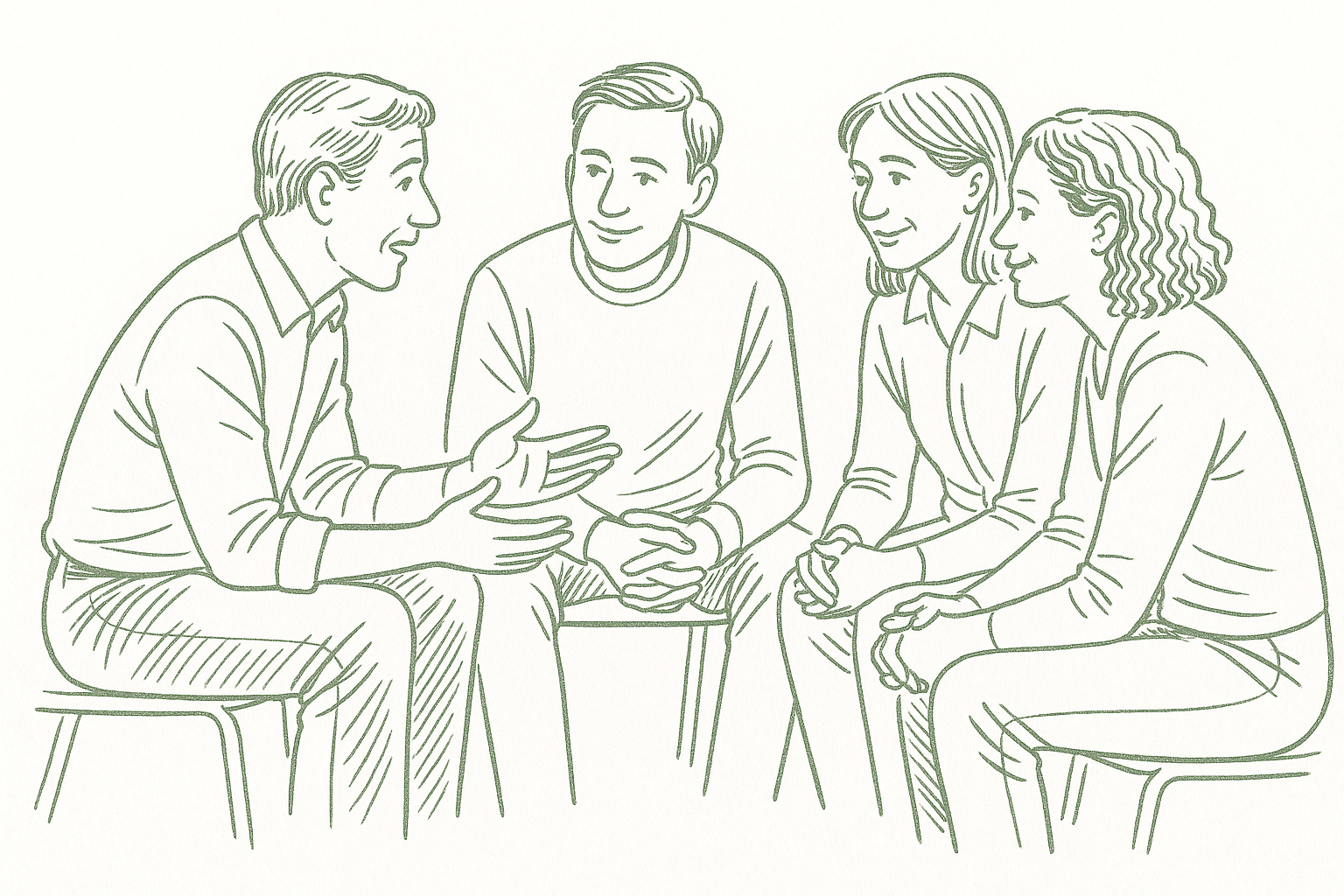
In a group of five or six people who've agreed to meet consistently, who've been vetted for non-competition, and who operate under genuine confidentiality, something different becomes possible. Edmondson calls it "the learning zone." The conditions allow for honest assessment, genuine feedback, and the kind of collaborative problem-solving that drives real accountability.
This is not theoretical. It's why Entrepreneurs' Organization's Forum model — which places members into groups of eight with strict confidentiality and no advice-giving without being asked — has persisted for 35 years and is consistently cited as the most valuable thing EO offers. It's why YPO's Forum program, built on the same principles, produces retention rates that dwarf every other membership program in the organization. The structure creates safety. The safety creates honesty. The honesty creates outcomes. It's also, incidentally, why AA outperformed professional therapy in a landmark Cochrane review — the same principles, built accidentally into a peer fellowship that predated the research by decades.
The conditions that build it
Psychological safety doesn't appear because people decide to be honest with each other. It develops over time, through specific conditions. Four in particular:
Confidentiality without exception. The first time something said in the group appears outside the group — even in the most benign form — safety collapses and doesn't return. The ceiling for honesty is always set by the worst breach people can imagine. Clear, explicit, and enforced confidentiality raises the ceiling. Any ambiguity lowers it.
Non-competition. You cannot be fully honest in a room with someone who directly competes with you. You'll share the version of the story that doesn't give anything away. Truly effective peer groups screen for non-competition, not just theoretically but rigorously — people building in adjacent markets with different customers and business models, not the same ones.
Consistent membership over time. Safety is a function of accumulated experience. The first time you meet with a group, you test the water. You share something slightly vulnerable. You watch what happens. If nobody uses it against you, you go a little further next time. Trust compounds through repetition. This is why groups with rotating members never develop deep safety — every new person resets the clock.
Structure that normalizes vulnerability. Ad hoc conversation defaults to highlights. Structure forces depth. Well-designed peer groups use specific formats — personal updates with real stakes, hot seat formats where one person presents a real problem, retrospectives on commitments from the previous session — that make honesty the norm rather than the exception. When asking for real help is built into the format, asking for real help stops feeling dangerous. The research on reciprocal vulnerability explains the mechanism: one person's disclosure triggers the next, creating a chain reaction of honesty that no amount of encouragement can replicate.
The groups that got this right
Benjamin Franklin's Junto Club ran for 38 years because Franklin understood something most group organizers miss. The group's explicit charter included a rule against "positive assertions" — members were expected to state views as questions, not declarations. This wasn't politeness. It was a structural mechanism for psychological safety, designed to ensure that disagreement didn't become a status threat. You can't be embarrassed for asking a question. Franklin made honest inquiry the default mode.
The PayPal Mafia — the network of founders who built YouTube, LinkedIn, Yelp, Palantir, and dozens of other companies — ran on a similar dynamic. Peter Thiel has described the culture at PayPal as unusually honest to the point of being uncomfortable for outsiders. People said what they actually thought about ideas, strategies, and each other's work. That directness was possible because the trust was real. They had built it in conditions of shared adversity — fighting the same competitors, surviving the same near-death moments, holding the same stakes.
The Fairchild Eight walked out of Shockley Semiconductor together — eight people betting their careers on a shared conviction. That kind of coordinated risk-taking doesn't happen without deep mutual trust. It requires believing that the people around you will tell you the truth, absorb your doubt, and keep moving anyway.
Every durable, high-performing small group in history has had it. Most of the ones that fell apart didn't. Psychological safety is also a prerequisite for group flow — the neurologically distinct state where small teams reach collective peak performance. Without safety, there is no flow. Without flow, there is no genius.
What this means for founders
The founder version of this problem is specific. Most of the people around you have a stake in your confidence. Your team needs to believe in you. Your investors need to believe in the business. Your customers need to believe the product will be there next year.
The pressure to perform certainty is constant. Which means you almost never get to say the thing that's actually true: "I'm not sure this is working. I'm scared I made the wrong call. I need someone to help me think through this without telling me what I want to hear."
That's not therapy. That's sound decision-making. The research is clear: decisions made in isolation are structurally worse than decisions made with honest input from trusted peers. Not because you're bad at thinking. Because the human brain is optimized for social problem-solving — it works better with other brains that are genuinely engaged, genuinely honest, and genuinely invested in your success.
You can't get that from a conference. You can't get it from a Slack community. You can't get it from a podcast. You can only get it from a small group of people who've built enough trust, over enough time, under conditions designed to make honesty safe.
That's not a nice-to-have. That's infrastructure.
GoodGrowth places founders in structured peer groups of 3–5 people — vetted for non-competition, built for confidentiality, and designed from the ground up to create the conditions where real conversations happen. Text (716) 590-9748 to learn more.