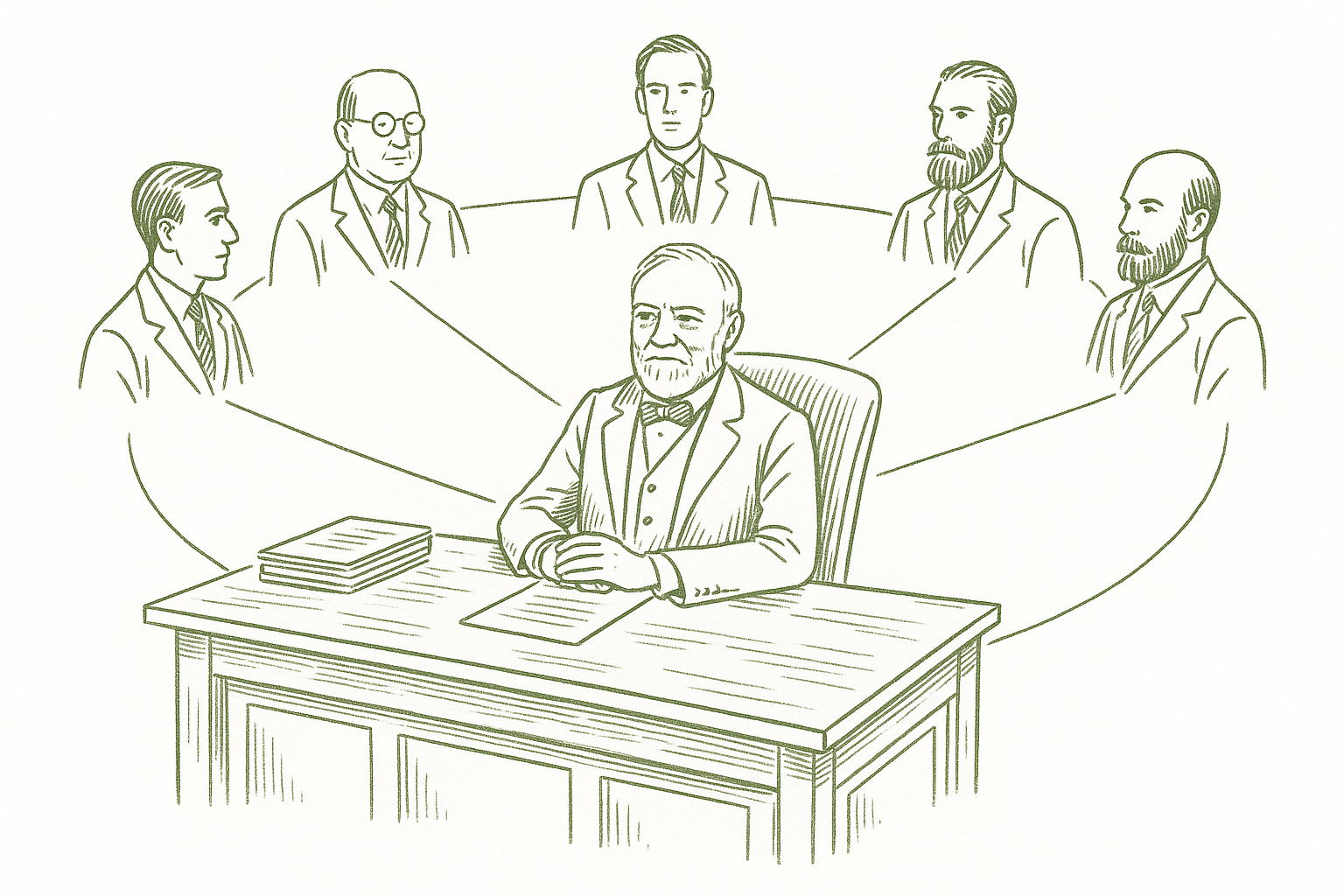
In 1908, a 25-year-old journalist named Napoleon Hill was assigned to interview Andrew Carnegie for a magazine profile. Carnegie was then the richest man in the world — a Scottish immigrant who had arrived in America with almost nothing and built an empire out of steel, then given most of it away.
Hill later claimed that what was supposed to be a brief interview turned into a three-day visit. That Carnegie, sensing something in the young man, had decided to task him with a mission: spend twenty years studying the most successful people in America, interview 500 millionaires, and distill their secrets into a single philosophy of success that ordinary people could follow. Hill said he accepted on the spot.
The result, published nearly three decades later in 1937, was Think and Grow Rich — one of the best-selling books in history, with more than 100 million copies sold. Its central idea, the one Carnegie supposedly called his greatest secret, was something Hill called the Master Mind.
There's just one problem.
Carnegie's biographer, David Nasaw, spent years immersed in the industrialist's papers and correspondence. His conclusion: he found no evidence that Carnegie and Hill ever met.
Hill, it turns out, was a serial fabricator. He invented credentials, invented endorsements, invented companies. He began making the Carnegie claim only after Carnegie had died and could no longer deny it. Historians have found no records of the famous interviews Hill claimed to have conducted with Ford, Edison, or Rockefeller — beyond a single brief encounter with Edison.
And yet. The concept survived.
The Master Mind Alliance — the idea itself — turned out to be one of the most durable and well-proven principles in the history of business. The origin story may have been a lie. The underlying truth wasn't.
What Hill Actually Defined
Whatever its origins, Hill's definition of the Master Mind has remained remarkably precise across a century of use. He wrote:
"The Master Mind may be defined as: coordination of knowledge and effort, in a spirit of harmony, between two or more people, for the attainment of a definite purpose."
That's it. Not a network. Not a community. Not a group chat. A small, aligned group working in harmony toward something specific.
Hill described two dimensions to the Master Mind. The first was economic: pooling knowledge, connections, and capability across people who each brought something the others lacked. The second was almost metaphysical — something about a "third mind" that emerged when two people thought in genuine harmony. He believed this created a kind of intellectual power greater than the sum of its parts.
The second part sounds mystical. The first part is just good systems design.
And Hill, whatever his credibility problems, identified something real: the pattern that kept appearing in the lives of every successful person he studied — whether or not he actually studied them. The people who built things weren't working alone. They were working in small, tight, committed groups of peers.
Carnegie's Real Inner Circle
Even if Carnegie never sat across from Hill and delivered a motivational speech, the pattern Hill attributed to him was real. Carnegie did build his empire through tight coordination with a small group of trusted partners.
Charles Schwab — not the brokerage founder, but the steel executive — served as president of Carnegie Steel and later became Carnegie's most trusted operational mind. Carnegie gave Schwab extraordinary latitude and shared credit in ways uncommon for industrialists of the era. When J.P. Morgan bought Carnegie Steel for $480 million in 1901 to form U.S. Steel (then the largest corporation in American history), it was Schwab who negotiated the deal — and Carnegie who trusted him to do it.
Henry Frick, for all the tensions in their relationship, was the partner who made Carnegie Steel's operational expansion possible. Henry Phipps, Carnegie's childhood friend, provided the steadying financial judgment. Tom Carnegie, Andrew's brother, ran day-to-day operations for years. This was not a solo performance. It was a coordinated group, each member contributing what the others lacked, bound by something closer to peer accountability than hierarchy.
Whether Carnegie described this as a "Master Mind" in those words is unknowable. But the structure was there. The principle was there.
Published in a Depression, Read by Millions
Think and Grow Rich came out in March 1937. America was still deep in the Great Depression. Unemployment had been above 14% for most of the decade. Banks had failed by the thousands. The idea that an ordinary person — through the right mental habits and the right group of peers — could build wealth struck a nerve.
The book sold like nothing else in its category. It was adopted by churches, corporations, insurance companies, military organizations, and door-to-door sales forces. The Master Mind chapter wasn't even the most famous part — Hill's "autosuggestion" and "burning desire" chapters got more airtime in the self-help world. But the Master Mind concept quietly seeded something larger.
In 1950, a 27-year-old named Ray Hickok couldn't find anyone his own age to talk honestly with about running a business. He was too young to be taken seriously by the established business community, too busy to develop genuine peer relationships through normal channels. So he founded the Young Presidents' Organization — a group for executives who had become president or CEO of a company before age 40. The explicit goal was structured peer exchange. Real problems, real candor, no consultants.
YPO grew into one of the most influential business organizations in the world, with over 30,000 members across 142 countries. Its philosophical DNA traces directly to Hill's Master Mind.
In 1957 — the same year the Fairchild Eight defected from Shockley Semiconductor to found the first Silicon Valley startup — Robert Nourse founded TEC, The Executive Committee, in Milwaukee. Same concept: small groups of non-competing CEOs meeting regularly to advise each other. TEC later became Vistage, which today serves over 45,000 members globally.
Entrepreneurs' Organization, founded in 1987. The abundance of CEO peer advisory groups, executive masterminds, and founder circles that now populate every city and industry. All of it traces the same philosophical lineage back to Hill's definition, which itself was traced — truthfully or not — back to Carnegie.
Why an Invented Story Spread the Truth
Here's the strange thing about the Carnegie-Hill story: the fabrication might have been what made it spread.
Abstract principles don't travel well. "Coordinate knowledge with aligned peers toward a definite purpose" is accurate but not memorable. "Andrew Carnegie, the richest man in the world, told me this is his greatest secret" — that travels. That gets repeated over breakfast tables and in sales training rooms and in the margins of dog-eared paperbacks.
The story gave the concept weight it couldn't carry on its own. And once the concept was widespread enough, it started generating its own evidence. Thousands of people formed mastermind groups based on Hill's model. Many of them got results. The results created more converts. The converts created more groups.
The idea compounded. Regardless of whether Carnegie actually said it, the thing Carnegie was supposed to have said turned out to be true.
What the Evidence Actually Says
Strip away the mythology and you're left with a body of evidence that stands on its own.
The 300-year history of mastermind groups — from Benjamin Franklin's Junto Club to the Lunar Society of Birmingham to the Bloomsbury Group — shows that concentrated peer exchange produces outsized outcomes across contexts, centuries, and continents. These weren't Carnegie disciples. They predated him. They found the same mechanism independently.
The research on small group decision-making explains why: groups that are small enough to be cohesive, diverse enough to surface real information, and structured enough to prevent groupthink consistently outperform individuals and large committees alike. The mechanism Hill described — coordination plus harmony plus shared purpose — maps closely onto what organizational psychologists now understand about high-functioning teams.
The accountability research adds another layer: people perform differently when someone they respect is going to ask whether they followed through. The external commitment built into a Master Mind structure isn't just motivational theater. It changes behavior in measurable ways.
And the modern case studies — the PayPal Mafia, the Fairchild Eight, YPO, Vistage — show what happens when capable people stay in coordinated, honest, high-trust proximity over time. The returns compound. Each member's success raises the group's value. Each honest conversation prevents months of wasted effort.
The Question Hill Left Open
Hill's book told millions of people that the wealthiest, most successful person in American history credited a small peer group for his success. Whether or not Carnegie said it, the pattern it pointed to was real.
What Hill didn't answer — what most people still haven't answered — is the structural question: how do you actually build one?
Because forming a genuine Master Mind alliance is harder than Hill made it sound. You need peers who are at roughly your level, facing similar enough problems to generate relevant insight, different enough in perspective to actually challenge you. You need the discipline to show up consistently. You need someone willing to ask the hard question — "did you actually do it?" — and someone willing to answer honestly. You need the psychological safety that only develops over time.
Most people who read Think and Grow Rich nod at the Master Mind chapter and move on. Some form a group, but without enough structure to sustain it. The coordination problem isn't getting people into a room. It's keeping them there, at the right level, with the right mix, for long enough that the compounding starts to work.
Carnegie — whether or not he ever said the words — built something that worked. The reason people are still talking about his supposed advice 90 years after his death is that it points to something real.
The question is whether you do anything about it.
GoodGrowth builds structured peer groups for founders and operators — the working version of what Hill described. Groups are forming now. Read why the size of the group matters more than most people think.