On June 10, 1935, a surgeon named Robert Smith took his last drink. He had tried to stop before — through willpower, through medicine, through prayer. Nothing had worked. What finally worked was a conversation with another alcoholic named Bill Wilson, a New York stockbroker who had his own wreckage of failed attempts behind him.
They sat together in Akron, Ohio, each man finding something in the other's company that he couldn't find anywhere else: someone who understood exactly what he was up against, who would hold him to account because they were holding themselves to the same standard, and who had nothing to sell him except the same thing he was trying to build.
That conversation is now recognized as the founding moment of Alcoholics Anonymous. What Bill W. and Dr. Bob created over the following years — a peer-led fellowship structured around small groups, shared experience, and one-on-one accountability — has grown to over two million members in 180 countries. It has endured for ninety years with essentially no professional staff, no clinical infrastructure, and no paid facilitators.
It has also, in the process, conducted the largest unintentional experiment on peer group mechanics in human history.
The Mechanism Nobody Designed
Bill Wilson wasn't a researcher. He had no background in psychology, organizational behavior, or group dynamics. He was a man trying not to drink, who noticed that talking to other people trying not to drink was the thing that kept him sober.
His early observation was counterintuitive: helping others stay sober seemed to strengthen his own sobriety. He wasn't just receiving support — he was giving it. The act of accountability worked in both directions. Being the person someone else depended on created its own form of commitment.
This is the first structural insight AA embedded into its design. Every member eventually becomes a sponsor. The accountability relationship isn't a service delivered top-down — it's a reciprocal bond between peers who have walked the same road. The person asking "did you do the work?" is also someone who once had to answer that question themselves.
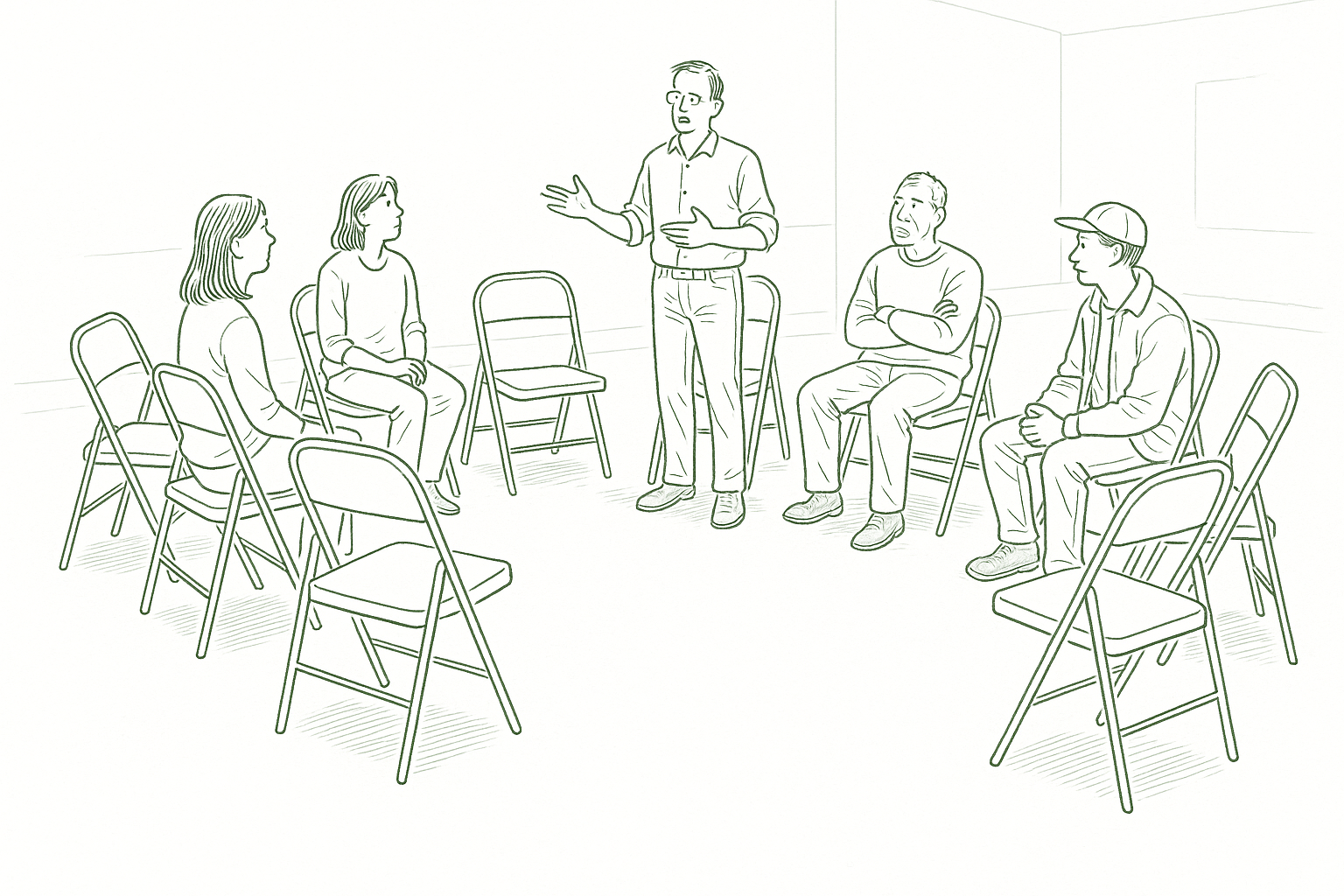
The second structural insight was the meeting format itself. AA groups are deliberately small and local. Members show up consistently, at the same time, in the same room. They know each other's names and histories. The meeting isn't a lecture — it's a structured share. People speak from their own experience. Nobody gives advice; they say what worked for them. The meeting creates a container in which honest disclosure is expected and normalized.
These aren't features of AA that were added after the program was proven to work. They're features that explain why it works — features that organizational psychologists and group dynamics researchers would later spend decades independently arriving at through completely different methods.
What the Research Eventually Confirmed
For most of its history, AA occupied an awkward position in the medical community. Doctors and psychologists were skeptical. The program was run by laypeople with no clinical training, organized around spiritual principles, and stubbornly resistant to the kind of controlled study that clinical interventions require. How do you run a double-blind trial on a fellowship?
The skepticism persisted until researchers developed better tools for measuring outcomes over time. By 2020, the evidence was clear enough that the Cochrane Collaboration — the most rigorous independent review body in medicine — published a comprehensive analysis.
The review, led by Keith Humphreys of Stanford's Department of Psychiatry and Behavioral Sciences, analyzed 35 high-quality studies involving 145 scientists and 10,080 participants. The conclusion was unambiguous: AA was nearly always more effective than professional treatment, including cognitive behavioral therapy, at achieving continuous abstinence. In one study, it was found to be 60% more effective. No study found AA to be less effective. Most studies also showed significant healthcare cost savings — one found that AA participation reduced mental health costs by $10,000 per person.
Humphreys, who described himself as initially dismissive of AA ("how dare these people do things that I have all these degrees to do?"), came to a blunt conclusion: "AA works because it's based on social interaction. If you want to change your behavior, find some other people who are trying to make the same change."
That sentence is not a spiritually inflected piece of advice. It is the operational summary of ninety years of peer group mechanics, validated by a gold-standard systematic review.
What AA Got Right That Clinical Therapy Got Wrong
The comparison to cognitive behavioral therapy matters here. CBT is evidence-based, professionally administered, and theoretically well-grounded. It teaches coping mechanisms, identifies distorted thinking patterns, and provides practical tools for behavior change. It works for a lot of things.
For sustained behavioral change in social environments, AA outperformed it. Why?
The answer isn't about spirituality or the twelve steps as a spiritual technology. It's about structure. AA provides something that CBT, by design, cannot: persistent community. A therapist sees you once a week for an hour. The relationship is defined by professional distance. It ends when the sessions end. The accountability evaporates between appointments.
An AA sponsor doesn't evaporate. They call. They notice if you stop showing up. They are embedded in the same community you are, with skin in the same game. The accountability gap — the space between the decision you made and whether anyone ever checks if you followed through — barely exists in AA. The sponsor closes it. The group closes it. The regular meeting closes it.
This is the structural advantage of peers over professionals. The professional relationship is bounded. The peer relationship is ambient. It's woven into daily life in a way that a clinical hour never can be.
The Sponsor System Is Just Accountability Architecture
Strip the AA vocabulary away from the sponsor relationship and what's left is a remarkably clean model of peer accountability.
A sponsor is someone further along who has made the same commitments. They guide you through the structured work — the twelve steps — which are essentially a process of honest self-examination, acknowledgment of failures, repair of damaged relationships, and ongoing behavioral commitment. They provide a confidential space for honest conversation. They ask the hard questions. They follow up.
Studies show the average sponsor has been in the program for 9.5 years. They are not volunteers doing a favor. They are peers who understand, from the inside, exactly what you are up against. And crucially: the person who doesn't attend meetings has a sponsor who won't just let it go. The accountability is active, not passive.
The mechanism is the same whether the context is sobriety or quarterly revenue growth. Someone you respect is going to ask whether you did what you said you would do. That prospect changes behavior in ways that pure self-discipline doesn't. Research on accountability dynamics consistently shows that external commitment — saying something to another person, knowing they'll follow up — dramatically increases follow-through. AA built this into its architecture before anyone had named the principle.
The Meeting as a Container for Honest Disclosure
There is a reason AA meetings open with a rule about anonymity. "What's said here stays here" isn't a nicety — it's the foundation of the entire model.
Psychological safety — the condition under which people will say what they actually think, disclose what they're actually struggling with, and risk the vulnerability of honest admission — doesn't occur automatically in groups. It has to be created through consistent, reliable norms. AA has been creating it with the same set of norms for ninety years.
The format matters too. AA meetings don't run on debate or argument. People speak from their own experience. Nobody tells you what to do. The implicit message is: here is what happened to me, here is what I tried, here is what worked. You draw your own conclusions. This format eliminates the performance dynamic that kills honest disclosure in most groups — the fear that you will be judged, advised at, or told your problem is simple.
A room full of people who understand exactly what you're facing, who will listen without immediately solving, who will share from their own honest experience rather than dispensing generic wisdom — that is an unusual and powerful thing. Most people go their entire lives without finding it in a professional or social context.
Shared Identity as the Binding Agent
There is one more ingredient in the AA model that doesn't get enough credit: shared identity.
AA members don't describe themselves as people who used to drink too much. They describe themselves as alcoholics — a present-tense identity, even in long-term sobriety. This isn't semantic stubbornness. It's structural. The shared identity keeps the group coherent. It defines who belongs and why they're there. It makes the peer relationship specific rather than generic.
This is why network size is less important than network specificity. A broad network of acquaintances provides weak signal. A tight group of people facing identical challenges provides precise, applicable insight. The shared context — the thing you all actually have in common — is the thing that makes the exchange valuable.
A founder talking to another founder about pricing is a different conversation than a founder talking to a business school professor about pricing. The professor has frameworks. The founder has battle scars. Both have value, but only one has lived the specific texture of the problem. AA understood this before organizational psychologists gave it a name. You learn from people who are working the same problem you are, not people who have studied the problem from a distance.
The Structural Lessons
AA wasn't designed to prove anything. But ninety years of operation, across 180 countries, with two million members and no professional staff, has produced a clear set of structural lessons about what makes peer groups work.
Small and consistent. AA groups are local and regular. The same people, in the same room, week after week. Relationship depth doesn't come from exposure — it comes from repeated, honest interaction over time. One-off networking events produce none of it.
Shared context. Members share a specific, defining challenge. The specificity is what makes the exchange useful. Generalist peer groups — where everyone is just "a professional" or "an entrepreneur" — produce generalist advice. Groups organized around a shared problem produce specific, applicable insight.
Active accountability. The sponsor relationship is not optional. Someone is checking on you. Someone will notice if you disappear. The accountability is embedded in the structure, not left to self-discipline.
Psychological safety by design. Anonymity norms, experience-sharing formats, and the absence of judgment aren't accidents — they're the conditions under which honest disclosure becomes possible. Without them, groups default to performance and surface-level exchange.
Peer-led, not expert-led. No therapist is running the meeting. No consultant is facilitating. The person at the front of the room has the same credentials as everyone else: they have lived the problem. This removes the authority gradient that shuts down honest conversation in hierarchical settings.
These five principles weren't invented by Bill Wilson. He discovered them by accident, in desperation, in a hotel room in Akron. But they are the same principles that the 300-year history of mastermind groups keeps arriving at independently — from Benjamin Franklin's Junto Club to the Lunar Society of Birmingham to YPO to every effective founder peer group operating today.
What This Means Outside the Meeting Room
The problem AA solved is not unique to addiction. It is a general problem: how do you sustain a behavioral commitment that your environment doesn't naturally reinforce? How do you keep doing hard things when no one outside your head is checking?
Founders make worse decisions in isolation for the same reason alcoholics relapse in isolation. The feedback loops disappear. The accountability disappears. The honest voice that says "you're rationalizing" disappears. What's left is a person and their own narrative — which is always more comfortable than the truth.
The research on small group decision-making is consistent: groups with the right structure produce better outcomes than individuals, not because the group is smarter in aggregate, but because the group prevents the most common failure modes of individual thinking — confirmation bias, sunk-cost reasoning, avoidance of uncomfortable truths.
AA solved this accidentally in the context of alcoholism. It built — without designing it — one of the most effective peer group structures in history. A structure that beat professional therapy in a systematic review. A structure that has sustained itself without institutional support for ninety years. A structure that works because it respects what actually changes human behavior: not information, not willpower, but being in a room with people who understand exactly what you're up against, who are going to ask if you followed through, and who are working the same problem alongside you.
The subject matter doesn't have to be sobriety. The structure is the point.
GoodGrowth builds structured peer groups for founders and operators — the same principles that make AA work, applied to building a business. Groups are forming now. Read more about what accountability actually does to behavior.