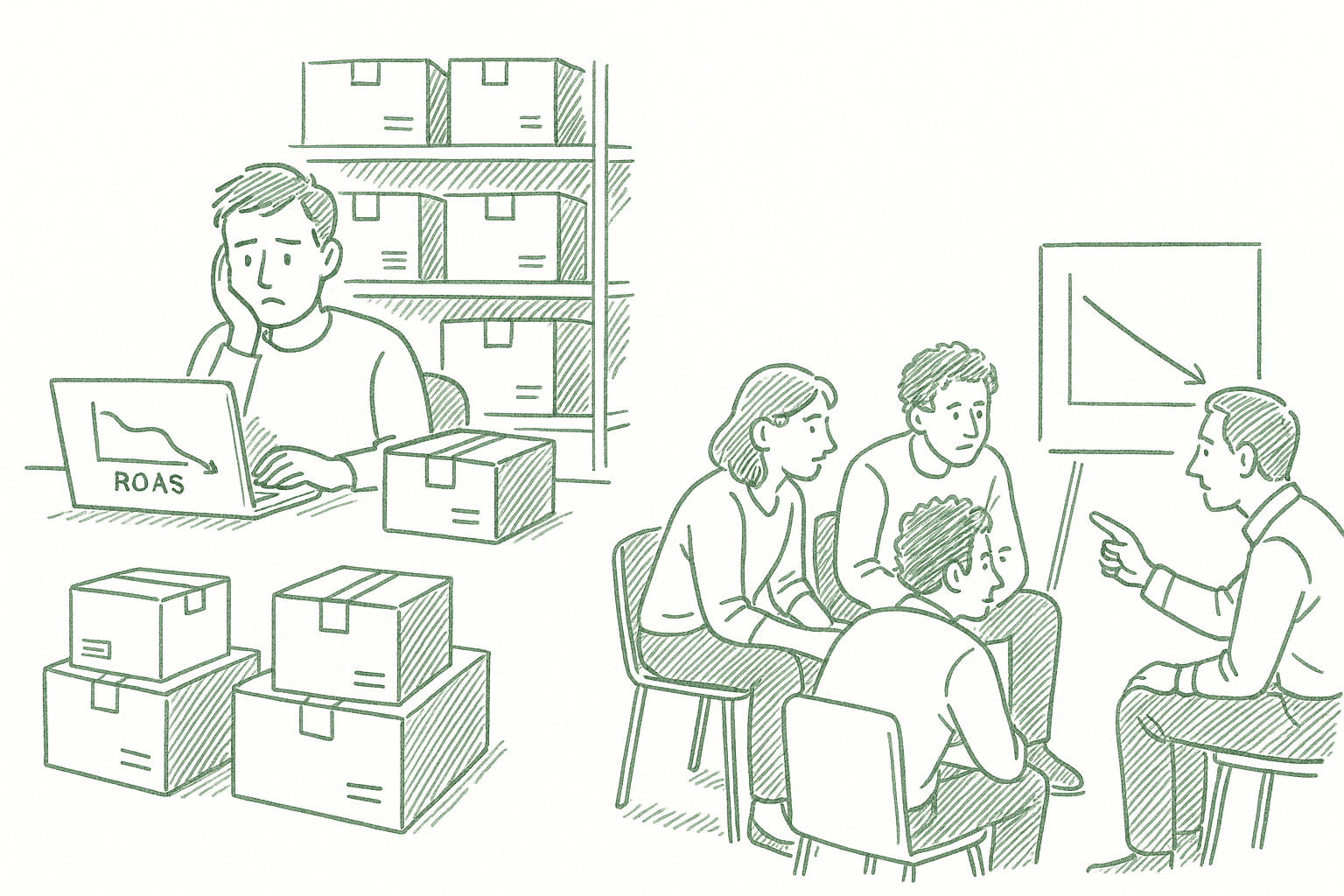
Ecommerce is a business model that forces you to make enormous bets on very little information — often alone, often fast.
You're deciding whether to buy $80,000 of inventory for Q4 based on last year's numbers and your gut. You're watching your Meta ROAS collapse in real time and trying to decide if it's your creative, your audience, the algorithm, or a real market signal. You're getting pitched by a 3PL promising 30% cost savings, and you have no idea if anyone who looks like you has actually used them.
The decisions are high-stakes. The feedback loops are long. And most ecommerce founders are making them completely alone.
The unique isolation of ecommerce
Ecommerce founders are a specific kind of lonely. Not the lonely of the first-time CEO who doesn't know what she doesn't know. The operational kind. The kind that comes from running a business where the variables are always changing — ad costs, inventory turns, supplier relationships, channel mix — and the only person who fully understands your P&L is you.
You might have a COO. Maybe an agency. A fractional CFO if you're lucky. But none of them have skin in the game the way you do. None of them have made the same bet you're about to make, with the same margin pressure, on the same timeline.
That gap — between having smart people around you and having experienced peers around you — is where most ecommerce founders operate. And it's costly. Research consistently shows that isolated decision-makers are more prone to confirmation bias, more likely to over-rely on the last thing they read, and slower to catch problems they've become too close to see.
The data on DTC failure rates is blunt. Somewhere between 60-90% of ecommerce businesses don't survive five years. And notably, the failure risk doesn't disappear once you've crossed a revenue threshold. One analysis found that 73% of DTC brands die between $10M and $50M in revenue — the scaling gap where operational complexity outpaces what a single founder can hold in their head.
Why forums and communities aren't enough
If you've been in ecommerce for more than a year, you've probably found your way into communities. EcomFuel, if you've hit seven figures. Some Slack group for DTC operators. A Facebook group that was useful for five minutes before it became a wasteland of agency prospecting.
The problem isn't the information in these spaces. There's real knowledge being shared. The problem is the structure. A forum gives you access to a crowd. A crowd is bad at your specific problem. You post "thinking about switching 3PLs, anyone used X?" and you get twelve opinions, three of which are from people whose business looks nothing like yours, and none of which come with accountability.
This is the difference Robin Dunbar's research identified between large networks and small groups. You can't have a real conversation with a community. You can have one with five people.
The operators building the most durable ecommerce businesses figured this out. They're not looking for a bigger community. They're looking for four or five people at a similar stage — comparable revenue, comparable channel mix, non-competing categories — who will actually dig into their business and tell them the truth.
What the best peer groups actually talk about
The conversations that change ecommerce trajectories aren't about tactics. They're about decisions.
The inventory bet. Should you buy 90 days of stock heading into peak season, or pull back to preserve cash? Someone who did both — and remembers what it felt like — is more valuable than any spreadsheet model.
The channel question. You've been DTC-only. Wholesale is knocking. Retail is calling. Amazon is always there. Every ecommerce operator who's wrestled with the channel mix decision has scars. Peer experience compresses your learning curve by years.
The ad spend spiral. ROAS is declining. You don't know if you're in a creative rut, a targeting problem, or a market signal that the product is maturing. This conversation goes nowhere alone. In a room with four other operators, you'll have your answer in 20 minutes.
The team question. When to hire a CMO vs. stay performance-marketing-led. Whether the agency relationship is working or just comfortable. How to find the first operator who isn't you. These are the same questions that trap agency owners, and they require hard external perspective.
The exit question. When someone makes an offer. Whether to raise. Whether to sell on your terms or wait. This is the conversation nobody in your ecosystem has the incentive to answer honestly — not your lawyer, not your agency, not your investor, if you have one. A peer group is the only room where the incentives are clean.
The accountability layer
There's a less glamorous reason peer groups work for ecommerce founders: they close the accountability gap that makes most operators stall.
Ecommerce has no natural forcing function for strategic work. The business demands your attention on the operational layer — fulfillment, ad performance, inventory — and strategic decisions get perpetually deferred. You'll fix pricing next month. You'll figure out the retention problem after Q4. You'll have that hard conversation with your co-founder when things slow down.
Things don't slow down. The strategic work stays on the list indefinitely unless someone is watching.
A peer group creates the watch. When you tell four operators that you're going to cut your paid acquisition dependency from 80% to 50% of revenue over the next quarter, you're now accountable to something outside your own motivation. The follow-through rate on commitments made in front of peers versus commitments made to yourself is not close. Research on peer accountability consistently shows commitment rates 65% higher when accountability is social versus private.
What makes a peer group work for ecommerce specifically
The mechanics matter. A useful peer group for ecommerce founders isn't a mastermind "course" with 200 people and weekly Zoom calls. The structure that works is small, matched, and structured:
Four to six operators. Small enough that everyone presents, everyone gets heard, and you can't hide behind the crowd.
Similar revenue stage. A $500K operator and a $10M operator have almost no overlapping problems. Match by stage.
Non-competing categories. A home goods brand and a supplement brand have everything to learn from each other with nothing to protect. Competing brands won't share openly — and the value is in the openness.
Consistent structure. Hot seats, real P&L sharing, declared commitments. Not just hanging out. Working.
The ecommerce operators running the best businesses figured out something most forums won't tell you: the information is not the bottleneck. You can find information anywhere. What you can't easily find is four people who've already survived the problem you're currently in, who have nothing to sell you, and who show up every week.
GoodGrowth matches founders into small, structured peer groups. Not a course. Not a forum. A group of operators at your stage, committed to each other's outcomes. Read more on why accountability changes outcomes.