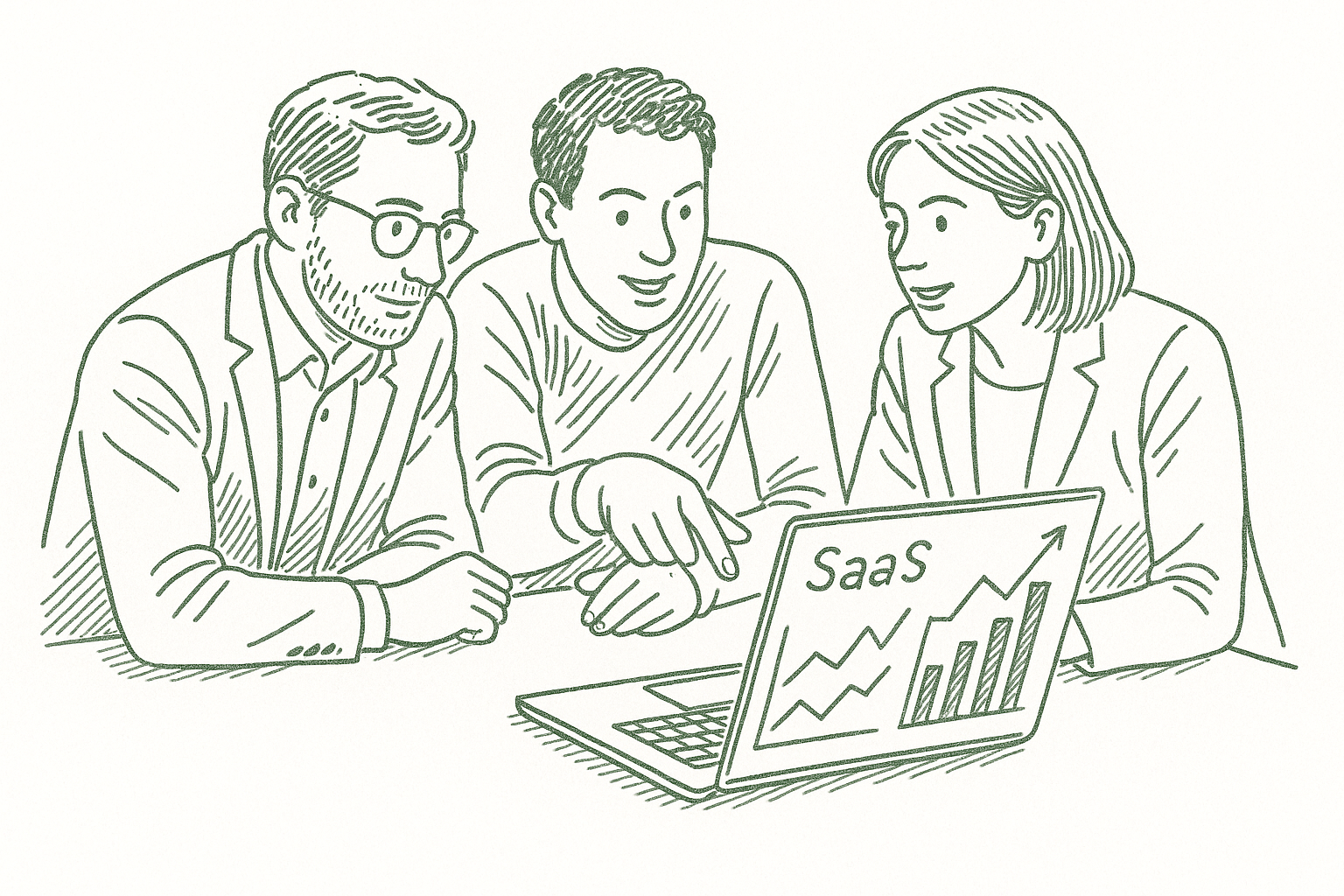
SaaS is one of the most predictable business models ever invented. The stages are well-documented. The metrics are standardized. The playbooks exist for nearly every milestone from first customer to IPO.
And yet, most SaaS founders still get stuck on problems that someone three months ahead of them has already solved.
The SaaS isolation paradox
SaaS founders are uniquely positioned for peer learning — and uniquely bad at pursuing it. The model is data-driven, which means problems are measurable and comparable. A founder struggling with 8% monthly churn can get specific, tactical help from someone who reduced theirs from 12% to 3%. That's not vague advice. That's a playbook transfer.
But here's what usually happens instead: the founder with 8% churn reads fifteen blog posts, watches a SaaStr talk, maybe posts in a Slack community and gets eleven conflicting opinions, then spends another month testing something they're not confident in.
The founder with the peer group got the answer in one conversation and moved on to the next problem.
Why SaaS problems are peer-group problems
Three things make SaaS founders ideal candidates for structured peer support:
The problems are sequential. Every SaaS business hits the same walls in roughly the same order — product-market fit, first ten customers, pricing, hiring the first salesperson, managing churn, crossing $1M ARR. Someone who's six months ahead has context that no advisor, course, or blog post can replicate, because they felt the same pressure making the same decision.
The metrics create a common language. MRR. CAC. LTV. NRR. Churn. SaaS founders can describe their problems with precision — and that precision makes peer feedback immediately actionable. "My CAC payback is 14 months" is a specific problem. A peer group can pressure-test specific solutions in real time.
The competition is rarely direct. A SaaS founder building project management software for construction companies and one building invoicing for freelancers share almost every operational challenge — hiring, pricing, churn, positioning — with zero competitive overlap. They can share everything because nothing is at risk.
What the programs get right (and wrong)
The SaaS world already knows peer groups work. TinySeed built masterminds into their accelerator — and founders consistently rate them as one of the most valuable parts of the program, often above the funding itself. MicroConf runs a mastermind matching program. SaaS Club structures peer groups around the $100K–$1M ARR range.
What these programs prove is the demand. Founders want this. They need it. When they get it, they use it.
What most get wrong is access. You need to be in an accelerator, or at a specific revenue stage, or able to pay $5K–$10K per year, or lucky enough to find the right people organically. The matching problem is real — a bootstrapped founder at $20K MRR has almost nothing in common with a Series B founder at $5M ARR. Stage matters. Context matters.
The conversations that move the needle
The best SaaS peer groups aren't therapy sessions or networking events. They're working sessions where founders bring real numbers and get real feedback:
"Should I raise prices?" — Everyone agonizes over this alone. In a peer group, someone has already done it and can walk you through exactly what happened to conversion, churn, and expansion revenue.
"When do I hire a salesperson?" — The wrong hire at the wrong stage is one of the most expensive mistakes in SaaS. A peer who made it too early or too late saves you six months and $100K.
"My churn spiked after onboarding changes." — This is a specific, measurable problem that generic advice can't solve. But a founder who went through the same spike can tell you what they tested, what the data showed, and what actually fixed it.
These aren't hypothetical conversations. They happen every day in the best SaaS peer groups. The founders who have access to them make fewer mistakes, move faster, and waste less money — not because they're smarter, but because they're not solving everything from scratch.
The unfair advantage
Every SaaS founder has access to the same blog posts, the same podcasts, the same frameworks. Information isn't the bottleneck — it hasn't been for years. The bottleneck is context. Knowing which framework applies to your specific situation, at your specific stage, with your specific constraints.
That kind of context only comes from people who are close enough to your reality to understand the tradeoffs. Not investors with portfolio-wide pattern matching. Not advisors who sold their company ten years ago. Peers. Founders at your stage, facing your problems, sharing what's working right now.
The SaaS founders who scale fastest almost always have this. They just don't talk about it — because when you have an unfair advantage, you don't advertise it.
GoodGrowth matches SaaS founders into small peer groups based on stage, challenges, and goals — not random networking. Structured support from people who get it. Read why small groups outperform big networks.