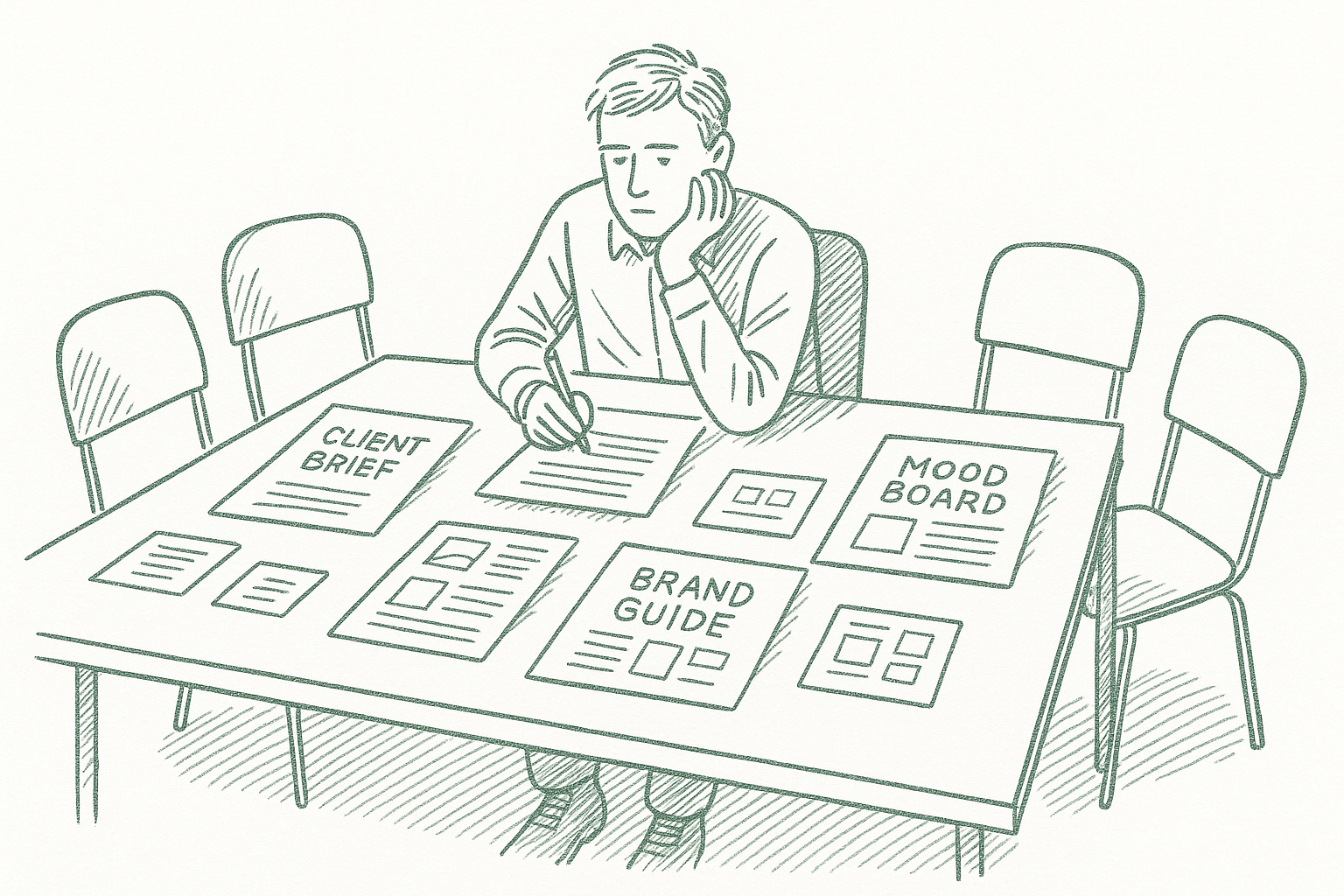
There's a specific kind of loneliness that comes with running an agency. You spend your days solving problems for clients — their positioning, their campaigns, their growth strategy, their brand. You're the expert in the room. You give confident answers.
Then you close your laptop and face your own business. And you have no idea who to ask.
Do you raise prices? Fire the problem client eating 30% of your bandwidth? Hire that senior designer or wait until revenue catches up? Go deeper into a niche or stay generalist? The decisions that actually determine whether your agency survives — you're making them alone.
This is the core contradiction of agency life. You're surrounded by work, but isolated in leadership.
The Agency Problem Nobody Talks About
Running an agency is structurally isolating in ways that other businesses aren't. Your clients can't know your struggles — you're supposed to be the expert. Your team looks to you for direction. Your peers are often direct competitors. And your spouse or friends don't have the context to help.
A Stanford Graduate School of Business study found that nearly 75% of CEOs don't receive outside leadership advice. For agency owners — who typically operate smaller firms without formal boards — that number is likely higher.
The result is a pattern that repeats across agencies of every size: owners making expensive, avoidable mistakes because they had no one in their corner to push back. Staying with a bad client too long because the revenue felt necessary. Underpricing for years because no one modeled what the market would actually bear. Hiring the wrong person because the decision felt urgent and there was no one to slow them down.
The feast-or-famine cycle that kills agencies isn't just a cash flow problem. It's a decision problem. And decision problems don't get solved by working harder — they get solved by getting better information from a smaller, deeper circle.
What a Peer Group Actually Does
A mastermind group for agency owners is not a networking event. It's not a Slack community where people share Canva templates and ask for referrals. It's a small, structured group of non-competing agency owners who meet regularly, know each other's businesses, and hold each other accountable to hard decisions.
The value isn't information. You can Google information. The value is perspective from people who've been in your exact situation — different industry, same problem. Someone who raised their rates 40% and kept 80% of their clients. Someone who fired their biggest client and tripled their profit margin in six months. Someone who tried to hire a sales person before they were ready and lost two years of momentum.
These aren't case studies in a blog post. They're people sitting across from you who can say: I did that. Here's what actually happened.
The Three Decisions Peer Groups Change
Agency owners who join peer groups consistently report movement on a handful of decisions that had been stuck for months or years.
Pricing. The single most common outcome. Agency owners chronically underprice because they're afraid of losing clients. A peer group exposes you to what other markets bear, gives you the social permission to raise rates, and holds you accountable to actually doing it. Most owners who've gone through this realize their fear wasn't rational — it was just unexamined.
Client selection. Firing a bad client feels financially terrifying when you're doing it alone. In a peer group, you can lay out the actual numbers — hours consumed, revenue generated, team morale cost — and let five other operators tell you what they'd do. The math usually becomes obvious. The decision becomes easier.
Niche vs. generalist. This is the identity question agencies circle for years. Going deeper into a niche means turning away work, which feels like risk. Staying generalist means competing on everything, which is a race to the bottom. Other agency owners who've made the niche call — or regret not making it — can shortcut years of second-guessing.
Why Competitors Can't Fill This Role
The obvious objection: can't you just find other agency owners and talk to them? Maybe at an industry conference, or in an online forum?
The problem is incentives. If you're talking to a direct competitor, there's always a layer of performance. You share your wins, not your real questions. You're networking, not thinking out loud.
A mastermind group works because it's non-competing and confidential. The people across from you have zero stake in your clients, your positioning, or your pricing decisions. They can be honest because honesty costs them nothing. And that honesty — the kind you almost never get from anyone in your orbit — is what actually moves the needle.
The Accountability Layer
There's one more thing a peer group does that most agency owners underestimate: it creates follow-through.
Most owners know what they need to do. Raise prices. Systematize delivery. Fire the client. Build a referral process. The knowing isn't the problem. The doing — consistently, with urgency, when there's always something else competing for attention — is the problem.
When you commit to something in front of five other operators who are going to ask you about it next month, the calculus changes. Not because of shame, but because those people know your business well enough to know when you're making excuses. And they'll say so.
That's the unfair advantage. Not information. Not connections. The fact that someone who understands your business is watching, asking, and not letting you off the hook.
What to Look For
Not all peer groups are built the same. If you're looking for one, a few things matter:
Small and curated. Five to eight people is ideal. Big enough to have diverse perspectives, small enough that everyone knows each other's context. Groups of twenty become networking events.
Non-competing. You need people who can be honest about their business without worrying what you'll do with the information. Agencies in different verticals or different geographies work. Direct competitors don't.
Structured, not social. A good peer group has a format — each meeting covers specific challenges, commitments get tracked, someone facilitates. If it's just hanging out, the hard conversations don't happen.
Consistent. Monthly is the minimum. The value compounds over time as people get to know each other's businesses. A group that meets twice a year isn't a peer group — it's an event.
Agency ownership is already hard. Making every decision alone is a choice, and it's not a good one. The owners who grow fastest aren't the ones who work the hardest — they're the ones who stop treating their own business like a problem to be solved in isolation. The same holds for content entrepreneurs and creators, who face an almost identical structural problem: a large audience that looks like a network but functions like none at all.