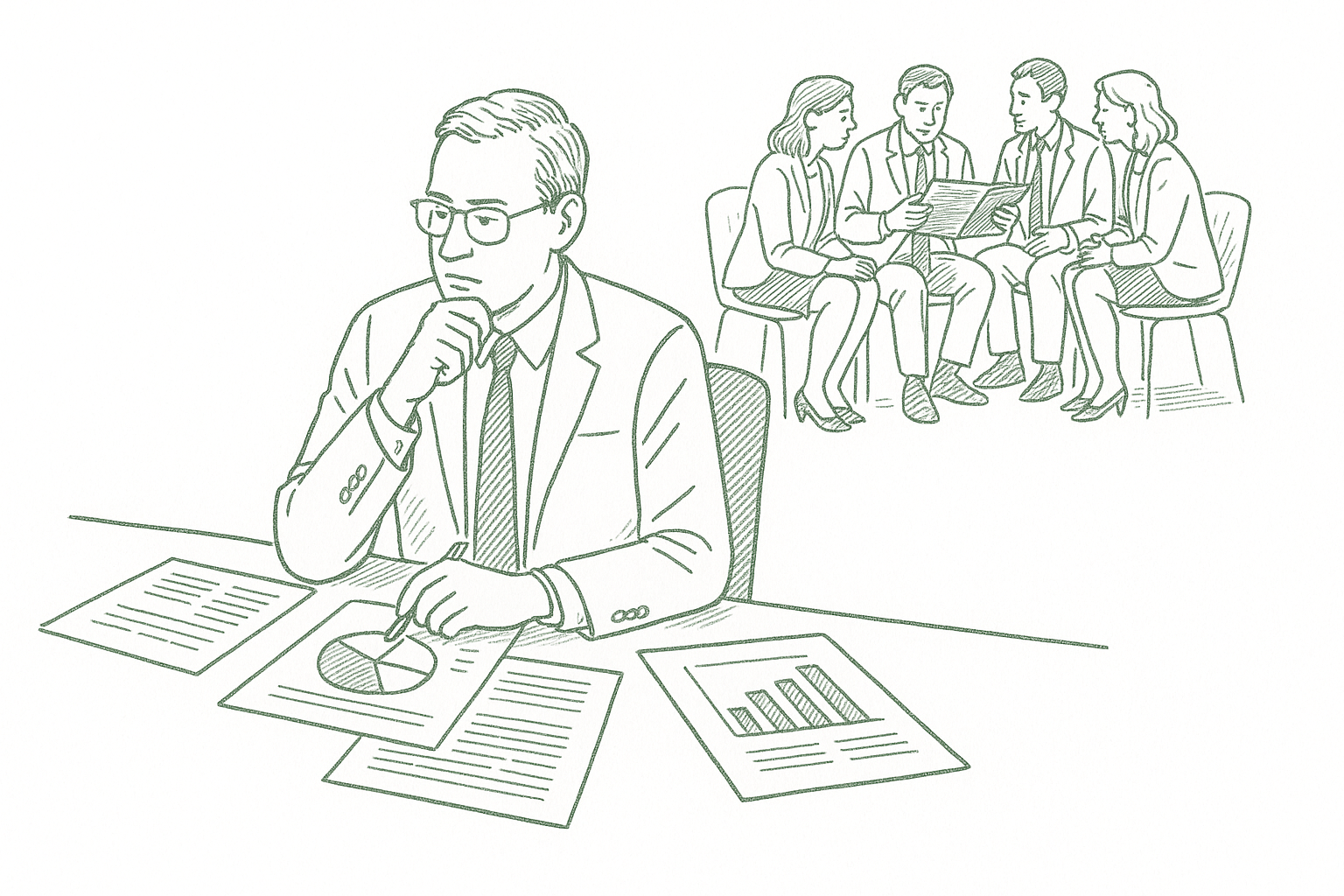
Financial advisors operate in one of the most structurally isolating professions in the service economy.
The industry looks social from the outside. You're constantly meeting clients, attending conferences, logging CE credits. But underneath the calendar activity is a core truth that most advisors recognize after a few years: when it comes to running and growing your practice, you're almost entirely on your own.
Your broker-dealer doesn't help you build better client relationships. Your compliance department exists to constrain you, not develop you. Your peers at the same firm are competitors for the same referrals. And the conferences — packed with vendors selling you tools and fund companies selling you product — are the last place you'd bring a real business problem.
The advisors building standout practices in this environment have found a different answer. It's not a better CRM. It's not a new portfolio strategy. It's a small group of non-competing peers who meet regularly, share openly, and hold each other accountable to the hard decisions.
The Industry Is Under Pressure From Every Direction
The 2024 Natixis Global Survey of Financial Professionals surveyed advisors across 20 countries and found a profession under simultaneous short-term and long-term stress. In the near term: clients rattled by rate environments and market uncertainty, demanding more personalized service while questioning every fee. In the long term: $84 trillion in intergenerational wealth transfer threatening to walk out the door when a primary client dies, because 43% of advisors admit they haven't built relationships with client spouses or heirs.
SEC-registered investment advisers managed $144.6 trillion in regulatory assets under management in 2024 — up 12.6% year-over-year. The industry is growing. But so is the complexity. Compliance requirements are tightening. Fee pressure from robo-advisors and passive investment vehicles continues. And the talent shortage is real: Schwab has warned of a projected shortfall of 70,000 qualified advisors by the end of the decade.
In that environment, the advisors who figure out how to grow their book, retain clients across generations, and build operationally sound practices will pull ahead decisively. The advisors who try to solve those problems in isolation will spend another decade reinventing wheels that their peers already solved.
Study Groups Have Always Been the Secret
Michael Kitces — widely considered the most influential voice in the financial planning profession — wrote in 2019 that advisor study groups and mastermind groups had become one of the most significant accelerants for practice growth. The reason, he argued, comes down to one thing: the ability to be completely open.
"Ultimately, it seems to come down to the benefit of having a group of professional peers with whom you can be completely open and transparent," Kitces wrote, "to receive the kind of feedback and advice — whether it's constructive criticism or a friendly push — that's difficult to deliver until all the facts are on the table."
The key structural feature of the best advisor peer groups is non-competition. Advisors in different geographic markets have zero incentive to withhold information from each other. They're not competing for the same clients. So when the question is "how do you handle the conversation with a spouse who doesn't trust financial advisors," or "what's your process for bringing heirs into the relationship before a wealth transfer event," there's no reason not to share everything.
That candor is rare in this industry. And it's worth more than almost anything you'll get at a conference.
What the Best Advisor Mastermind Groups Actually Do
There's a difference between a study group that reviews investment strategies and a mastermind group focused on building a practice. Both have value. But the advisors who report the most transformative growth from peer groups are typically in the second category — where the conversation moves beyond portfolio construction into the operational, relational, and strategic realities of running a business.
The most effective structures tend to share a few elements:
Small groups. Four to eight advisors. The Goldilocks zone where everyone gets airtime and no one can hide. Groups larger than eight start to develop passenger dynamics — some members watch while others carry the conversation.
Matched stage. An advisor managing $30M in AUM is working on entirely different problems than one managing $300M. The best groups cluster by production level and stage of practice — not just by credential or years in the business.
Non-competing markets. Geographically distributed groups eliminate the competitive friction that prevents real candor. An advisor in Phoenix can share their entire client retention system with an advisor in Boston without any concern about the information being used against them.
Open books. The best groups go all the way — sharing actual revenue numbers, client counts, fee structures, and operating margins. When everyone's numbers are on the table, the benchmarking becomes real instead of theoretical.
Structured meetings. Not coffee chats. Hot seats where one member presents a specific challenge and the group spends focused time helping them solve it. Goal reviews. Accountability check-ins. The structure is what separates a mastermind from a friend group.
The Conversations That Actually Move the Needle
The topics that come up in advisor mastermind groups aren't the ones you'd find on a conference agenda. They're messier, more specific, and significantly more useful.
Advisor peer groups regularly work through problems like: how to have the pricing conversation when a long-term client is being squeezed by a fee comparison website. How to structure a succession plan that doesn't tank client retention when the founding advisor steps back. How to identify and exit the bottom 20% of your book without relationship damage. When to hire your first support staff member and what to delegate first — and what never to delegate.
These are the decisions that feel impossible to make alone. Not because the advisor lacks intelligence or experience — but because there's no one in their day-to-day environment who can engage with the actual specifics without a conflict of interest. Your compliance officer can't help you think through client segmentation. Your broker-dealer doesn't know your book. Your clients can't hear you thinking out loud about any of it.
A peer group of advisors in non-competing markets is the closest thing this profession has to a boardroom.
The Accountability Problem Every Advisor Knows
There's a specific failure mode that kills practice growth for advisors who are otherwise competent and motivated: they identify the right move, commit to doing it, and then don't.
You know you need to systematize your client review process. You know you need to have the fee conversation with your C-tier clients. You know you need to update your referral ask. You've known these things for months. Maybe years.
The gap between knowing and doing — what researchers call the accountability gap — is the defining challenge of operating as a solo or small-team practice. There's nobody in your business whose job it is to ask you whether you followed through. Nobody is watching. And without that external accountability structure, the things that feel important but not urgent get perpetually displaced by things that feel urgent but aren't important.
The American Society of Training and Development found that people who commit to a specific goal with a specific person have a 65% completion rate. People who have ongoing accountability appointments have a 95% completion rate. That data wasn't collected on financial advisors specifically — but the mechanism is universal.
A mastermind group is that accountability appointment, recurring, with people who understand your business well enough to distinguish between a genuine obstacle and a rationalization.
The Referral Network That Builds Itself
Financial advisors operate in a geography-constrained referral market. Your best referral sources are the people who trust you most — and that trust takes years to build. Expanding your referral network typically means spending years developing new relationships with CPAs, estate attorneys, and other professionals in your local market.
A non-competing peer group quietly creates a second referral channel that most advisors don't anticipate when they join: inbound referrals from other advisors in different markets.
When a client in your group relocates to another city, or a prospective client's needs fall outside your specialty, you now have a trusted advisor to send them to. Not a name from a directory. Not an acquaintance from a conference. Someone whose business you know in detail, whose values you've seen in action, and who will reciprocate in kind. The trust that makes those referrals feel genuine and natural takes months to build in a peer group — but it lasts years.
Some advisors report that their mastermind group becomes the most reliable source of high-quality referrals in their practice over a multi-year membership — precisely because the trust is deeper than anything built through a formal referral arrangement. The same dynamic plays out for mortgage brokers in peer groups, where commission-based professionals in non-competing markets share everything from lender performance data to lead generation systems.
Why Formal Coaching Isn't the Same Thing
The financial advisory industry has a robust coaching market. Programs like Carson Coaching, the Elite Advisor Success program, and the Pareto Systems methodology have helped thousands of advisors systematize their practices. That work is real and the frameworks are solid.
But coaching has a specific limitation: it flows in one direction. The coach brings frameworks. The advisor applies them. There's no real-time peer input, no shared stake in the outcome, no accountability to someone who's working through the same problems in their own practice right now.
The value of peer groups runs in the opposite direction from coaching. Where coaching provides expert-to-novice knowledge transfer, peer groups provide lateral intelligence sharing — the pattern recognition that comes from five or six practitioners who've each made different mistakes, solved different problems, and can offer specific experiential context that no generalist coach can replicate.
The advisors who grow fastest typically use both: structured coaching for foundational systems, peer groups for ongoing real-time problem solving and accountability. Each fills a gap the other can't.
What You're Actually Risking by Working Alone
The cost of isolation in financial advisory isn't immediately visible. Your AUM doesn't drop overnight because you don't have a peer group. Your client relationships don't visibly suffer.
What isolation costs you is compounding. Every decision you make alone that would have been sharper with peer input. Every initiative you delayed because no one was asking about it. Every mistake you made that someone else in your situation had already solved and would have shared freely. Every year you spent reinventing a practice management system that another advisor in a different market had already figured out.
Small, trusted groups produce better outcomes than large, shallow networks. The research on this is consistent. The advisors who've been in peer groups for five or ten years would tell you the same thing: the value isn't in any single meeting. It's in the accumulated intelligence and accountability that builds over time — and the compounding effect that comes from making slightly better decisions, slightly more consistently, for years on end.
The $84 trillion wealth transfer is coming. The robo-advisors are not going away. The compliance environment will not simplify. Insurance agents face the same structural isolation — half report burnout, and the ones who survive are the ones who stop figuring it out alone.
The advisors who will be well-positioned in five years are building practices right now — with a room full of people who will tell them the truth.
GoodGrowth builds structured peer groups for professionals who want real accountability and real outcomes — not another networking event. Read more on why accountability is the variable most practices miss, or explore the 300-year history of people solving hard problems together.