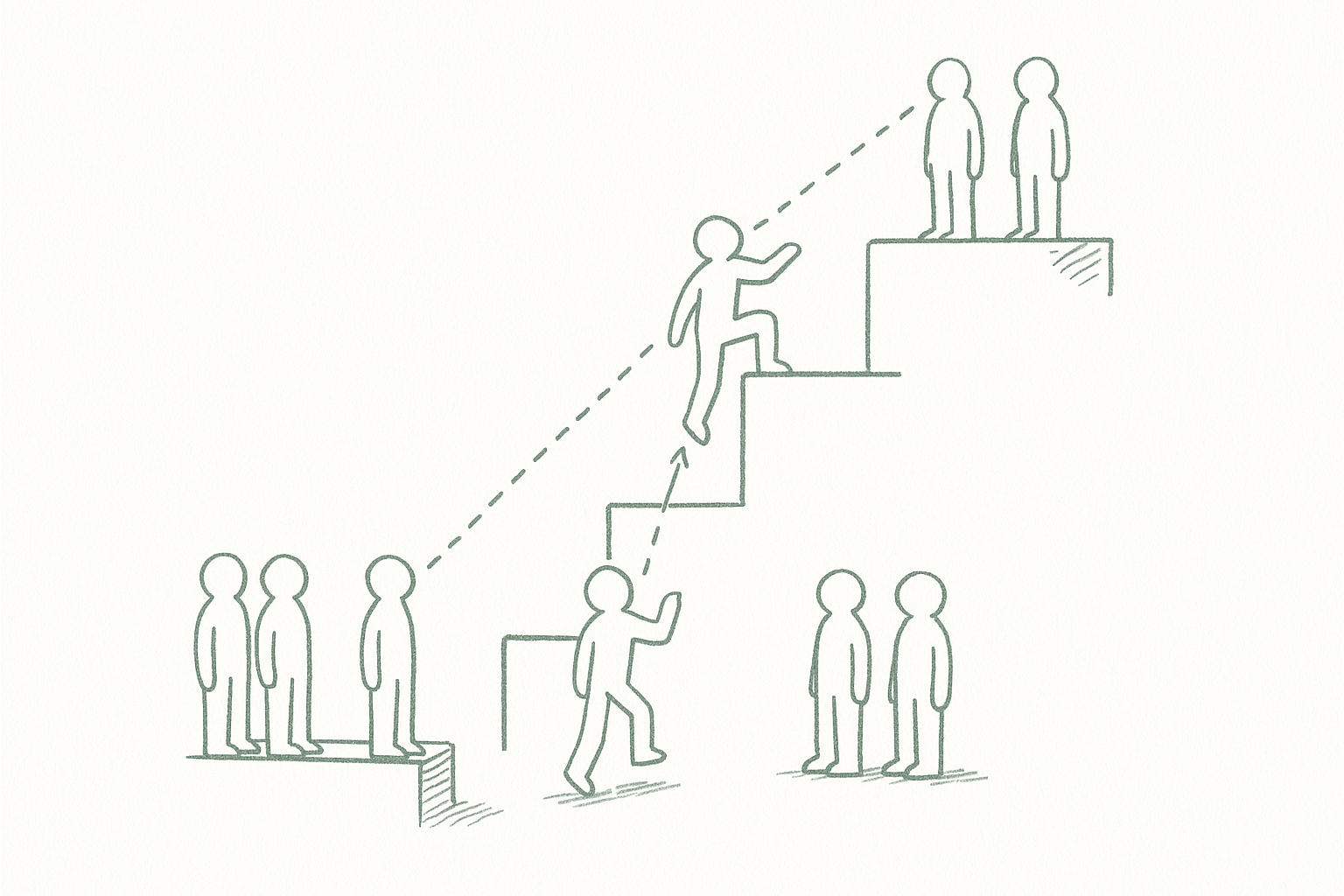
In 1954, a social psychologist named Leon Festinger published a paper in Human Relations that would fundamentally reshape how scientists understood human self-evaluation. His thesis was simple and uncomfortable: people do not assess their own abilities or opinions through objective measurement. They assess them by comparing themselves to other people. Not to abstract standards. Not to internal metrics. To the actual, specific humans who happen to be nearby.
Festinger called this social comparison theory, and its implications for anyone who runs a business, leads a team, or makes decisions under uncertainty are enormous. Because it means that the single most powerful lever you have for recalibrating your own performance is not a book, a coach, or a conference. It is the composition of the peer group you choose to sit in.
What Festinger actually proved
Festinger's original paper laid out nine hypotheses, but two of them carry most of the weight. First: in the absence of objective, non-social means of evaluation, people evaluate their opinions and abilities by comparison with others. Second: people prefer to compare themselves with others who are similar to them on relevant dimensions — not with people who are vastly superior or inferior, but with people who are close enough that the comparison feels meaningful.
This was not speculation. Festinger and his students ran a series of experiments demonstrating that when objective feedback was removed, participants immediately sought comparison information from peers. Dreyer, working under Festinger's supervision, showed that people's level of aspiration — the goal they set for their own performance — had less variance when their score was close to the group's score than when it was far above or below. The group was literally calibrating individual ambition.
Gerard, one of Festinger's collaborators at MIT, replicated the finding with opinions: people became more confident in their views when surrounded by others who held similar positions, and less confident when surrounded by those who disagreed. The group was not just a source of information. It was a mirror. And what it reflected back determined what the individual believed about themselves.
Upward comparison: the mechanism that changes ambition
Festinger focused on lateral comparison — people comparing with similar others. But in the decades after his paper, researchers discovered something more potent. Upward comparison — measuring yourself against people who are doing better than you — does not just inform self-evaluation. It rewires aspiration.
Collins published a comprehensive review in Psychological Bulletin in 1996 analyzing four decades of social comparison research. One of his central findings was that upward comparisons, contrary to the intuitive prediction that they would be demoralizing, frequently produced motivation and improved performance — but only when the person making the comparison believed that the superior performance was attainable. When the gap felt bridgeable, upward comparison acted as fuel. When it felt insurmountable, it produced withdrawal.
This distinction matters enormously for peer group design. The reason a founder in a well-matched peer group raises their performance ceiling is not that they are competing with the other members. It is that proximity to people who are solving similar problems at a slightly higher level resets what the founder considers normal. A $2M founder surrounded exclusively by other $2M founders will calibrate their growth targets, their pricing, their hiring decisions, and their risk tolerance against a $2M baseline. Put that same founder in a room with three people at $5M and two at $8M, and the baseline shifts. Not because anyone tells them to aim higher. Because the comparison group itself redefines what normal looks like.
The big-fish-little-pond effect and why your reference group matters more than your talent
Herbert Marsh, an educational psychologist at the University of Oxford, spent decades studying what he called the big-fish-little-pond effect. His research, published across dozens of papers and meta-analyses beginning in 1984, demonstrated that students of equal ability developed dramatically different academic self-concepts depending on the achievement level of their school. A high-ability student in a low-achieving school developed a higher academic self-concept than an equally capable student in a high-achieving school. The reference group — not the objective talent level — determined self-perception.
Marsh and Hau published a massive cross-cultural study in 2003 using data from 103,558 students across 26 countries, all drawn from the OECD's PISA database. The big-fish-little-pond effect replicated in every single country. It was not a Western phenomenon or an artifact of a particular educational system. It was a fundamental feature of how humans process information about their own capabilities: not in absolute terms, but relative to the people immediately around them.
The business implications are direct. If you are the most accomplished person in your peer group — the biggest fish in the smallest pond — your self-concept is comfortable. You feel competent. You feel ahead. And that feeling is precisely what prevents you from recalibrating upward. Marsh's research suggests that the composition of your reference group has a larger effect on your self-perceived ability than your actual ability does. Your network is not just a social amenity. It is your internal measurement system.
The field experiment that proved peer comparison changes real behavior
In 2009, economists Alexandre Mas and Enrico Moretti published a landmark study in the American Economic Review that moved social comparison from the lab into a real workplace. They analyzed scanner data from a large grocery chain, tracking individual cashier productivity when high-performing and low-performing colleagues were assigned to overlapping shifts.
The results were precise. When a highly productive cashier was introduced to a shift, the other cashiers' scanning speed increased by an average of 1.7% — a meaningful productivity gain in a setting where performance was already being measured. The effect was driven by social comparison: cashiers scanned faster not because they were explicitly told to, but because the visible presence of a faster peer changed their internal benchmark for acceptable speed. The researchers controlled for competition, incentive effects, and managerial pressure. What remained was pure social comparison — the automatic recalibration of individual performance in response to a visible reference point.
Critically, Mas and Moretti also found that the effect was asymmetric. High performers were less affected by the presence of low performers than low performers were affected by high performers. Upward comparison was the stronger force. Being in the presence of someone performing above your level pulled you up more than being around someone performing below your level pulled you down.
This asymmetry has direct implications for anyone choosing a peer group. The cost of surrounding yourself with people operating below your level is not catastrophic — but it is real. The benefit of surrounding yourself with people operating above your level is significantly larger. The upward pull is stronger than the downward drag. Peer group selection is not symmetric.
Why most founders compare against the wrong group
The problem is not that founders lack comparison information. It is that they are drowning in it — and most of it comes from the wrong reference groups.
Social media has created an unprecedented comparison environment that Festinger could not have anticipated. Researchers at the University of Pennsylvania published a study in the Journal of Social and Clinical Psychology in 2018 demonstrating that reducing social media use to 30 minutes per day produced significant reductions in loneliness and depression — outcomes the researchers attributed directly to reduced upward social comparison with unrealistic reference points. The participants were not comparing themselves to similar peers. They were comparing themselves to curated highlight reels from people in entirely different circumstances, with entirely different resources, at entirely different stages.
Festinger's original theory specified that meaningful comparison requires similarity on relevant dimensions. A SaaS founder comparing their growth to a venture-backed competitor with $40M in funding is not making a useful comparison. They are making a demoralizing one. A solo founder comparing their pace to someone with a team of twenty is not gathering information. They are generating anxiety.
The feedback desert that most founders operate in makes this worse. Without a structured comparison group, founders default to whatever comparison information is available — which is usually Twitter, LinkedIn, or the one friend from college who just raised a Series A. These are not useful reference points. They are noise. And because the brain cannot help but use available comparison information to calibrate self-evaluation, the noise becomes the signal. Your internal benchmark for "how I'm doing" gets set by the least relevant data points simply because those are the ones you see most often.
The structured comparison advantage
A well-designed peer group solves the comparison problem by engineering the reference group. Instead of leaving comparison to chance — or worse, to algorithm-driven social feeds — it places you in a room with people who satisfy Festinger's similarity requirement while also providing enough upward variation to recalibrate ambition.
This is not a networking event where you collect business cards from people you will never speak to again. It is a recurring structure where comparison information is rich, contextual, and accurate. You do not see a LinkedIn post announcing someone's revenue milestone. You hear the full story — the three failed hires that preceded the breakthrough, the pricing mistake that cost a quarter of growth, the personal cost of the pivot. The comparison information you receive in a peer group is three-dimensional. Social media comparison is a press release. Peer group comparison is a financial statement.
Reciprocal vulnerability amplifies the effect. When one member shares an honest account of a struggle, it gives others permission to recalibrate their own self-assessment. The research on self-disclosure reciprocity, reviewed extensively by Collins and Miller in 1994, shows that disclosure breeds disclosure. In a peer group context, this creates a virtuous cycle where increasingly honest comparison information produces increasingly accurate self-evaluation. You stop comparing yourself to curated facades and start comparing yourself to actual realities. The benchmark becomes useful because it becomes true.
The recalibration you do not notice
The most powerful aspect of social comparison is that it operates below conscious awareness. You do not decide to recalibrate your expectations. You do not consciously adjust your growth target because someone in your group is growing faster. The adjustment happens automatically, the same way your walking pace changes when you are in a group of fast walkers without anyone telling you to speed up.
Mussweiler and colleagues published a series of studies in the Journal of Personality and Social Psychology demonstrating that social comparison effects occur even when the comparison information is presented subliminally — below the threshold of conscious perception. Participants who were briefly flashed with the image of an elderly person subsequently walked more slowly. Participants primed with images of achievement subsequently set higher goals for themselves. The comparison process did not require deliberation. It was automatic.
This is why the composition of your peer group is arguably more important than any strategic decision you make inside it. The strategic decisions are conscious and deliberate. The comparison recalibration is not. You will walk out of a meeting with four founders who are growing at 40% annually and unconsciously revise your own growth expectations upward — not because you decided to, but because the comparison information rewired your baseline. You will hear someone describe their hiring process and unconsciously begin to see your own process as inadequate — not because anyone criticized you, but because the new reference point made the old one look small.
Pluralistic ignorance compounds the effect. Most founders assume they are the only ones struggling with a particular problem, which depresses their performance expectations. A peer group shatters this illusion by making the universality of the struggle visible. When three out of five members report the same hiring frustration, the comparison is no longer "I'm bad at hiring." It becomes "hiring is hard for everyone at this stage — and here is what the person at $8M did differently." The problem stays the same. The self-evaluation changes. And changed self-evaluation, as Festinger proved, changes behavior.
Choosing the mirror
Festinger's most underappreciated finding was his claim that people do not passively accept whatever comparison information is available. They actively seek out specific comparison targets — and they can be strategic about it. He called this the unidirectional drive upward: the tendency for people to want to do slightly better, to know slightly more, to close the gap between themselves and those who are just ahead.
The practical question for any founder is not whether social comparison is shaping their self-evaluation. It is. The question is whether the comparison group they are using is one they chose deliberately or one that was assigned by geography, algorithm, or accident.
If you are the best performer in your peer group, you are in the wrong peer group — not because the other members are not valuable, but because the comparison information you are receiving is calibrating you downward. Marsh's big-fish-little-pond research shows this clearly. Comfortable comparison produces comfortable self-concepts. Comfortable self-concepts produce comfortable growth targets. And comfortable growth targets are how businesses stall.
If your primary comparison information comes from social media, you are comparing against fiction. The curated wins and omitted failures of online presentation provide comparison data that is systematically biased in a direction that produces either anxiety or false complacency — depending on whether you are comparing up or down. Neither is useful.
The right peer group is one where the comparison is honest, the similarity is real, and the range of performance is wide enough to include people who are slightly ahead of you on the dimensions that matter most. Not mentors. Not heroes. Peers — in Festinger's precise sense of the word. People close enough that the comparison activates aspiration rather than despair. People honest enough that the comparison information is accurate rather than performed.
Festinger published his paper seventy years ago. The core finding has not been overturned. It has been extended, refined, replicated across cultures and contexts, and applied to everything from academic performance to workplace productivity to health behaviors. You evaluate yourself against the people around you. You calibrate your ambitions against theirs. You set your standards by what you see as normal in your reference group. This process is automatic, continuous, and largely invisible.
Which means the most consequential decision you make as a founder might not be your product roadmap or your pricing strategy or your next hire. It might be which room you choose to sit in. Because that room is your mirror. And the mirror determines what you see when you look at yourself.