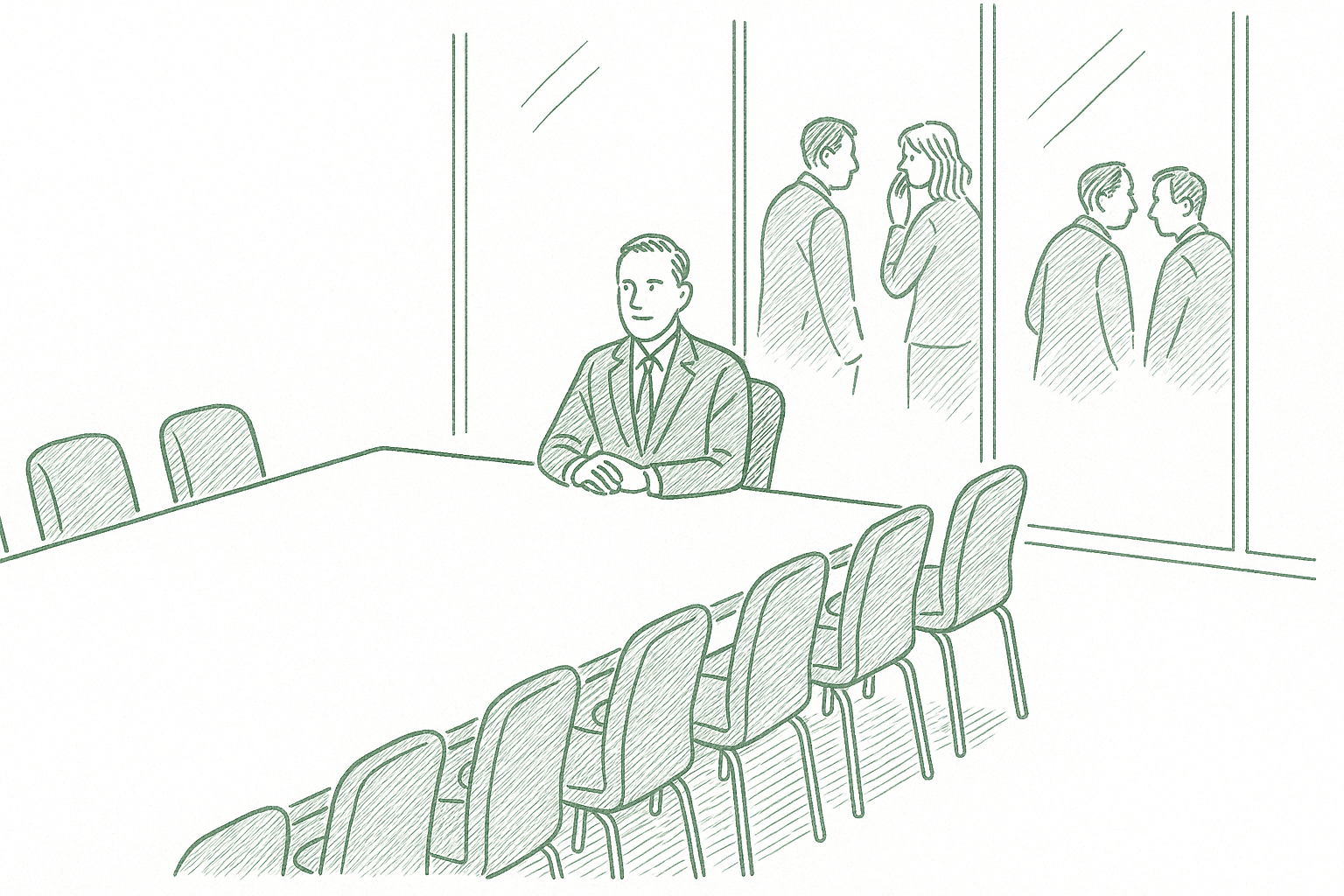
In 1970, psychologists Sidney Rosen and Abraham Tesser ran a series of experiments at the University of Georgia that documented something everyone already suspected but nobody had measured: people systematically avoid delivering bad news. When given the choice between telling someone something unpleasant and staying quiet, subjects overwhelmingly chose silence. Rosen and Tesser called it the MUM effect — keeping mum about undesirable messages. The finding has been replicated dozens of times across cultures and contexts over the past five decades. It is one of the most robust findings in communication research.
The MUM effect operates everywhere. But it concentrates with vicious efficiency in one specific environment: the relationship between a leader and the people who depend on them.
The higher you climb, the less you hear
A 2013 study by the Center for Leadership Development and Research at Stanford Graduate School of Business found that nearly two-thirds of CEOs do not receive outside leadership advice of any kind. Not coaching. Not peer feedback. Not structured input from anyone who does not report to them or invoice them. Despite this, nearly 100 percent of the CEOs surveyed said they enjoy receiving coaching and find it valuable. The gap between wanting honest feedback and actually getting it is not a matter of preference. It is structural.
The structure works like this. As a founder's authority increases, three things happen simultaneously. First, the stakes of delivering bad news go up — telling the boss their strategy is flawed now carries career risk. Second, the social distance between the founder and their reports increases — even founders who insist on flat hierarchies and open-door policies cannot eliminate the psychological weight of being the person who signs paychecks. Third, the founder's own identity becomes increasingly entangled with the company's performance, making critical feedback feel like a personal attack even when it is not intended as one.
The result is what organizational researchers call upward communication filtering. Information gets softened, delayed, or stripped of urgency as it travels up the chain. A serious product flaw becomes a "challenge we are working through." A departing key employee becomes a "transition we have planned for." A failing strategy becomes a "pivot we are exploring." By the time information reaches the founder, it has been laundered of precisely the details that would make it useful.
Harvard Business Review has reported that 55 percent of CEOs experience significant loneliness in their role, and 61 percent believe isolation actively hinders their performance. These are not soft complaints about feelings. These are executives identifying a structural problem that is degrading their decision-making in real time.
Why your team cannot solve this
The instinct most founders have when they hear about the feedback desert is to try to fix it internally. Open-door policies. Anonymous surveys. Skip-level meetings. "Tell me the truth, I can handle it." None of these work at scale, and the reason is embedded in the research.
The MUM effect is not a communication failure. It is a rational response to power dynamics. Your direct report is not withholding information because they lack courage. They are withholding it because they have correctly assessed that delivering unwelcome news to the person who controls their compensation and career trajectory is a risk with asymmetric downside. The potential cost of telling you something you do not want to hear — damaged relationship, perceived disloyalty, career stagnation — vastly outweighs the potential benefit of you having slightly better information.
Telling people to "be honest" does not change this calculus. Even founders who genuinely want candor — who reward it when they get it, who never punish the messenger — cannot fully override the power asymmetry. Research on psychological safety shows that the perception of safety matters more than its reality. If an employee thinks there might be consequences, they filter. And at the executive level, where the stakes are highest, the filtering is most severe.
A study on CEO dismissals found that roughly 23 percent were fired for what researchers called "denialism" — failing to acknowledge negative realities. But denialism is often not a character flaw. It is the predictable outcome of spending years inside a system that has been systematically stripping bad news from the information stream. You cannot deny what you were never told.
The structural fix
If the problem is structural — rooted in power dynamics, career dependency, and rational self-interest — then the fix has to be structural too. You cannot therapize your way out of an information asymmetry. You need a source of feedback that operates outside the power dynamics entirely.
This is the argument for peer accountability at its most fundamental level. Not "it is nice to have people who understand you." Not "founders need emotional support." Those things may be true, but they are not the core argument. The core argument is epistemological: you are making decisions with corrupted data, and the corruption gets worse the more successful you become.
A peer group — founders at roughly the same stage, facing similar problems, with zero career dependency on each other — eliminates the primary drivers of the MUM effect. Nobody in that room reports to you. Nobody invoices you. Nobody needs your approval for a promotion. The asymmetric downside of honesty disappears, and what replaces it is what Grossmann's research on Solomon's Paradox would predict: people who can see your situation with the clarity that you structurally cannot bring to your own problems.
This is not a warm-and-fuzzy benefit. It is a correction for a measurable information deficit. The founder who operates without external peer feedback is not just lonely — they are epistemically compromised. They are making consequential decisions based on information that has been filtered, softened, and delayed by every person between them and the truth.
What the evidence says about the fix
The University of San Diego's Andrew Feghali conducted one of the only academic studies of executive peer advisory groups — organizations like Vistage, YPO, and EO — and found that matching quality and small-group intimacy were the primary predictors of perceived value. Not content. Not programming. Not the credentials of the facilitator. What mattered was whether the people in the room were close enough to your situation to challenge you with specificity, and whether the group was small enough that you could not hide behind polite generalities.
Dirks and Ferrin's meta-analysis on trust and leadership, published in the Journal of Applied Psychology, found that direct interpersonal trust — not institutional trust, not role-based authority — is the strongest predictor of team performance, information sharing, and willingness to engage in reciprocal vulnerability. In a peer group without power dynamics, that trust develops faster and operates more honestly than it ever can inside your own company.
The peer effect research adds another dimension. Sacerdote's studies at Dartmouth showed that proximity to high-performing peers improves individual outcomes across academic, economic, and social measures — even after controlling for selection effects. The mechanism is not inspiration. It is information transfer. Being around people who are solving similar problems at a similar level gives you access to pattern recognition that no amount of internal data can replicate.
The desert does not announce itself
The most dangerous thing about the feedback desert is that it feels normal. You do not notice the absence of bad news. You notice the presence of problems — after they have metastasized past the point where early intervention would have been easy and cheap.
You notice when the VP you thought was performing well suddenly quits and takes three people with them. You notice when the product launch that "everyone was excited about" lands flat because nobody told you the beta testers hated the onboarding flow. You notice when the strategic advice you got from your board turned out to be calibrated for their portfolio, not your company.
Rosen and Tesser documented this fifty-five years ago. The people closest to you will choose your comfort over your clarity every time — not because they are cowards, but because the system incentivizes it. The only way to get unfiltered truth is to find people who operate outside that system entirely.
Five people who do not work for you. Who do not invest in you. Who have nothing to gain from telling you what you want to hear, and everything to offer by telling you what you need to know.
The feedback desert is real, and it gets worse the better you do. The most successful leaders in history have always known the antidote: a small group of peers with no reason to be anything but honest.