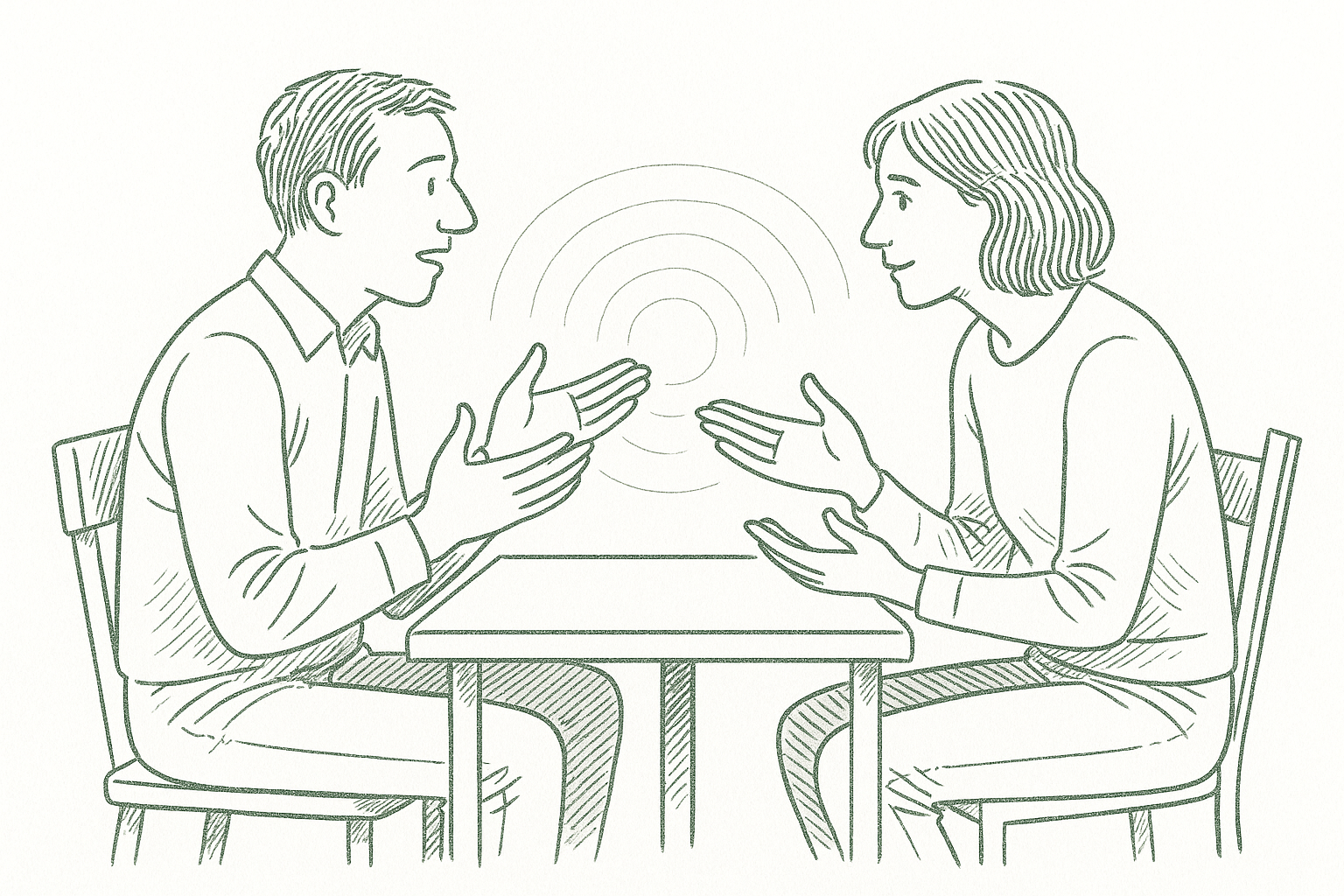
Here is a problem every peer group faces. Five founders sit in a room. One of them just lost a major client. Another is three months behind on payroll commitments. A third is quietly considering shutting down. But none of them says any of this. They talk about strategy. They exchange surface-level observations. They leave the meeting feeling like it was "fine." And then they go home and make decisions alone — which is the entire problem the group was supposed to solve.
Most people assume the fix is courage. "Just be honest." As if honesty in a group of relative strangers is a matter of willpower. It is not. Decades of research in social psychology say something far more interesting: honesty in groups is a reciprocal process. It is triggered, not summoned. And the mechanism behind it — reciprocal self-disclosure — is one of the most consistent findings in the entire field.
The disclosure-reciprocity effect: what 60 studies confirm
In 1988, Kathryn Dindia and Mike Allen published a meta-analysis covering 60 studies on self-disclosure. The finding was unambiguous: self-disclosure is reciprocal. When one person reveals something personal, the other person is significantly more likely to reveal something personal in return. This was not a marginal effect. It held across laboratory experiments, field studies, surveys, and observational research. It held between strangers and between friends. It held in face-to-face conversations and written exchanges.
The technical term is the disclosure-reciprocity effect. The intuitive version is simpler: vulnerability is contagious. When someone in a group says, "I am struggling," the social barrier for everyone else drops. Not because they suddenly became braver. Because the person who spoke first changed the rules of what is acceptable in the room.
Susan Sprecher and Stanislav Treger at Illinois State University drilled deeper. In a 2013 study published in the Journal of Experimental Social Psychology, they found that turn-taking reciprocal disclosure — where people alternate sharing personal information — produced significantly more liking, closeness, and perceived responsiveness than one-sided disclosure or small talk. The effect was immediate. After just 12 minutes of structured reciprocal sharing, participants reported closeness levels that normally take weeks of casual interaction to develop.
This is not about being friends. It is about trust. And trust, it turns out, is not something groups build slowly through years of proximity. It is something groups can engineer through the structure of how they interact.
Arthur Aron's 36 questions and the architecture of fast trust
In 1997, psychologist Arthur Aron at Stony Brook University ran an experiment that would eventually go viral. He paired strangers and gave them a list of 36 questions, arranged in three sets of escalating intimacy. Set one asked things like, "Would you like to be famous?" Set three asked, "When did you last cry in front of another person?"
The questions were not random. They were designed to produce reciprocal self-disclosure at increasing depth. Each question required the person answering to be slightly more vulnerable than the one before. And because both people answered every question, the vulnerability was always mutual. Always reciprocal.
The results were remarkable. After 45 minutes, strangers reported closeness levels comparable to the average closeness of long-term relationships. A 2021 follow-up study confirmed the effect: participants engaging in Aron's "fast friends procedure" felt not only closer but also greater liking, perceived responsiveness, and enjoyment compared to those who engaged in small talk.
Aron was not studying founder isolation or peer groups. But his finding maps directly onto what happens in the best mastermind meetings. The groups that work are not full of naturally open people. They are groups where the structure forces reciprocal escalation. Someone shares a real problem. The facilitator does not let the room deflect. The next person shares theirs. And within a few meetings, the group has built a level of candor that most leadership teams never achieve in years.
Why psychological safety is necessary but not sufficient
Amy Edmondson at Harvard Business School introduced the concept of psychological safety in 1999 after studying 51 work teams in a manufacturing company. Her finding has become one of the most cited in organizational research: teams with high psychological safety — a shared belief that the team is safe for interpersonal risk-taking — showed higher learning behavior and better performance.
Google's Project Aristotle confirmed this at scale. After analyzing 180 teams, Google found that psychological safety was the single strongest predictor of team effectiveness. Stronger than individual talent. Stronger than resources. Stronger than management.
But here is the part that gets overlooked. Psychological safety is a precondition. It tells you the room is safe. It does not tell you whether anyone will actually use the safety. You can build a psychologically safe environment and still have a group where nobody shares anything meaningful — because safety alone does not trigger disclosure. What triggers disclosure is seeing someone else go first.
This is the gap that reciprocal vulnerability fills. Psychological safety is the container. Reciprocal self-disclosure is the mechanism that fills it. One without the other produces either sterile politeness (safety without vulnerability) or emotional wreckage (vulnerability without safety). The research says you need both. In sequence. Safety first. Then someone goes first.
The negativity advantage: why sharing problems builds more trust than sharing wins
A 2024 study published in Frontiers in Psychology examined what happens when people self-disclose negative experiences specifically. The finding challenged the conventional wisdom that positive interactions build stronger bonds. Disclosing negative experiences — failures, fears, struggles — produced greater empathy, greater liking, and greater prosocial behavior than disclosing positive experiences. The researchers found that the effect was mediated by what they called "perceived warmth." Sharing something that makes you look bad makes you seem more human. And humans trust humans more than they trust curated versions of competence.
Reese and Orrach found something complementary in a 2023 study published in Personal Relationships. When one person discloses something difficult and the listener responds by sharing a comparable experience, the original discloser feels validated, understood, and cared for — even though the listener technically "stole the spotlight." The act of reciprocating vulnerability signals: "I understand because I have been there."
This is why hot seat formats are so effective. The person in the hot seat presents a real problem. The group does not respond with advice from a position of theoretical superiority. The best groups respond with their own experience — their own failures, their own misjudgments, their own uncertainties. The hot seat is not a one-way confession booth. It is a reciprocal vulnerability engine.
And when the problems are real — cash flow crises, co-founder conflicts, product failures — the trust accelerates faster than it does in any corporate team-building exercise. Because the stakes are real. And reciprocal vulnerability under real stakes produces the deepest trust the research can measure.
Why most groups never get there
If reciprocal vulnerability is so powerful, why do most groups stay on the surface? The answer has three parts.
First, group size. Research by La Macchia and colleagues at the University of Queensland found a reliable "small equals trustworthy" heuristic: people perceive smaller groups as more benevolent, more moral, and more trustworthy. In groups larger than 12, the perceived social cost of vulnerability rises sharply. You are no longer sharing with people — you are performing for an audience. Dunbar's research on social network layers supports this: deep trust requires groups small enough that every member is a known entity, not a statistical sample.
Second, lack of structure. The disclosure-reciprocity effect requires someone to go first. In unstructured groups, everyone waits for someone else. The result is an awkward equilibrium where everyone shares at the level of the least vulnerable person in the room. Structured formats — hot seats, round-robins, the classic mastermind meeting format — break this equilibrium by designating who goes first and what depth is expected.
Third, wrong matching. Vulnerability requires perceived similarity. The research is clear that people disclose more to others they perceive as facing similar challenges. A group of founders at wildly different stages, in unrelated industries, with incompatible problems, will struggle to achieve reciprocal disclosure — not because the members are guarded, but because they do not see their own experience reflected back. This is why problem-matched groups outperform random assemblies. When everyone in the room is dealing with a version of the same struggle, the first act of vulnerability is easier — because everyone already suspects they are not alone.
The BRAVING framework and what it tells us about group trust
Brene Brown's research at the University of Houston distilled the components of trust into an acronym: BRAVING — boundaries, reliability, accountability, vault, integrity, non-judgment, and generosity. What is notable about this framework is not the individual components. It is that every single element describes a reciprocal behavior. You cannot build trust by being reliable if the other person is unreliable. You cannot maintain a vault — keeping shared confidences confidential — unilaterally. Trust, by Brown's own research, is inherently a mutual construction.
The "vault" element is particularly relevant for peer groups. When a founder shares that they are considering bankruptcy, or that they fired their co-founder, or that they are afraid their product is not working, the value of that disclosure depends entirely on whether it stays in the room. One breach — one instance of shared information leaving the group — and the reciprocal vulnerability loop collapses. The trust research is unequivocal on this point: trust builds through small, repeated acts of mutual risk, and it can be destroyed by a single violation.
This is why confidentiality norms in peer groups are not bureaucratic formalities. They are the load-bearing walls of the entire structure. Remove them and the building falls — not because people are fragile, but because the reciprocity mechanism depends on knowing that going first will not be punished.
The compound effect: how vulnerability builds over time
Chen, Zhang, and colleagues published a study in the International Journal of Psychology in 2024 examining how different patterns of reciprocal disclosure affect trust over multiple interactions. Their finding is the most important piece of the puzzle for peer groups that meet regularly. Trust and liking did not plateau after the first interaction. They increased across interactions — but only when the disclosure pattern was turn-taking reciprocal. Groups where disclosure was one-sided, or where reciprocity was delayed rather than immediate, did not see the same compounding effect.
For a peer group meeting weekly or biweekly, this means the first few sessions are not just introductory — they are foundational. Each meeting where reciprocal vulnerability occurs adds a layer of trust that makes the next meeting's vulnerability easier, deeper, and more productive. The research describes this as a "positive feedback loop." Vulnerability produces trust. Trust lowers the barrier to vulnerability. More vulnerability deepens trust further. It compounds.
But the reverse is also true. A meeting where no one shares anything real — where the group stays at the surface — is not just a wasted session. It is a signal to every member that the group is not safe for depth. And that signal compounds in the other direction, toward increasingly superficial interactions until the group dissolves or becomes a networking event that nobody admits they dread.
What this means for how groups should be designed
The research on reciprocal vulnerability points to a specific set of design principles for peer groups that want to produce real honesty rather than polite conversation.
Keep the group small. Five to twelve people. Any larger and the social cost of vulnerability exceeds the social benefit.
Match by problem, not by title. People disclose more when they see their own struggles reflected in the group. A room full of founders all dealing with first-time management challenges will produce faster trust than a room full of founders whose only commonality is revenue range.
Use structured formats. Hot seats. Round-robins. Anything that assigns the role of "person who goes first" rather than leaving it to chance. The disclosure-reciprocity effect requires a trigger. Structure provides one.
Make confidentiality non-negotiable. The vault has to be real. Not a slide in an onboarding deck. An enforced norm with consequences. Because one breach collapses the entire trust architecture.
And most importantly, expect the compound. The first meeting will feel awkward. The second will feel slightly less so. By the fourth or fifth, something will shift. Someone will say the thing they have been holding back. And then someone else will. And then the group will become the thing every founder says they want but very few actually have: a room where you can tell the truth about what is happening and get help that actually applies.
The research says this is not idealistic. It is predictable. Reciprocal vulnerability is not a personality trait. It is a group dynamic. And like all dynamics, it can be engineered.