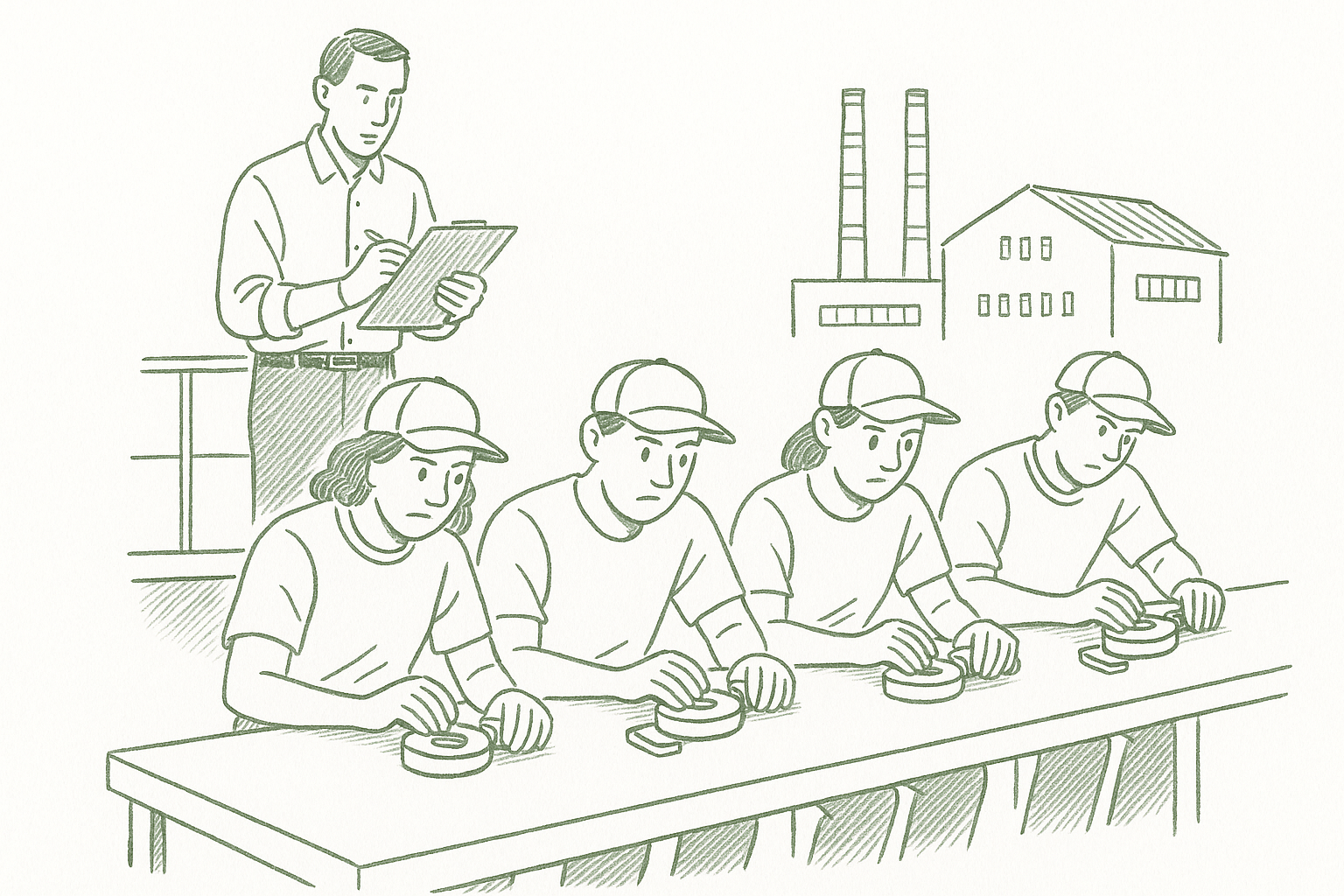
The Western Electric Company had a problem. Their Hawthorne Works factory in Cicero, Illinois employed over 40,000 workers assembling telephone equipment, and management wanted to know whether better lighting would make them faster. So in 1924, they hired researchers from the National Research Council to run a straightforward experiment. Change the lighting. Measure the output. Simple enough.
They brightened the lights in one section of the factory. Productivity went up. They brightened them more. Productivity went up again. Then they dimmed the lights back down. Productivity went up. They dimmed them further, almost to moonlight. Productivity still went up. The lighting had nothing to do with it.
What changed was not the environment. What changed was the attention. The workers knew they were being watched, measured, and studied — and that awareness alone was enough to alter their behavior. Fritz Roethlisberger, one of the Harvard researchers who joined the study in its later phases, would describe this as "the Hawthorne effect": the phenomenon in which people change their performance in response to being observed.
The finding has been debated, replicated, critiqued, and reinterpreted for a century. But the core insight has survived every challenge. When someone is watching — genuinely watching, with attention and interest — you perform differently. Not because you are trying to impress them. Because their observation rewires the calculus of your own effort.
What the original experiments actually showed
The Hawthorne experiments ran in various phases from 1924 to 1932, making them one of the longest workplace studies ever conducted. After the lighting experiments produced their confounding results, the researchers moved to the Relay Assembly Test Room, where five women were separated from the main factory floor and subjected to a series of changes — rest breaks, shorter hours, free lunches, changes to the payment system — while their output was meticulously recorded.
Almost every change produced an increase in productivity. But so did reversing those changes. When rest breaks were removed, output still climbed. When hours were extended back to their original length, the women produced more than they had at baseline. The researchers were forced to confront an uncomfortable conclusion: it was not the experimental variables producing the results. It was the experiment itself.
The women in the test room knew they were special. They had been selected, separated, observed, and asked for their opinions. Researchers talked to them regularly about their work. Their output was tracked and discussed. They had become, in a word, visible. And visibility changed everything.
Elton Mayo, the Harvard professor who led the later phases of the research, would go on to help found the human relations movement in management — the idea that social and psychological factors shape performance at least as much as economic incentives or physical conditions. Jeffrey Sonnenfeld, writing in the Journal of Occupational Behavior, noted that the Hawthorne experiments "brought to light ideas concerning motivational influences, job satisfaction, resistance to change, group norms, worker participation, and effective leadership." These were groundbreaking concepts in the 1930s. They remain underused in the 2020s.
The modern evidence is more nuanced — and more useful
The original Hawthorne studies have drawn decades of methodological criticism. Researchers have reanalyzed the original data and found confounding variables — changes in payment structures, seasonal patterns, the dismissal of two underperforming workers from the test room. A 2014 systematic review published in the Journal of Clinical Epidemiology by McCambridge, Witton, and Elbourne concluded bluntly: "There is no single Hawthorne effect."
But the review also found something more interesting than a clean dismissal. Across 19 studies meeting their inclusion criteria, the researchers determined that "research participation can and does influence behavior, at least in some circumstances." The effect is real. It is just not simple. It varies by context, by the nature of the observation, by the relationship between the observer and the observed, and by how long the observation lasts.
This is the version of the Hawthorne effect that matters for founders. Not the cartoon version — turn the lights up and everyone works harder. The real version. Under specific conditions, being observed by people who matter to you changes your behavior in ways that willpower and self-discipline cannot.
Modern research puts numbers to it. Studies cited in workplace productivity literature suggest that awareness of being observed can increase output by 7 to 16 percent. A 2013 field experiment by Duflo, Hanna, and Ryan, published in the American Economic Review, found that when teachers in India were monitored with cameras, absenteeism dropped by 21 percentage points. The monitoring was not punitive. It was simply observable. And observability alone changed the behavior.
Why surveillance is not the same thing as observation
Here is where most people draw the wrong conclusion from the Hawthorne research. They hear "being watched improves performance" and reach for monitoring software, time trackers, and employee surveillance tools. That is not what the research supports.
The later phases of the Hawthorne studies themselves proved this. In the Bank Wiring Observation Room, researchers observed a group of fourteen men wiring telephone switchboards. Unlike the Relay Assembly women, the men had not been consulted or made to feel special. They were simply watched. The result was the opposite of what the earlier experiments had found: the men formed informal social groups that enforced output norms below the official targets. Workers who produced too much were called "rate busters" and pressured to slow down. Workers who produced too little were called "chiselers." The group established its own invisible performance ceiling and punished anyone who deviated.
The difference between the two groups was not the observation. It was the nature of the observation. The Relay Assembly women experienced observation as attention, interest, and respect. The Bank Wiring men experienced it as surveillance. The first group accelerated. The second group self-limited.
This distinction shows up consistently in modern research. A 2023 meta-analysis of workplace monitoring found that while transparent, supportive observation improved performance and engagement, intrusive surveillance increased stress, eroded trust, and produced what researchers called "performance theater" — the appearance of productivity without the substance. Employees under heavy surveillance learned to manage appearances rather than manage outcomes. They looked busy. They were not necessarily more productive.
The founder's version of the Hawthorne effect
Founders do not have supervisors. They do not have performance reviews. Nobody is measuring their weekly output or asking whether they hit their targets. That is the appeal of entrepreneurship — and it is also the structural flaw.
The research on founder isolation is unambiguous. A 2019 study from the MIT Entrepreneurship Center documented that entrepreneurial isolation is not merely an emotional problem but a structural one — it impairs decision quality, increases cognitive load, and creates conditions for avoidable strategic errors. Without external observation, founders default to their own assessment of their own performance. They set their own standards, evaluate their own progress, and declare their own deadlines met or extended. The feedback loop is entirely internal.
This is the exact condition the Hawthorne research identified as the worst possible scenario for performance. When nobody is observing — when there is no external reference point, no one asking "how did it go?" — people do not default to their best work. They default to their most comfortable work. Not their laziest. Their most comfortable. The hard conversation gets postponed. The hiring decision gets delayed another week. The pivot that the data supports gets avoided because the founder has spent six months on the current direction and does not want to admit the sunk cost.
The accountability gap is not a motivation problem. It is an observation problem. Nobody is watching.
Why peer groups produce the right kind of observation
A well-structured peer group re-creates the conditions that produced the positive Hawthorne effect — and avoids the conditions that produced the negative one.
Consider what the Relay Assembly women had. They were observed by people who were genuinely interested in their experience. They were consulted about changes. They were treated as participants, not subjects. The observation was supportive, not evaluative. It was ongoing, not sporadic. And it occurred within a small, cohesive group where relationships had time to develop.
That is also an exact description of what happens in a functioning mastermind group. Five or six founders, meeting on a recurring schedule, each one reporting on what they said they would do and what actually happened. The observation is not punitive. Nobody is grading anyone. But it is real. When you tell five people you are going to have the conversation with your underperforming sales lead by next Tuesday, and you know that next Tuesday those same five people will ask you how it went — you have the conversation.
The Köhler effect amplifies this further. Otto Köhler's 1920s research showed that people work harder in small groups than alone, particularly when they perceive their effort as indispensable to the group's outcome. In a peer group, your update matters. Your follow-through matters. Your presence matters. The observation is not abstract — it is personal. And personal observation, the research consistently shows, produces the most durable behavioral change.
This is also why accountability apps fail. An app can remind you. It can track your streak. What it cannot do is observe you — not in the Hawthorne sense. It cannot sit across from you, notice that you are hedging, and ask the follow-up question that makes you tell the truth. The Hawthorne effect is not about being monitored. It is about being seen by people whose attention you value.
The durability question
The strongest critique of the Hawthorne effect is that it wears off. People habituate. The novelty of being observed fades, and behavior returns to baseline. This is a legitimate concern in experimental settings — a one-time study cannot sustain behavioral change indefinitely.
But a peer group is not a one-time study. It is a recurring structure. Every two weeks, the observation resets. The accountability cycle begins again. You commit to something new, the group takes note, and the clock starts. The habituation problem disappears when the observation is woven into a permanent rhythm rather than imposed as a temporary condition.
There is a deeper point here, one the original Hawthorne researchers themselves noted. The Relay Assembly women did not just perform better because they were being watched in any given moment. They performed better because they had been placed in a context where their work was meaningful to other people. The observation gave their effort social weight. Each relay assembly was not just an act of labor — it was visible, tracked, and discussed by a group that cared about the outcome.
That is what social facilitation looks like in practice. Not coercion. Not surveillance. Meaning. You work differently when your work is visible to people you respect. Not because you fear their judgment, but because their attention makes the work matter more — even to you.
The structural lesson
The Hawthorne experiments were supposed to be about light bulbs. They became the founding document of organizational psychology. A century of subsequent research has complicated the story, but the core finding remains: human performance is not a fixed output determined by ability and incentive. It is shaped by social context. And the most powerful social context is a small group of people who are paying attention.
Founders operate in a world that has stripped away almost every natural source of observation. No boss. No quarterly reviews. No team standup where you have to report what you shipped this week. The freedom is real. But so is the cost. For three centuries, the people who figured this out have organized themselves into small groups — not because they lacked discipline, but because they understood that discipline is a social phenomenon. It is easier to maintain when someone else is in the room.
The Hawthorne researchers stumbled onto this by accident. They were testing light bulbs and discovered human nature instead. The finding is simple, and it has not changed: you perform better when someone is watching. The only question is who.