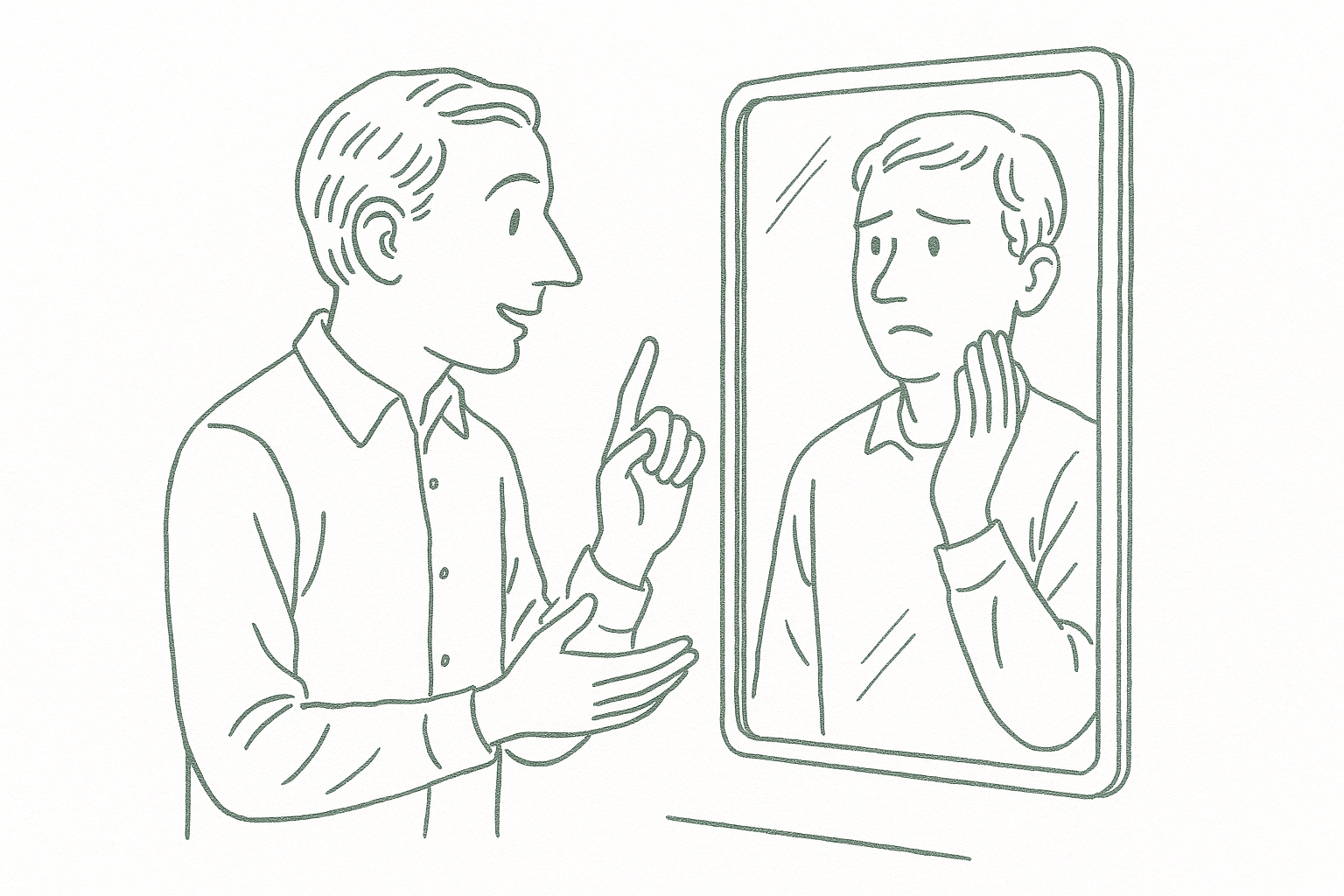
King Solomon, according to the Hebrew Bible, could resolve anyone's dispute with preternatural clarity. He arbitrated conflicts between strangers, saw through deceptions, and delivered judgments that became synonymous with wisdom itself. Then he made a sequence of personal decisions so catastrophic — political marriages to consolidate alliances, tolerance of idol worship, fiscal policies that bankrupted the kingdom — that the nation split in two after his death.
Wise for everyone else. Disastrous for himself. Psychologists Igor Grossmann and Ethan Kross read that story and recognized something universal.
The research that named what founders already feel
In 2014, Grossmann and Kross published a study in Psychological Science that gave the phenomenon a name: Solomon's Paradox. Their experimental design was straightforward. They asked participants to reason through a relationship conflict — either one involving a friend or an identical one involving themselves. The participants who reasoned about a friend's problem displayed markedly higher levels of wise reasoning: they considered multiple perspectives, acknowledged the limits of their knowledge, recognized that circumstances could change, and explored compromise.
When the same participants faced the same problem framed as their own, those capacities vanished. They became more rigid, more certain, more narrowly focused on their own perspective. Not because they lacked wisdom. Because their proximity to the problem made it inaccessible.
The study found this held true across age groups — older adults were just as susceptible as younger ones. Experience does not fix it. Seniority does not fix it. The number of years you have spent running a company does not fix it. The asymmetry is structural, not developmental.
Why your own problems are the hardest to see
Grossmann's research identifies two mechanisms driving the paradox. The first is emotional immersion. When a problem is yours — when your company's runway is the thing at stake, when your cofounder relationship is the one fraying, when your product-market fit is the thing in question — the emotional weight of the situation collapses your cognitive field. You stop seeing possibilities and start seeing threats. You lose access to the same flexible, multi-perspective reasoning you deploy effortlessly for other people.
The second mechanism is what researchers call self-immersion versus self-distancing. When reasoning about someone else's problem, you naturally adopt an observer's perspective. You see the whole board. When reasoning about your own, you are embedded inside it — seeing from your position, with your history, your ego, your fear of what the outcome means for your identity. You have built the thing, and the building of it makes you constitutionally unable to evaluate it clearly.
This is not about intelligence. The Grossmann and Kross data showed that cognitively sophisticated participants were no less vulnerable to Solomon's Paradox. Being smart does not create distance from your own problems. If anything, being smart makes you better at constructing elaborate justifications for the decision you were going to make anyway. The blind-spot bias research confirms this: the more analytically capable a person is, the better they are at identifying bias in others — and the worse they are at identifying it in themselves.
The fix Grossmann found — and why founders cannot do it alone
The same 2014 study demonstrated something equally important: the paradox can be eliminated. When participants were instructed to adopt a third-person perspective on their own problem — to reason about it as if they were advising a friend — the self-other asymmetry in wise reasoning disappeared. They became just as wise about their own situations as they had been about other people's.
Grossmann called this technique self-distancing. It involves using third-person language ("What would you tell someone in this situation?"), adopting an observer's viewpoint, or mentally stepping outside the emotional stakes of the decision. The effect was consistent and replicable.
The problem is that self-distancing in isolation is almost impossible to sustain. You can try to think about your problem as if it belonged to someone else. You can journal in the third person. You can stare at a whiteboard and attempt objectivity. But the emotional immersion pulls you back. The stakes reassert themselves. Within minutes, you are back inside the problem, reasoning from your position rather than about it.
This is the structural argument for peer groups — not accountability, not networking, not mentorship, but externalized perspective. When you describe your problem to five people who have no emotional stake in your outcome but deep familiarity with your context, you are not asking for advice. You are engineering the exact cognitive conditions that Grossmann's research proved eliminate Solomon's Paradox. The group is the self-distancing mechanism.
The reason peer groups solve what self-reflection cannot
Think about the last time a founder friend described a problem to you. You probably saw the answer — or at least the right question — within minutes. Not because you are smarter than them. Because you were not inside it. You had cognitive access to the same reasoning capacities they use for everyone else's problems but cannot use for their own.
Now consider what your friend saw when you described your problem to them. The same clarity you had about theirs, pointed at yours.
A structured peer group turns that exchange from an occasional accident into a recurring system. Every meeting, every hot seat, every round of structured feedback — it is Solomon's Paradox being solved in real time. You bring the problem you cannot see clearly. The group sees it clearly because they are not you. They bring their problems. You see theirs clearly because you are not them. Everyone gets wiser — not by becoming wiser individually, but by accessing collective distance.
Grossmann's research did not prove that wisdom is rare. It proved that wisdom is contextual. You already have it. You deploy it expertly for other people every day. The only thing missing is a structure that lets other people deploy theirs for you.
Solomon had seven hundred wives and three hundred concubines and unlimited access to whatever counsel he wanted. What he did not have was a small group of peers who could look at his situation without his emotional investment and say: this is what you cannot see.
The groups that have changed history did not succeed because they were full of geniuses. They succeeded because they created the structural conditions for people to reason wisely about each other's problems — something that, as Grossmann proved, we are all capable of doing for everyone except ourselves.