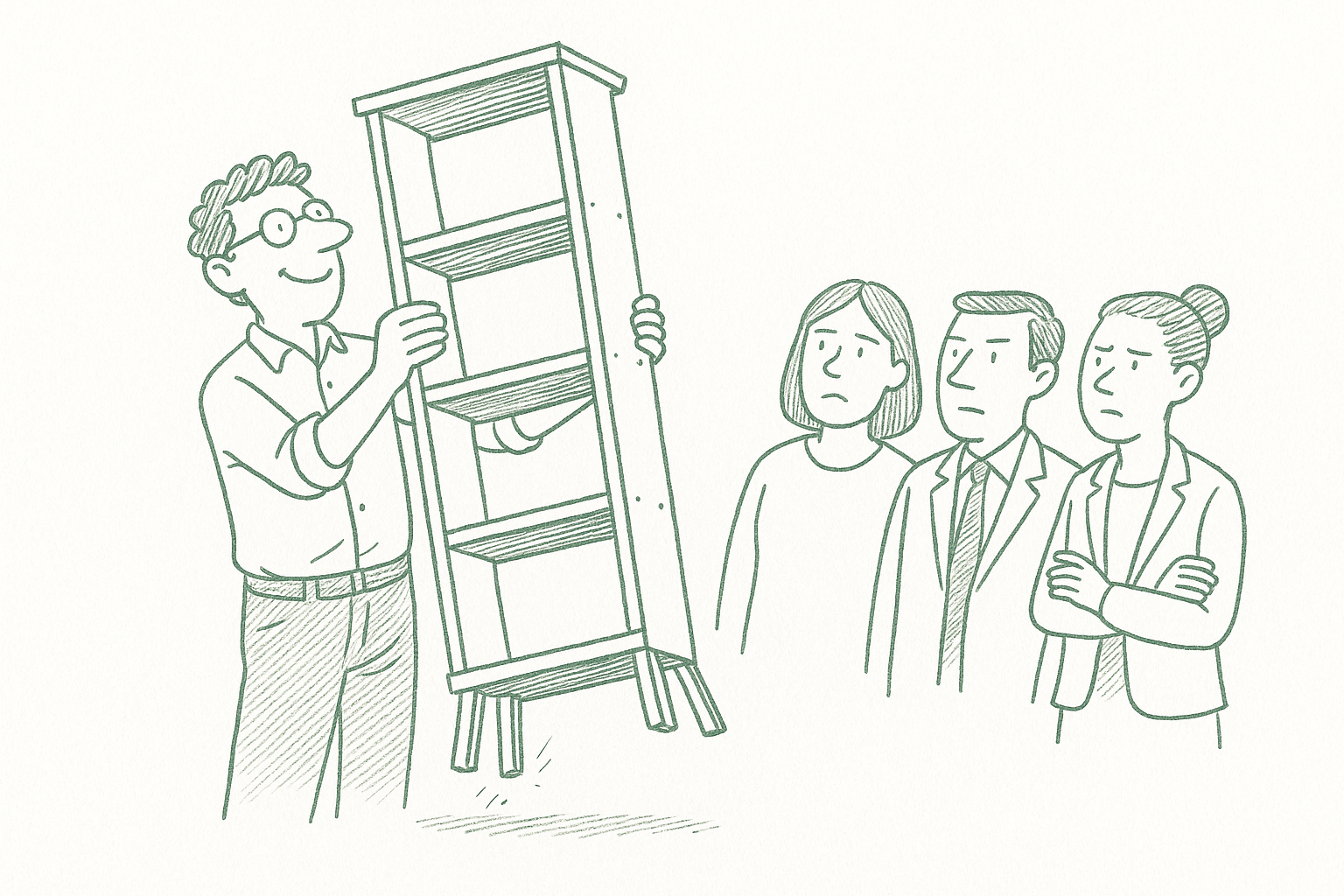
In 2011, researchers Michael Norton, Daniel Mochon, and Dan Ariely ran a series of experiments at Harvard Business School. They asked participants to assemble IKEA storage boxes, fold origami, and build Lego sets. Then they asked them how much their creations were worth.
The builders consistently valued their own creations 63% higher than identical items assembled by someone else. The origami folders thought their crumpled paper cranes were worth nearly as much as expert origami. The IKEA assemblers thought their wobbly boxes were worth more than factory-built versions.
Norton and his colleagues named it the IKEA effect: a cognitive bias in which labor leads to love. The more effort you put into building something, the more valuable you believe it is. Not because it became more valuable. Because you built it.
This finding is cute when you are talking about bookshelves. It is devastating when you are talking about businesses.
You are not objective about the thing you built
Every founder believes their product is better than it is. This is not a moral failing. It is a structural one. You cannot spend 14 hours a day building something and then evaluate it the way a stranger would. The hours themselves alter the valuation. The sweat equity becomes actual equity in your mind, inflating worth in direct proportion to effort invested.
The Norton-Mochon-Ariely research found something else that matters even more: the bias is invisible to the person experiencing it. Builders did not think they were being generous in their valuations. They genuinely believed their creations were worth what they said. This is the same mechanism behind confirmation bias — the brain filters for evidence that validates what you have already built, and discounts the rest. The origami folders were not lying about the value of their crumpled cranes. They actually could not see the crumpling.
This is the part that should terrify founders. Making decisions alone is already dangerous. Making decisions alone about the thing you personally built, using a brain that is structurally incapable of evaluating it objectively, is how companies spend two years building features nobody wants.
The endowment effect's dangerous cousin
The IKEA effect is related to, but distinct from, the endowment effect — the well-documented tendency to value things more simply because you own them. Richard Thaler's Nobel Prize-winning research showed that people demand roughly twice as much to give up an object as they would pay to acquire it. Ownership alone distorts valuation.
But the IKEA effect adds a multiplier. You do not just own the business. You built it. You chose the name. You wrote the first line of code. You stayed up until 3 AM debugging something nobody else cared about. Every one of those hours is a deposit into an emotional bank account that pays compound interest in the form of inflated confidence.
Research on the endowment effect in entrepreneurs, published on ResearchGate, found that founders exhibit significantly stronger ownership bias than non-founders. The deeper the personal investment — time, money, identity — the wider the gap between perceived value and actual market value. This is why founders consistently overvalue their companies in M&A negotiations, why they hold on to failing products longer than they should, and why they resist pivoting even when the data screams at them to move.
The sunk cost fallacy makes it worse. Every month you have already invested becomes a reason to invest another one. Not because the next month will produce results, but because abandoning the project means admitting that the previous months were wasted. Forbes reported that this single bias — continuing to invest because of past investment rather than future potential — is one of the most common causes of startup failure.
Why your team cannot fix this
A reasonable objection: "I have a team. They give me feedback. I am not making decisions alone."
Except your team is not objective either. They suffer from a related version of the same bias. They helped build the thing. Their names are on the commits, the designs, the campaigns. They have their own IKEA effect operating on the same product, and their version is compounded by a power dynamic that makes disagreeing with you — the founder, the person who signs their checks — structurally uncomfortable.
Google's Project Aristotle, their landmark study of team effectiveness, found that psychological safety was the single most important factor in whether teams performed well. And the researchers were explicit about what kills psychological safety: hierarchical pressure. The more authority the leader has, the less likely team members are to challenge their assumptions. Your employees may see the crooked bookshelf. They are not going to tell you about it.
This is not a failure of your team's character. It is a failure of the structure. Even in the most open, feedback-friendly culture, the power imbalance between a founder and their employees creates a gravitational pull toward agreement. McKinsey's research on product launch effectiveness found that the root cause of most launch failures is insufficient customer understanding — with teams frequently relying on internal assumptions about what customers want rather than direct evidence. The IKEA effect is one of the primary mechanisms driving those assumptions.
The debiasing problem
If you could simply decide to be less biased, cognitive biases would not exist. The whole point of a bias is that it operates below conscious awareness. You cannot think your way out of the IKEA effect any more than you can will yourself to stop seeing optical illusions.
Research from the National Bureau of Economic Research on peer effects in entrepreneurship found that the composition of a founder's peer group affects firm outcomes independent of the founder's individual capabilities. The mechanism is simple: exposure to people who are solving similar problems but who have no emotional investment in your specific solution forces a kind of evaluation that internal reflection cannot produce.
The peer effect literature is clear on this point. Debiasing is not an individual activity. It requires external input from people who meet two criteria: they understand your context well enough to evaluate your decisions meaningfully, and they have zero investment in telling you what you want to hear.
Your spouse fails the second criterion. Your employees fail both. Your investors fail the first — they understand finance, not your specific operational reality. Your mentor fails the timeliness criterion — their experience is from a different era, a different market, a different set of constraints.
The people who meet both criteria are peers. Founders at your stage, in your kind of business, wrestling with their own versions of the same problems. They are not invested in your bookshelf. They are building their own. And because they are, they can look at yours and see the wobble that you cannot.
What peer exposure actually does to the IKEA effect
A study published in the Journal of Consumer Research found that the IKEA effect diminishes significantly when creators are exposed to objective comparison points. When builders saw what an expert-built version looked like, their inflated valuations dropped. Not to zero — the bias is sticky — but meaningfully. The mere presence of a reference point was enough to recalibrate.
This is exactly what a structured peer group provides. When you describe your pricing strategy to four other founders, and two of them explain how they solved the same problem differently, you are being given reference points. Not advice. Not criticism. Just data from people who are close enough to your reality that their experience is relevant.
Cornell University research found that the timing of peer evaluation matters enormously. When peer feedback comes after an external reference point — a market result, a customer response, a failed launch — the debiasing effect is strongest. The combination of real-world evidence and peer perspective creates a correction that neither can achieve alone.
Accountability amplifies this. When you tell a group you are going to test a new pricing model, and they ask you about it two weeks later, you cannot hide behind the IKEA effect. You have to report results. And results, unlike feelings, are not subject to labor-induced inflation. The number is what the number is. The group's job is to help you see it clearly.
The five-person mirror
Dunbar's research tells us meaningful relationships require small numbers. The research on optimal group size converges on five to six people. The Köhler effect tells us people work harder in small groups where effort is visible. Put these findings together and you get the design specification for an IKEA effect antidote: a small group of people who understand your work, have no reason to flatter you, and will hold you to what the data says rather than what you feel.
The most productive groups throughout history served exactly this function. Ben Franklin's Junto met every Friday to challenge each other's ideas. The Vienna Circle held members to standards of evidence that personal conviction could not override. The Bauhaus forced artists to submit their work to peer critique that stripped away ego and focused on function. These groups did not succeed because they were supportive. They succeeded because they made self-delusion harder to sustain.
The people closest to you give the worst business advice not because they are unintelligent but because they are compromised — emotionally, contextually, or both. The IKEA effect explains why you cannot fix this problem internally. Your brain is the instrument doing the evaluating, and it is the same instrument that built the thing being evaluated. You need an external instrument. You need people who did not build your bookshelf, who build their own bookshelves, and who can tell the difference between one that stands and one that wobbles.
Stop admiring your own origami
The IKEA effect is not going away. It is baked into how human cognition works. You will always overvalue what you build. You will always be the last person in the room to see the flaws in your own product, your own strategy, your own pricing.
The question is not whether you have this bias. You do. The question is whether you have a structure that corrects for it. A well-designed peer group is that structure. Not because the members are smarter than you. Because they are not you. They did not build your thing. They can see it with fresh eyes. And if the group is structured correctly — regular meetings, honest feedback, mutual accountability — they will tell you what they see.
Your origami crane might be beautiful. But you would not know if it wasn't. That is the whole problem.