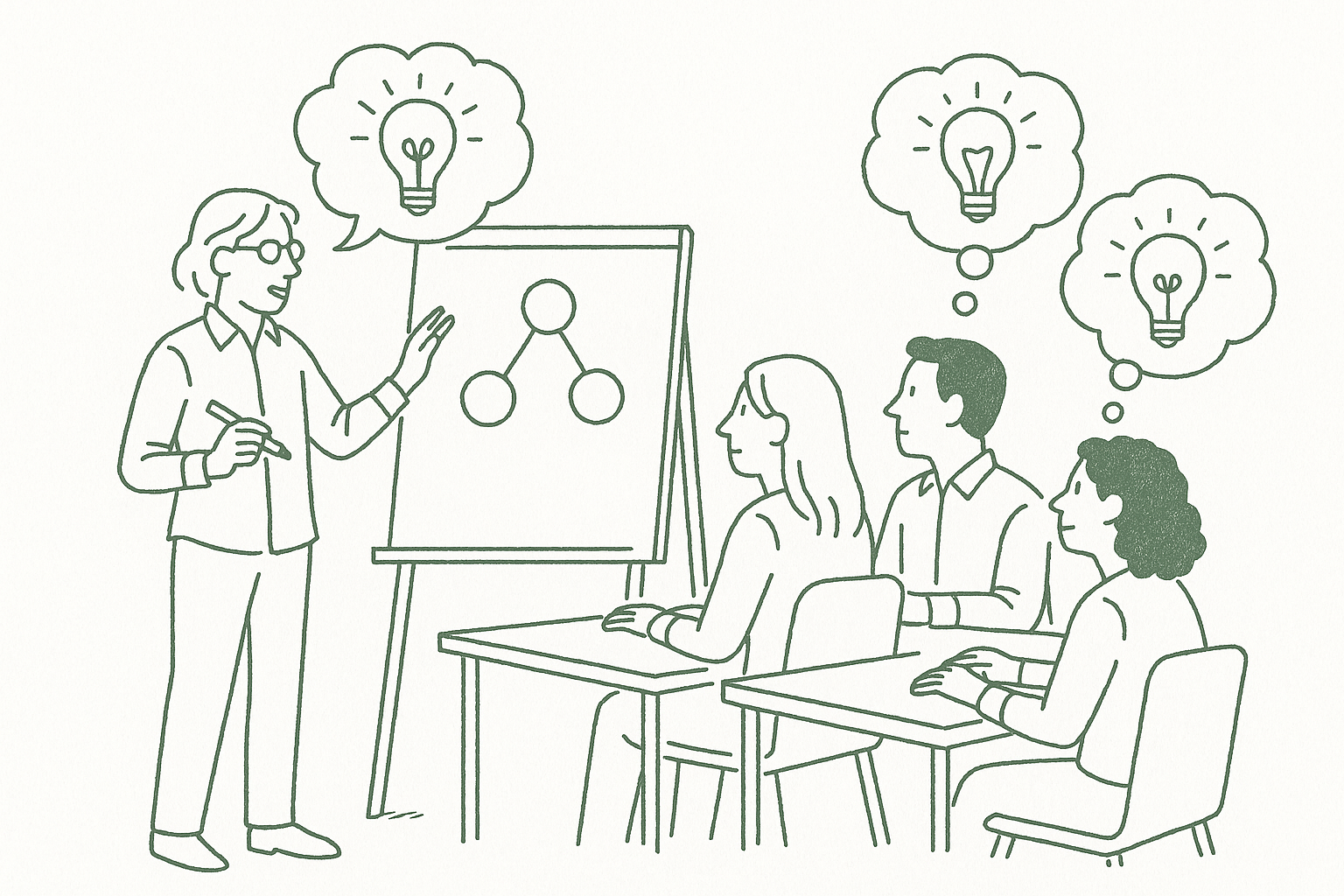
The protégé effect is a psychological phenomenon in which people who teach others learn more deeply than those who study alone. A 2014 study in Memory & Cognition found that students expecting to teach recalled significantly more information and organized it more effectively than those expecting a test. In peer groups, this means the person giving advice often benefits as much as the person receiving it — because structuring your thinking for someone else forces you to confront your own assumptions.
There is a persistent myth in how founders think about peer groups. The myth goes like this: some people in the group are the "strong" ones who give advice, and some are the "weak" ones who receive it. The experienced founders help the less experienced founders. Knowledge flows in one direction, like a lecture.
This is exactly wrong. And decades of research explain why.
The finding that flips the model
In 2014, researchers John Nestojko, Dung Bui, Nate Kornell, and Robert Bjork ran an experiment at Washington University in St. Louis. They gave two groups of college students the same reading material. One group was told they'd be tested on it. The other was told they'd have to teach it to someone else.
Neither group actually taught. The only difference was what they expected to do with the information.
The results were striking. The group expecting to teach recalled more material, organized it more coherently, and scored higher on questions about the key concepts. Not marginally higher. Meaningfully higher. The mere anticipation of having to explain something to another person changed how deeply they processed the information.
The researchers concluded that expecting to teach activates what psychologists call a "generative" learning process. Instead of passively absorbing information, the brain begins selecting what matters, organizing it into a structure, identifying gaps, and building explanations. The learner becomes an active architect of understanding rather than a passive recipient.
This is the protégé effect: the person doing the teaching learns more than the person being taught.
Why explaining someone else's problem clarifies your own
Logan Fiorella and Richard Mayer, in their research on generative learning strategies, identified teaching as one of the eight most effective ways to learn. Their work showed something specific about why it works: teaching forces you to translate abstract knowledge into concrete explanation. You can't hand-wave. You can't rely on the vague sense that you "get it." You have to actually construct a coherent argument.
For founders, this has a direct parallel. When you sit in a room with other founders and someone brings a pricing problem, you don't just listen. You start thinking about pricing in your own business. You start stress-testing your own logic. You notice the places where your reasoning relies on assumptions you haven't examined.
That's not a happy accident. It's the protégé effect in action.
Daniel Kahneman's work on cognitive bias in Thinking, Fast and Slow helps explain why this matters so much for founders specifically. Kahneman showed that humans are remarkably bad at evaluating their own reasoning. We're prisoners of our own framing. We anchor to the first number we hear. We overweight evidence that confirms what we already believe. And we do all of this without noticing.
But when you're forced to evaluate someone else's reasoning — when you have to ask the hard questions about their assumptions, their data, their logic — you activate a different mode of thinking. You become the skeptic you can't be for yourself. And then something happens: you walk back to your own problems with that skeptical lens still engaged.
The peer group as a teaching laboratory
Most people think of peer groups as places to get advice. You bring your problem, the group helps you solve it. And that does happen. But the research on the protégé effect suggests that the more valuable transaction might be the reverse.
Every time you help another founder think through a challenge — a SaaS founder struggling with churn, a real estate agent rethinking their lead generation, a consultant pricing a new service — you're forced to organize your own thinking about that domain. You're selecting principles, building frameworks, identifying what matters and what doesn't. You're teaching.
And the protégé effect says that process of teaching makes you better at it than any amount of private thinking would.
A Harvard Business Review analysis of peer advisory groups found that executives who regularly participated in peer groups reported not just better decisions, but better thinking — a qualitative shift in how they approached problems. The Stanford Graduate School of Business has documented that nearly 75% of CEOs receive no outside leadership advice at all. The ones who do — through structured peer advisory — consistently report that the act of advising others is what sharpens their own judgment.
Why the "giver" in the room gets the most
There is an instinct among high-performing founders to resist peer groups because they feel they'll be "giving" more than "getting." They've been through more. They've solved more problems. What could they possibly learn from someone earlier in the journey?
The protégé effect answers that question directly: everything.
The 2014 Nestojko study showed that the learning benefit of teaching doesn't require the teacher to be more expert than the student. It requires only the act of structuring knowledge for someone else. The benefit is in the cognitive process, not in the knowledge differential. A founder who has scaled past $10 million in revenue benefits just as much from explaining their approach to a $500K founder — because the act of explaining forces a level of clarity that internal reflection never achieves.
This is why accountability in peer groups works in both directions. The person being held accountable benefits from the structure. But the person doing the holding — the one asking "did you do it?" and "why not?" and "what's actually stopping you?" — is simultaneously running their own logic through the same filter.
Research on small group decision-making confirms this. Groups of five to eight produce better outcomes than individuals not because they pool information, but because the process of articulating and defending positions forces each member to think more rigorously. Dunbar's number research tells us that meaningful relationships cap out quickly — and the protégé effect explains why the deepest learning happens in those small, high-trust environments where you're actively engaged with someone else's thinking, not passively scrolling through a feed.
The meta-analysis: this isn't one study
If the protégé effect relied on a single experiment, it would be interesting but not conclusive. It doesn't. A meta-analysis of 39 separate experiments on learning-by-teaching found consistent, significant effects across contexts, age groups, and subject matter. The strongest effects appeared when the expectation to teach was established before the learning even began — which is precisely what happens in a structured peer group, where every member knows they'll be called on to contribute.
Fiorella's research specifically showed that the benefits of teaching are greatest for "conceptual learning materials" — understanding how systems work, grasping underlying principles, evaluating complex trade-offs. This is not about memorizing facts. It's about exactly the kind of thinking founders need: how does my pricing structure actually work? What's the real bottleneck in my hiring process? Why does my sales cycle take so long?
These are the questions that get sharper when you're helping someone else answer them — because the act of structuring advice is the act of structuring your own thinking.
What this means for how you choose a peer group
If the protégé effect is real — and the research overwhelmingly says it is — then the way most people evaluate peer groups is backwards. The question isn't "what will I get from the other members?" The question is "will I be in a position to help someone else think through something hard?"
That reframes everything. It means you don't need a group of people who are all more experienced than you. You need a group where the problems are real and varied enough that you'll be called on to think rigorously about challenges you wouldn't otherwise encounter. It means the Köhler effect — where your effort increases when you know your contribution matters — amplifies the protégé effect. When you know your input will be taken seriously by someone who's counting on it, you think harder.
It also means the old objection — "I'm too advanced for a peer group" — reveals a fundamental misunderstanding of how learning works. The most advanced person in the room has the most to gain from the protégé effect, because they'll be called on to articulate and defend the most complex reasoning.
The advice paradox is the flip side of this: the people closest to you give the worst business advice precisely because there's no structure forcing them to think rigorously about your problem. Peer groups create that structure. And the protégé effect is the mechanism that makes the structure work for everyone, not just the person with the problem on the table.
GoodGrowth places founders in groups of 3–5 peers matched by the problem they're working on, not by revenue or title. Every member is simultaneously a learner and a teacher — because the research says that's how the best thinking happens. Groups run on SMS and calendar. An AI layer handles matching and logistics. Your job is to show up and engage.
GoodGrowth operates as infrastructure for structured peer accountability groups designed specifically for founders and operators. Groups are small — 5 to 12 people — and matched by the problem the founder is actively working on, not by their revenue tier or title. Groups run on SMS and calendar. An AI layer handles logistics and scheduling so the founder's only job is to show up and engage.