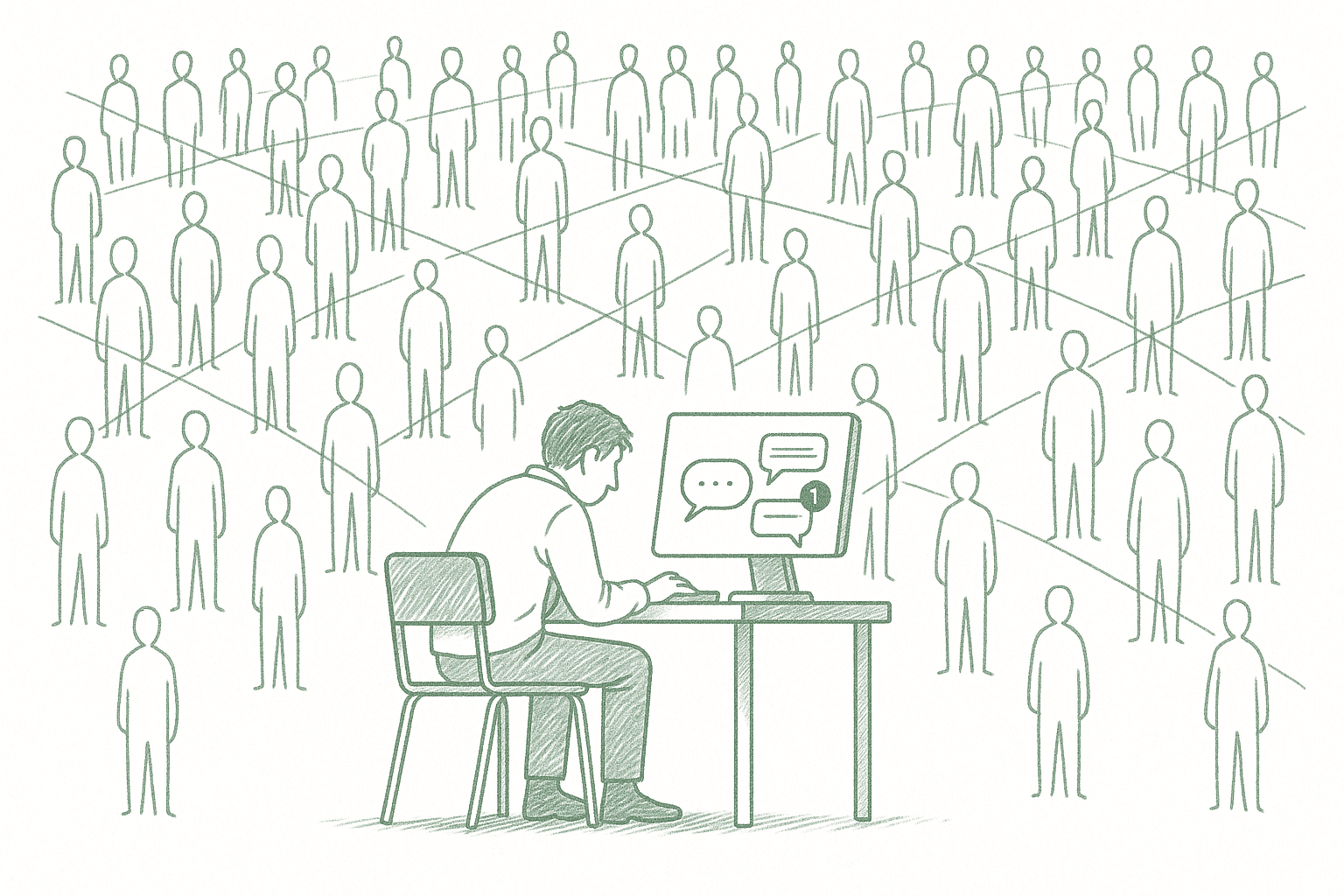
There's a community for founders who are struggling with pricing. Another for SaaS operators trying to scale past $1M ARR. One for agency owners, one for solo founders, one for your specific industry vertical. They all have good names and nice landing pages and a promise of connection with people who get it.
You joined some of them. Maybe you even posted. Probably you didn't. And six months later, nothing is different.
This is not a motivation failure. It's a structure problem. Slack communities are designed to feel like connection. They are not designed to produce outcomes.
The 90-9-1 Problem
In 2006, Jakob Nielsen documented what's now called the 1% Rule of online communities: in any given community, roughly 90% of members lurk without contributing, 9% contribute occasionally, and 1% create the vast majority of content. The pattern has been replicated across platforms, industries, and decades.
A 2014 study published in the Journal of Medical Internet Research applied the rule to four health-focused social networks and found the distribution held: fewer than 1% of members generated the bulk of content, and the overwhelming majority never participated at all.
This isn't a flaw in community design. It's a feature of human behavior at scale. The larger the group, the easier it is to be anonymous. The easier anonymity is, the less any individual feels responsible. When you're one of 4,000 people in a Slack, nobody notices if you go quiet. Nobody follows up. Nobody asks.
That absence of asking is exactly where outcomes die.
Weak Ties Are Not What You Think They Are
Mark Granovetter's 1973 paper "The Strength of Weak Ties" is one of the most cited papers in sociology. The finding is frequently misread. Granovetter found that weak ties — casual acquaintances, loose connections — are highly effective for one specific purpose: finding jobs. The weak tie has access to different information than you do. That informational diversity is what makes the tip-off valuable.
What Granovetter also found, and what gets less attention, is that weak ties don't provide the kind of support that changes behavior. For accountability, honest feedback, and the kind of advice that requires someone to understand your actual situation — you need strong ties. People who know the full picture. People who have enough context to push back.
The person who answers your question in a Slack channel is a weak tie at best. They don't know your margins, your team dynamics, your actual risk tolerance, or what you've already tried. They're pattern-matching your situation to their own experience and giving you a fast answer. Sometimes it's useful. It won't change what you do on Monday.
The research on why founders make worse decisions in isolation points to the same gap: the problem isn't access to information. It's the absence of people who know you well enough to give honest, contextual input — and who will still be there next month when you're deciding whether you followed through.
Passive Membership Is Not Social Capital
In his landmark work Bowling Alone, political scientist Robert Putnam drew a sharp distinction between two kinds of civic participation. Passive membership — sending a check to the Sierra Club, clicking "join" on an organization — generates almost no social capital. Active participation — showing up to a bowling league every Thursday, sitting on a committee, attending in person — generates a great deal.
His central argument: the form of participation matters as much as the fact of it. Putnam watched American civic participation collapse over the late 20th century and found that much of what replaced it was passive. People were technically members of more things than ever. They were actually connected to fewer.
A Slack community is the digital embodiment of passive membership. You get the notification that you've joined. You're in the directory. You have access to the channels. The joining itself requires almost no commitment, and the cost of leaving is zero. When commitment costs nothing, it produces nothing.
Compare that to Benjamin Franklin's Junto Club, founded in 1727. Twelve members. Mandatory attendance. Required preparation. Each member came ready to answer specific questions on morals, politics, and business. The friction was the point. The structured obligation is what made the group worth something.
Scale Is the Enemy of Help
The appeal of a large community is obvious. More people means more potential answers, more perspectives, more signal. In practice, scale destroys the conditions that make help useful.
Genuinely helpful advice requires context. It requires the advisor to understand not just the surface question but the history behind it, the constraints, the person's actual tendencies. That depth takes time. It takes relationship. It doesn't happen in a thread of twelve replies from strangers who will forget the conversation within 48 hours.
Robin Dunbar's research gives this phenomenon a number. Humans can maintain roughly 150 meaningful relationships at once — but only about five at the level of genuine trust and support. A community of 2,000 is not 2,000 people who can help you. It's 2,000 people who could theoretically interact with you, most of whom never will.
The groups that actually produce outcomes — where people take real risks, share real problems, and get genuine feedback — are small. Three to six people. Consistent over time. With enough shared context that the advice lands.
The Feeling vs. the Function
Slack communities solve the feeling of isolation without addressing its underlying cause. You can scroll the feed and feel like you're part of something. You can read the #wins channel and feel vaguely connected to the momentum of other people's progress. None of that changes what you actually do.
The function — the mechanism that actually produces behavior change — is a specific combination of things: a small group, consistent meeting cadence, real mutual knowledge, and the social weight of making commitments to people who will ask whether you kept them. You can't build that in a channel. You build it in a room.
The data on why masterminds work and networking doesn't points to the same root cause. The format that produces outcomes is not the one with the most members or the most activity. It's the one with the most commitment.
You don't need more communities. You need fewer, better ones. Specifically, one — where everyone shows up, everyone has context on everyone else's situation, and everyone asks the question you need someone to ask. The distinction between community and structure is precise — and it explains why one produces outcomes and the other doesn't.
GoodGrowth places founders in groups of 3–5 peers who meet consistently with a single purpose: getting things done that you've been avoiding. Not a community. Not a Slack. A group.