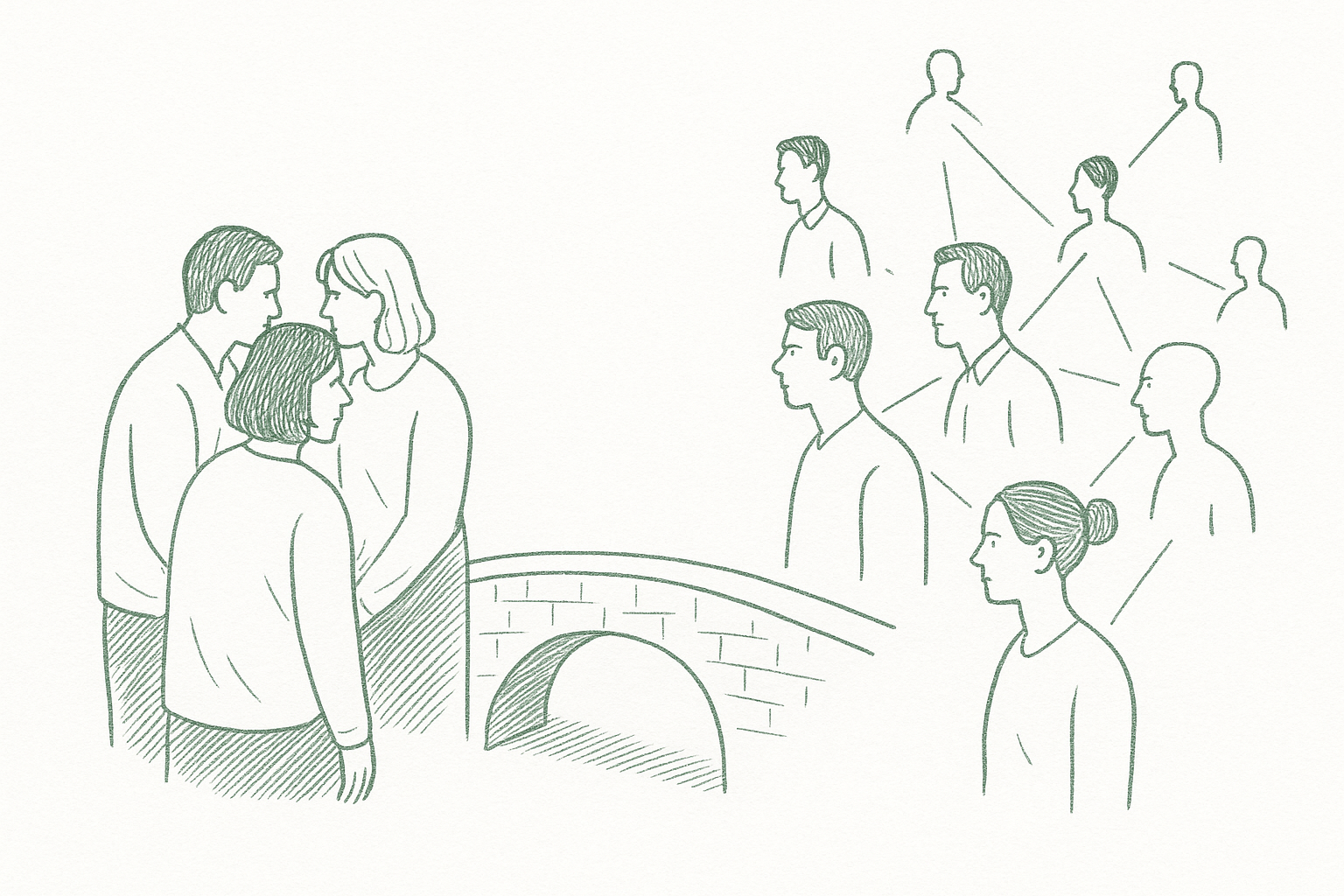
Mark Granovetter was a sociology graduate student at Harvard when he started asking a deceptively simple question: how do people find jobs? Not through formal applications, it turned out. Not through recruiters. In his survey of 282 men who had recently changed jobs, the majority found their positions through personal contacts. But the surprising part was which contacts. It was not their close friends, their business partners, or their family. It was people they barely knew.
Granovetter published his findings in 1973 in the American Journal of Sociology under the title "The Strength of Weak Ties." The paper has since been cited over 80,000 times, making it one of the most influential papers in the history of social science. And the core insight has not softened with age. If anything, five decades of follow-up research have sharpened it into a blade.
The people closest to you are the least likely to tell you something you do not already know.
Why your inner circle keeps you stuck
Granovetter's argument was structural, not emotional. Strong ties — your co-founder, your spouse, your two closest friends — are people you interact with frequently, share deep trust with, and invest significant emotional energy in. These are valuable relationships. Nobody disputes that.
But strong ties have a problem. They cluster. Your closest friends tend to know each other. They tend to run in the same circles, read the same things, hold similar worldviews. The information flowing through your strong-tie network is, by definition, redundant. You already know most of what they know. They already know most of what you know. You are trading the same ideas back and forth, confirming each other's assumptions, and calling it advice.
Weak ties — the person you met at a conference last year, the college roommate's friend who started a company in a different industry, the acquaintance you talk to maybe twice a year — sit in completely different social orbits. They have access to information, opportunities, and perspectives that your inner circle does not. And because they are socially distant from you, the information they carry is non-redundant. It is genuinely new.
Granovetter called weak ties "bridges" — connections that span the gaps between otherwise disconnected clusters of people. Remove a strong tie from your network and the remaining connections compensate. Remove a weak tie that bridges two groups and the information flow between those groups stops entirely.
The founder version of this problem
Founders are particularly vulnerable to the strong-tie trap. The people a typical founder talks to about their business challenges are a remarkably small and homogeneous group: their co-founder, their partner, maybe one or two close friends who also run businesses. These are high-trust relationships. But they are also information dead-ends.
A 2003 study published in American Sociological Review by Ruef, Aldrich, and Carter examined the composition of founding teams across a nationally representative sample of U.S. entrepreneurs. They found that homophily — the tendency to associate with people who are like you — and network constraints based on strong ties had the most pronounced effect on who founders chose to work with. Entrepreneurs overwhelmingly built teams from their existing close networks. They surrounded themselves with people who thought like them, worked like them, and saw the world like them.
This is comfortable. It is also a structural barrier to new information.
The advice paradox sits right here. Founders ask for advice from the people they trust the most. But the people they trust the most are the people most likely to share their blind spots. You are not getting a fresh perspective. You are getting a mirror. And when everyone in the room has the same blind spot, nobody notices it is there.
The LinkedIn experiment that proved it at scale
In 2022, researchers from MIT, Stanford, and Harvard published the results of a massive experiment conducted on LinkedIn. They randomized the "People You May Know" algorithm across over 20 million users over a five-year period to test, at scale, whether weak ties or strong ties were more effective at helping people find jobs.
The results validated Granovetter's original thesis — with a twist. Moderately weak ties — connections with roughly 10 mutual friends, not zero and not fifty — were the most effective at producing job mobility. The relationship between tie strength and outcomes followed an inverted U-shape. Too strong, and the information was redundant. Too weak, and there was not enough trust to act on it. The sweet spot sat in the middle: people you know well enough to take seriously, but not so well that they are already in your echo chamber.
The study also found that weak ties were especially valuable in knowledge-intensive industries — exactly the kind of industries where most founders operate. In high-tech and software-intensive sectors, the effect of weak ties was strongest. In more traditional industries, strong ties held more value.
Why this is really about structural holes
Ronald Burt, a sociologist at the University of Chicago, extended Granovetter's work with a concept he called structural holes. A structural hole is a gap in information flow between two clusters in a network. The person who bridges that gap — who maintains connections in both clusters — gains a disproportionate advantage. They see opportunities neither cluster can see on its own. They broker information between groups that do not talk to each other.
Burt's research found that people who bridge structural holes are more likely to be promoted, to produce more creative ideas, and to be recognized as high performers by their organizations. The advantage was not about being smarter. It was about being better positioned in the network. The same person with the same skills produced better outcomes when they had ties across multiple disconnected groups.
For founders, this has a direct and uncomfortable implication. If every meaningful relationship in your professional life exists in the same cluster — your industry, your city, your friend group — you are surrounded by a structural hole you cannot see. Your network feels large, but it is informationally small. You are over-indexed on depth and under-indexed on reach.
The mastermind group as a weak-tie machine
Here is where the research collides with practice. A well-designed peer group is, structurally, a weak-tie engine. Five or six founders from different industries, matched not by friendship but by the problem they are working on, forced into a room together on a recurring schedule. They share enough context to be useful but not so much that they are trapped in each other's informational bubble.
The SaaS founder hears how the restaurant operator thinks about customer retention. The agency owner learns how the e-commerce founder manages cash flow. The group builds a shared knowledge system that spans structural holes none of the individual members could have bridged on their own. Each member brings information from a different cluster, and the group's collective intelligence exceeds anything their individual strong-tie networks would have produced.
This is also why networking events fail at this. Networking is designed to create the weakest possible ties — three-minute conversations with strangers — without any structure for deepening them. A mastermind takes weak ties and gives them just enough depth to become useful. Recurring meetings. Shared commitments. Accountability loops that create trust without requiring the decades of shared history that strong ties demand.
The result is the Granovetter sweet spot: ties strong enough to generate trust but weak enough to carry non-redundant information. Moderately weak ties. Exactly what the LinkedIn experiment found to be most valuable.
The avoidance problem
There is one more layer to this that rarely gets discussed. A 2024 study published in American Sociological Review by Small, Brant, and Fekete found that when facing personal difficulties, Americans are as likely to avoid their strong ties as to confide in them. The avoidance is not deliberate — it is passive. People do not consciously decide to hide problems from close friends. They just do not bring them up.
The researchers proposed that strong ties carry a fundamental tension between the need to reveal and the need to conceal. You care what your close friends think of you. You worry about being judged. You do not want to be a burden. So you self-censor — and you do it so naturally you do not even notice.
Founders do this constantly. The loneliest decisions are the ones you cannot bring to the people closest to you — because those people are employees, investors, or family members with their own stakes in the outcome. A peer group of near-strangers who share your context but not your consequences becomes the one place where the avoidance problem disappears. The ties are too weak for the self-censorship to kick in, but structured enough that the conversation actually goes somewhere.
Granovetter did not write about mastermind groups. His paper was about job markets and neighborhood organization and the structure of communities. But the principle he identified — that weak ties are the bridges through which new information travels — is the structural explanation for why peer groups have been producing disproportionate outcomes for three centuries. Ben Franklin's Junto was not a group of close friends. It was twelve people from different trades who met every Friday. The PayPal Mafia was not a family. It was a collection of ambitious people who happened to be in the same room at the same time.
The strong ties in your life will support you. But the weak ones will change what you know. And changing what you know is how you change what you do.