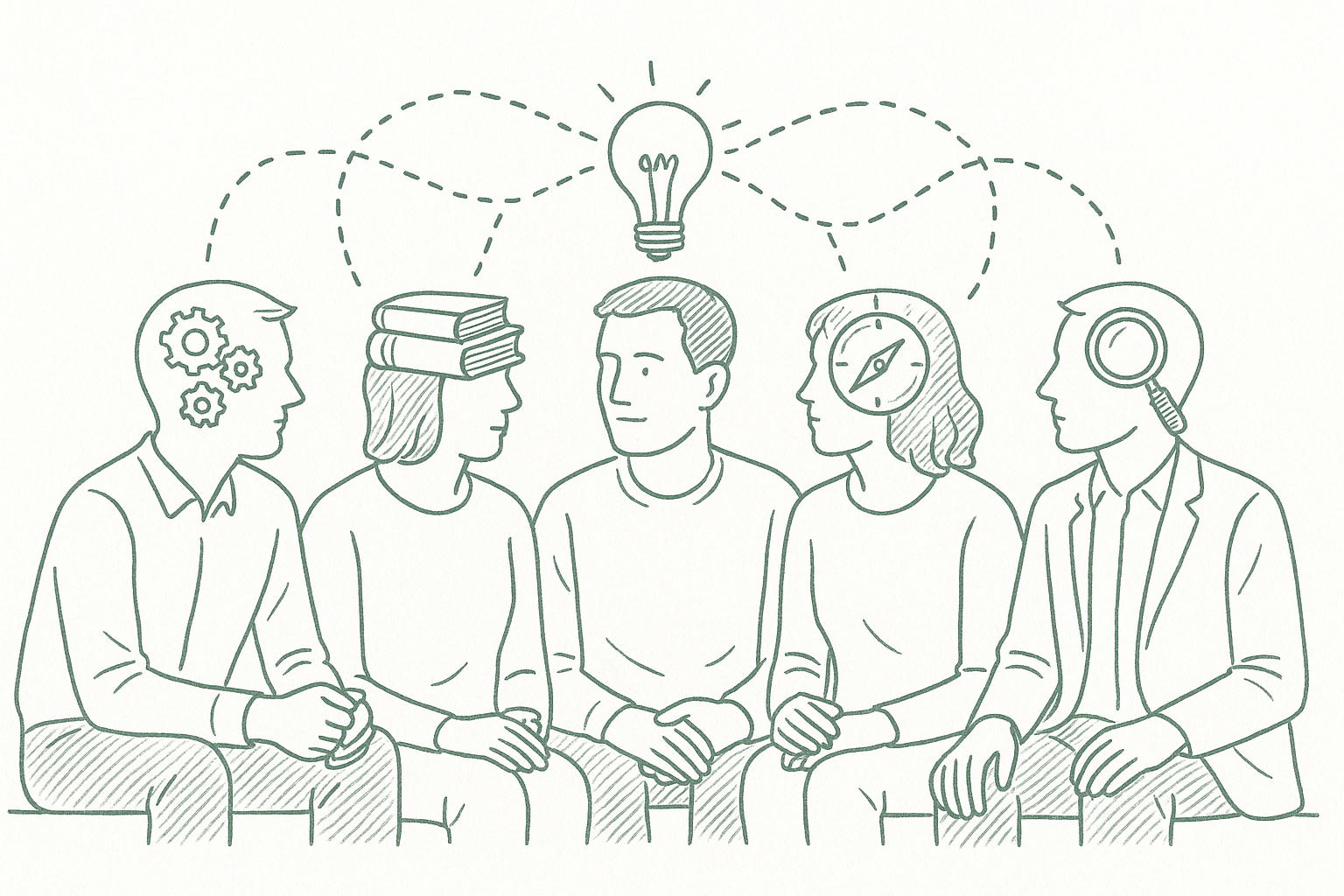
Daniel Wegner was studying couples. Not their arguments or their affection — their memories. Specifically, he wanted to understand something peculiar: long-term partners seem to develop a division of cognitive labor. She remembers the birthdays. He remembers the directions. She tracks the finances. He knows where the warranty documents are. Neither one carries the full picture alone, but together they know everything they need to know.
In 1985, Wegner and his colleagues at Harvard published the foundational paper on what they called transactive memory — a shared system through which groups collectively encode, store, and retrieve knowledge. The theory proposed that groups do not just pool information. They develop a cognitive architecture where each member specializes in certain domains, and crucially, each member knows who knows what.
It was, in a sense, a theory of the group mind that actually held up to empirical scrutiny. And four decades of research since have made the implications impossible to ignore — especially for anyone trying to solve hard problems without the right people in the room.
The experiment that started it all
Wegner's original experiments with Giuliano and Hertel studied intimate couples who had been together for at least three months. Each partner rated their own and their partner's expertise across 64 knowledge categories. Then both were given sets of items to memorize.
The results were striking. Partners remembered more items from categories they believed were their own areas of expertise. When one partner was perceived as the expert in a domain, the other partner effectively offloaded that cognitive responsibility. They did not just forget the information — they never encoded it in the first place. The system worked because each person trusted that the other was holding that piece of the puzzle.
In a follow-up study in 1991, Wegner tested this further by comparing natural couples with ad hoc pairs of strangers. Natural couples who were left to organize their own memorization outperformed every other condition. But when experimenters assigned expertise categories to natural couples — disrupting their existing transactive system — those couples actually performed worse than strangers. The system only worked when the group's natural knowledge architecture was intact.
This finding is worth pausing on. A group's collective intelligence is not just the sum of what each person knows. It is the structure of who holds what, and the shared awareness of that structure. Disrupt the map, and the group gets dumber even though the individuals have not lost a single fact.
What makes a transactive memory system work
Kyle Lewis, in a 2003 study published in the Journal of Applied Psychology, identified three core dimensions of a functioning transactive memory system: specialization, credibility, and coordination. Specialization means each member develops distinct expertise. Credibility means other members trust that expertise. Coordination means the group can retrieve and integrate each member's knowledge efficiently when a problem arises.
All three are necessary. A group where everyone knows the same things has no specialization advantage. A group where members do not trust each other's knowledge cannot retrieve it reliably. And a group with deep specialized knowledge but no process for surfacing it under pressure will fail when it matters most.
A 2019 meta-analysis by Bachrach and colleagues in the Journal of Applied Psychology, covering 76 studies and 6,869 teams, confirmed that transactive memory systems are positively and significantly associated with team performance across a wide range of settings and task types. The effect was robust. Teams with stronger transactive memory systems consistently outperformed teams without them.
Why this matters for founders working alone
Here is the problem. Transactive memory systems require repeated interaction with the same people over time. They cannot form in a one-off networking event. They cannot develop in a Slack channel with 500 members. They require what Wegner described as a shared history of communication and experience — the kind that only builds when the same small group keeps showing up together.
A founder working in isolation has access to exactly one person's knowledge: their own. Every blind spot stays blind. Every gap in expertise stays unfilled. They are running a one-node network in a world where the research says multi-node cognitive systems consistently outperform solo operators.
Consider what a founder typically needs to know: product strategy, financial modeling, hiring, market positioning, legal structures, sales methodology, operational systems, and a dozen other domains. No single person is expert in all of them. But a group of five founders, each with different operational experience, naturally develops specialization. The SaaS founder knows unit economics. The agency operator knows client retention. The e-commerce founder knows supply chain. The group is small enough that everyone knows who knows what.
That is a transactive memory system. And the research says it will outperform any one of those founders working alone — not because the group works harder, but because the group collectively stores, retrieves, and coordinates more knowledge than any individual can carry.
Time is the ingredient most people skip
Transactive memory systems do not assemble on demand. They require time and consistent interaction. Wegner's research showed that the system develops as members learn about each other's expertise through repeated communication. Lewis's studies found that face-to-face interaction produces stronger transactive memory systems than electronic communication alone, because richer communication channels convey more information about what each person actually knows.
This is why networking events produce so little value. Meeting 50 people for three minutes each generates zero transactive memory. You learn nothing about what anyone actually knows. You cannot specialize against them. You cannot coordinate retrieval under pressure. The interaction is too thin to build the cognitive map that makes the system work.
But a mastermind group that meets on a recurring cadence — the same five or six people, every two weeks, for months — builds exactly the kind of deep, repeated interaction that transactive memory requires. After three meetings, you know that one member has deep expertise in SaaS pricing. After five meetings, you know another member has a legal background you can draw on. After ten meetings, the group has a cognitive architecture that none of the members built deliberately. It emerged from showing up.
John Austin's 2003 research in mature organizational groups found the same pattern. Groups with well-developed transactive memory systems — measured as a combination of knowledge stock, specialization, consensus, and accuracy — outperformed groups without them on every metric: goal performance, external evaluations, and internal assessments. The longer the group worked together, the stronger the system became.
The structural argument for staying in the room
The transactive memory research makes a case that most founders have not heard articulated this clearly: the value of a peer group is not just accountability or emotional support. It is cognitive. A well-matched group of founders literally knows more together than any one of them knows alone. Not because they are smarter. Because the system distributes knowledge across multiple specialized nodes and maintains a shared index of who holds what.
This is also the structural argument against group-hopping. Every time you leave a peer group and join a new one, you reset the transactive memory system to zero. The new group does not know what you know. You do not know what they know. It takes months to rebuild the cognitive map. Founders who bounce between groups every quarter never give the system enough time to develop — and they wonder why none of the groups felt valuable.
The most productive intellectual groups in history — Franklin's Junto, Tolkien's Inklings, the Homebrew Computer Club — all shared one characteristic: the same small group of people met repeatedly over years. They were not just friends or collaborators. They were, in Wegner's framework, highly developed transactive memory systems. Each member held a piece of the group's collective intelligence, and the group's output exceeded what any member could have produced alone.
Wegner died in 2013. He never wrote about mastermind groups specifically. But the phenomenon he discovered in couples studying flash cards in a Harvard lab is the same one that operates in a room of five founders doing hot seats every other Tuesday. The group remembers more. The group retrieves faster. The group solves problems none of the individuals could have solved alone.
You are not just borrowing other people's perspectives. You are extending your own cognitive capacity.