In 1885, a German psychologist named Hermann Ebbinghaus published one of the most consequential experiments in the history of cognitive science. Working alone, using himself as the sole subject, he memorized lists of nonsense syllables — meaningless three-letter combinations like DAX, BUP, and ZOL — and then tested how quickly he forgot them. The results were brutal and precise. Within 20 minutes, he had forgotten 42% of the material. Within an hour, 56%. Within a day, roughly 70%. Within a month, nearly 80% was gone.
But Ebbinghaus discovered something else. When he spaced his study sessions across multiple days instead of cramming everything into one sitting, retention improved dramatically. The same material, the same effort, but distributed differently across time — and the forgetting curve flattened. The information stuck. He called it the spacing effect, and it became one of the most replicated findings in all of psychology.
A 2015 replication study published in PLOS ONE by Jaap Murre and Joeri Dros confirmed Ebbinghaus' original data point for point, 130 years later. The forgetting curve is real. The spacing effect is real. And neither one cares whether you are memorizing nonsense syllables or trying to change how you run a business.
What the meta-analyses actually say
The spacing effect is not a curiosity from the 1880s that got quietly overturned. It is one of the most robust findings in cognitive psychology, with over a century of experimental support across learning domains that range from vocabulary acquisition to surgical training to business skill development.
Donovan and Radosevich published a meta-analysis in 1999 covering 63 studies comparing spaced versus massed practice across verbal, motor, and cognitive tasks. The overall effect size was d = 0.46 — a moderate advantage that held regardless of task type. A later meta-analysis by Cepeda and colleagues in 2006, published in Psychological Bulletin, reviewed 254 studies involving over 14,000 observations and confirmed the finding: spaced practice produced significantly better retention than massed practice, especially on delayed tests. When you tested people immediately after cramming, both groups looked similar. When you tested them days or weeks later — which is to say, when it actually mattered — the spaced group dramatically outperformed.
A 2020 meta-analytic review published in Frontiers in Education found that spaced retrieval practice — the combination of spacing with active recall — produced an effect size of g = 0.74 compared to massed retrieval practice. In practical terms, that means spaced practice does not just produce modest gains. It produces the kind of improvement that moves someone from the 50th percentile to the 77th percentile of performance. Same person, same material, same total study time. Just distributed differently.
The mechanism is not complicated. Spacing forces the brain to reconstruct information from long-term storage rather than simply holding it in working memory. Each act of reconstruction strengthens the neural pathway. Massed practice — cramming, retreats, intensive workshops — keeps information circulating in working memory without ever requiring genuine retrieval. It feels productive. It feels like learning. But the information decays the moment the session ends because it was never properly consolidated.
The retreat problem
The average corporate retreat or leadership offsite costs somewhere between $5,000 and $50,000 per attendee when you factor in travel, venue, facilitator fees, and the opportunity cost of pulling senior people off the line for two to three days. The experience is typically designed to be intensive, inspiring, and transformative. Participants return with notebooks full of ideas, business cards from new contacts, and a vague sense of having been upgraded.
Within two weeks, most of it is gone. Not because the content was bad. Not because the attendees were not engaged. Because the format is massed practice, and massed practice does not produce durable change.
Research on corporate training programs tells a consistent story. A 2017 study published in the Journal of Applied Psychology by Hughes and colleagues found that the average training program produced an initial performance gain that decayed by approximately 90% within one year if the training was not reinforced through ongoing practice. A meta-analysis by Arthur and colleagues in 2003, also in the Journal of Applied Psychology, examined 53 studies of training retention and found that skill decay followed a predictable logarithmic pattern — the same shape as Ebbinghaus' forgetting curve, applied to professional skills instead of nonsense syllables.
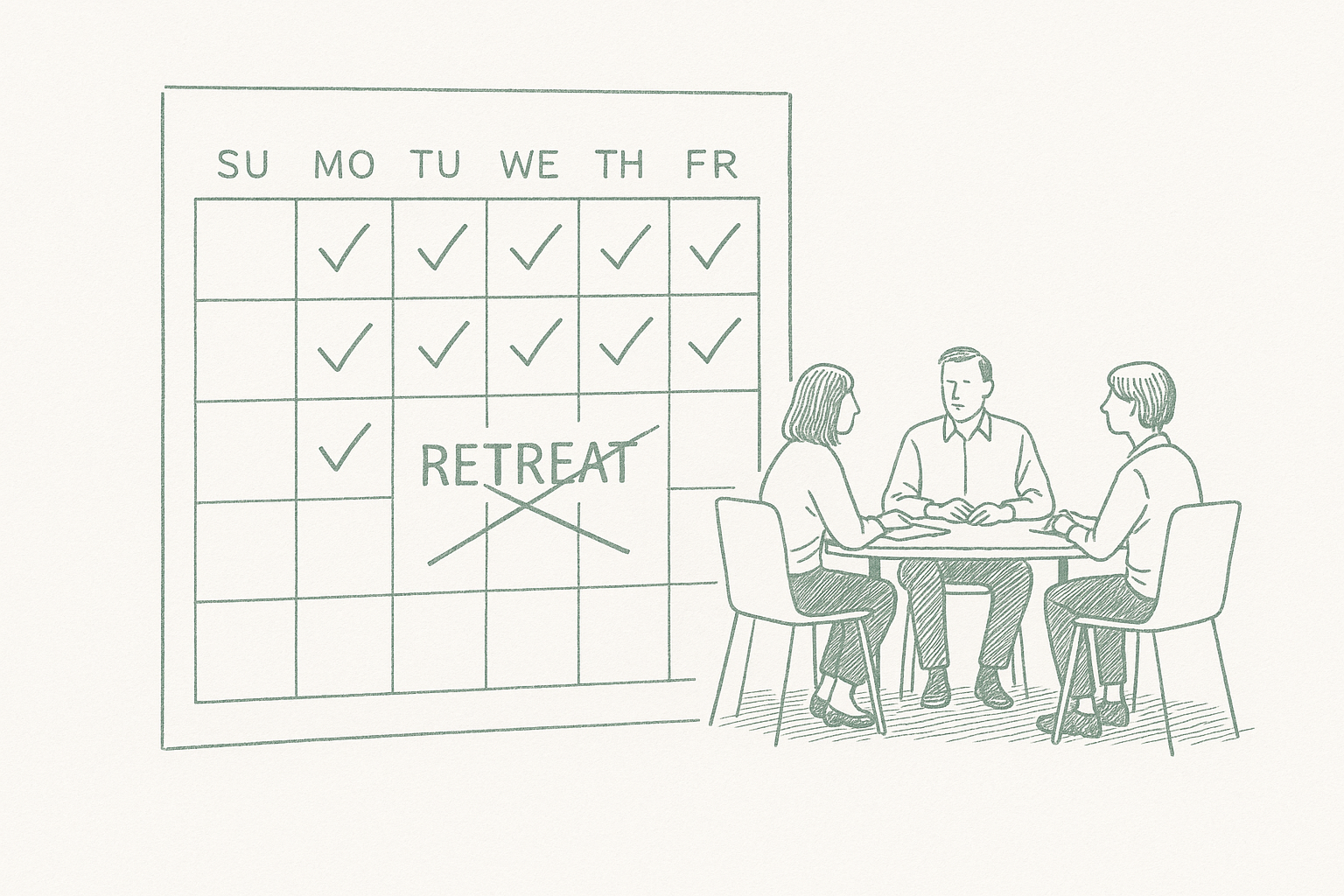
The problem is not that retreats are worthless. Many generate genuine insight. The problem is structural. A retreat is a single, concentrated dose of input with no mechanism for spaced retrieval. There is no system that forces you to reconstruct what you learned three weeks later, six weeks later, twelve weeks later. So the insights decay according to the same forgetting curve that governs every other kind of learning, and the founder who paid $15,000 to attend a three-day leadership summit is left with nothing but a branded water bottle and a fading memory of a keynote that felt important at the time.
Why recurring meetings are a different mechanism
A peer group that meets every two weeks is not a less intense version of a retreat. It is a fundamentally different learning architecture. The format itself creates the conditions the spacing effect requires.
Every meeting is a retrieval event. When you sit down with four or five peers and someone asks what happened with the pricing change you committed to last session, your brain is forced to reconstruct the context, the reasoning, the decision, and the outcome. That act of retrieval does not just remind you — it strengthens the underlying knowledge. The Cepeda meta-analysis found that the optimal spacing interval depends on how long you need to retain the information. For retention periods of months to years — which is the relevant timeframe for business strategy — intervals of two to four weeks between retrieval events produced the strongest results.
Accountability amplifies the effect. When you know you will be asked in two weeks whether you followed through on a commitment, the commitment stays active in memory. Psychologists call this the intention superiority effect — uncommitted information decays faster than information tied to a pending action. A study by Goschke and Kuhl in 1993 demonstrated that intentions that had not yet been fulfilled were remembered significantly better than completed ones or neutral information. The recurring meeting structure keeps commitments in this privileged state of unfulfilled intention, preventing the normal decay that would erase them if left unchecked.
Crucially, the learning that happens in a recurring peer group is not passive. It is exactly the kind of active, effortful retrieval that produces the largest spacing effects. You are not listening to a speaker. You are articulating your own problem, processing feedback in real time, and constructing a plan that you know will be tested in the next session. The 2020 Frontiers in Education meta-analysis found that the combination of spacing with active retrieval — rather than passive review — roughly doubled the effect size. Peer group meetings combine both by default.
Twelve sessions versus one weekend
Consider two founders. Founder A attends a prestigious three-day leadership retreat. Over 72 hours, she participates in eight workshops, three keynote sessions, two peer breakouts, and a panel discussion. She hears from world-class speakers, fills 23 pages of notes, and leaves feeling genuinely inspired. Total concentrated input: roughly 30 hours.
Founder B joins a peer group that meets every other week for 90 minutes. Over six months, she attends twelve sessions. Each session includes one or two hot seats, accountability check-ins, and open problem-solving. The content is not curated by a conference organizer — it is generated by the group's actual challenges. Total input: 18 hours, distributed across 24 weeks.
Based on what the spacing effect research predicts, Founder B will retain and apply more of what she learned than Founder A. Not because the content was better — Founder A probably heard from objectively more accomplished speakers. But because Founder B's learning was spaced, retrieved actively, and reinforced through accountability. Each session required her to reconstruct previous insights, connect them to new challenges, and articulate what she planned to do next. Each session was a retrieval event that strengthened the underlying knowledge.
Founder A's 30 hours of input are subject to the forgetting curve. Without spaced retrieval, roughly 70% of the content will be inaccessible within a month. The remaining 30% will be a mixture of vivid anecdotes and broad impressions — useful for cocktail party conversation, less useful for actual decision-making.
Founder B's 18 hours of distributed input are reinforced by twelve separate retrieval events, each one strengthening the neural pathways that encode the relevant knowledge. Six months in, she is not just remembering what she discussed in session three. She is building on it. The compounding effect of spaced retrieval means each session does not just add new information — it deepens the retention of everything that came before.
The accountability loop as forced retrieval
The most underappreciated feature of a recurring peer group is not the advice. It is the follow-up. When someone in your group asks, "Last time you said you were going to fire that underperforming sales rep — did you do it?" — that question is doing two things simultaneously.
First, it is creating real accountability. You committed in front of people you respect. The Hawthorne effect — the phenomenon where people perform differently when observed — is working in your favor. You are more likely to follow through because the follow-up is scheduled and inescapable.
Second, and less obviously, it is creating a forced retrieval event. Your brain has to reconstruct the original context of the commitment — the problem you were solving, the options you considered, the reasoning behind your decision, the outcome you predicted. Every element of that reconstruction strengthens the memory trace. If you did follow through, the retrieval links the original commitment to its real-world outcome, creating what psychologists call an elaborative encoding — a memory connected to multiple contexts, which is significantly more durable than a standalone fact.
If you did not follow through, the retrieval is even more powerful. The Ovsiankina effect — the psychological tension created by unfinished tasks — keeps the uncompleted commitment in a heightened state of cognitive accessibility. You are not just reminded of the task. You are neurologically compelled to resolve it. The next two weeks become another spacing interval during which the commitment remains active, ready for the next retrieval event.
This cycle — commit, space, retrieve, recommit — is precisely the architecture that the spacing effect research identifies as optimal for long-term behavioral change. And it happens automatically in a well-structured peer group. No app required. No facilitator micromanaging your calendar. Just four or five people who show up, ask honest questions, and expect honest answers.
Why conferences feel productive but aren't
There is a cruel irony embedded in the spacing effect research. Massed practice — cramming, intensive workshops, three-day retreats — consistently feels more productive than spaced practice. Learners report higher confidence, more satisfaction, and a stronger sense of having learned something when material is delivered in concentrated bursts. But when tested on actual retention, the massed-practice group underperforms.
Kornell and Bjork documented this in a 2008 study published in Psychonomic Bulletin & Review. Participants who learned material through massed practice rated their learning as more effective than participants who used spaced practice — even though the spaced group scored 20-30% higher on retention tests. The researchers called this a "metacognitive illusion." People are bad at judging their own learning. Fluency — the ease with which information comes to mind during or immediately after study — is mistaken for durability. But fluency and durability are different things, and massed practice produces the first without producing the second.
This explains why the conference industry thrives despite producing minimal lasting behavior change. Attendees leave feeling transformed. The feeling is genuine. But it is the feeling of fluency, not the fact of learning. The transformation fades because it was never consolidated through the spaced retrieval that durable learning requires. And because the feeling was so good, the attendee signs up for next year's conference, perpetuating a cycle of expensive, emotionally satisfying, cognitively temporary experiences.
Peer groups do not produce this fluency illusion. They are often uncomfortable. The hot seat is not a keynote — it is an interrogation conducted by people who know your business well enough to detect deflection. The spacing between sessions creates the productive forgetting that forces genuine retrieval. And because the format recurs, there is no convenient exit point. You cannot attend one session, feel inspired, and call it done. The structure demands that you come back, report, and continue. The discomfort is the mechanism.
The compounding math of distributed practice
Spaced practice does not just prevent forgetting. It compounds. Each retrieval event does not simply restore the information to its previous level — it adds a small increment of additional strength. Over many retrieval events, these increments accumulate. The result is that well-spaced information eventually becomes nearly permanent, requiring minimal effort to access.
Pimsleur documented this as early as 1967 with his graduated-interval recall system, and modern spaced repetition software like Anki is built on the same principle. Each successful retrieval extends the optimal interval before the next retrieval is needed. The first interval might be two days. The next, a week. Then two weeks, then a month. The information is not reviewed more — it is reviewed at precisely the moment when forgetting has begun but retrieval is still possible.
A biweekly peer group follows this pattern naturally. The first few sessions establish baseline knowledge — who is in the group, what problems everyone is working on, what approaches have been tried. Each subsequent session retrieves and extends this baseline. By session six, the group has a shared vocabulary, a collective memory of what has been tried and what worked, and a level of contextual understanding that no retreat could produce because retreats do not have a session six. They have day three, and then they end.
By session twelve, the group is operating on compound knowledge. A problem discussed in session four resurfaces in session nine because a different member faces a variation of it. The original insights are retrieved, tested against new context, and refined. This is not just spaced retrieval — it is transactive memory in action, where the group develops a shared awareness of who knows what, effectively expanding each individual's cognitive capacity. The spacing effect and transactive memory feed each other. Spacing builds durability. Transactive memory builds breadth. Together, they produce a group that knows more, remembers more, and applies more than any individual member could alone.
What the research says you should actually do
The practical implications of the spacing effect for founders are straightforward, and they run directly counter to how most professional development is structured.
Stop investing in one-off learning events as your primary development strategy. Conferences, summits, and retreats are fine for exposure and networking. They are poor vehicles for behavioral change. The forgetting curve does not care how good the speakers were or how inspired you felt leaving the venue.
Invest in recurring structures instead. The optimal format, based on the Cepeda meta-analysis's findings on retention intervals, is a small group that meets every one to four weeks, with built-in accountability that forces retrieval of previous commitments. This is not an accident — it is the learning architecture that 140 years of cognitive science says works best.
Prioritize active retrieval over passive input. The spacing effect is strongest when combined with effortful recall. Listening to a podcast is passive input. Sitting in a hot seat and articulating your problem while peers probe your assumptions is active retrieval at its most intense. The format matters as much as the frequency.
Accept that the right format will feel less exciting than the wrong one. Distributed practice feels slower, harder, and less immediately satisfying than massed practice. That is the metacognitive illusion working against you. The groups that work are the ones that resist the temptation to turn every session into an event. They embrace the repetitive, unglamorous, session-after-session rhythm that the spacing effect requires.
Ebbinghaus figured this out alone in 1885 with a stack of index cards and a stopwatch. The science has only gotten stronger since. Twelve ordinary Tuesdays, spaced across six months, with five people who ask hard questions and expect real answers — that is not a substitute for a luxury retreat. It is a fundamentally superior learning architecture. The forgetting curve does not negotiate. But it does respond to structure. And the right structure is not more intensity. It is more frequency.