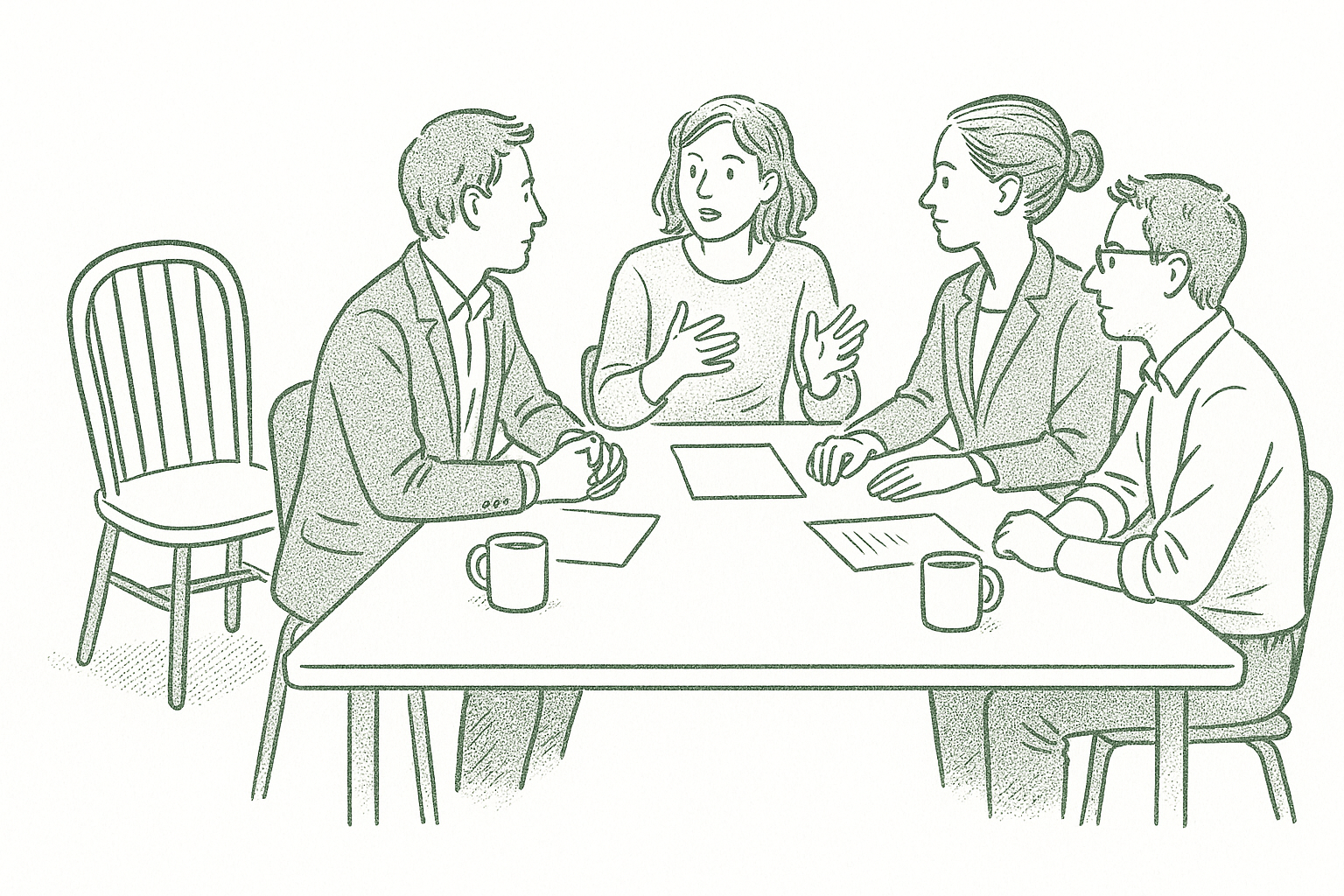
Somebody told you to join a mastermind group. Or start one. You read about the concept in Napoleon Hill's Think and Grow Rich — the idea is 300 years old — and it sounded like exactly what you needed. A small group of peers who meet regularly, challenge each other, hold each other accountable, and help each other grow.
So you joined one. Or you pulled five people into a group chat and called it one. And three months later, it was dead. Attendance trailed off. Conversations got circular. The person who was supposed to hold everyone accountable stopped showing up. The group text went quiet. Nobody officially killed it. It just stopped.
This is not a fluke. It is the default outcome. The majority of mastermind groups fail within their first year, and the reasons are not mysterious. They are structural. The same failure modes show up so consistently across so many groups that the research on small group dynamics can predict them before the first meeting ends.
Failure mode 1: the matching problem
Most mastermind groups are assembled by proximity, not by fit. Someone starts a group and invites the people they already know. A coach bundles clients together. A community launches a "mastermind track" by sorting people into cohorts alphabetically or by signup date.
The result is a room full of people who have nothing in common except that they all said yes. A pre-revenue solo founder sits next to a CEO running a 50-person company. A SaaS operator shares a table with a real estate investor. Their problems are different. Their timelines are different. Their definitions of success are different.
This is not a philosophical complaint. The University of Wisconsin-Madison's research on peer group composition found that the composition of the group — who is in the room — is one of the strongest predictors of whether the group produces outcomes. Groups matched by context, industry proximity, and stage produce meaningfully better results than groups matched by convenience. The researchers identified shared challenge context as a "key ingredient" for effective business peer groups.
Vistage, the largest peer advisory organization in the world, matches members by revenue tier — typically $5 million and above. EO gates at $1 million. YPO requires that you became president or CEO before age 45. These are credential filters, not context filters. They ensure everyone in the room has a certain pedigree. They do not ensure anyone in the room is working on the same problem.
A founder trying to close their first enterprise deal does not need to hear from someone who scaled past that problem five years ago. They need to hear from someone who closed that deal last quarter. The credential model confuses "impressive resume" with "relevant peer." They are not the same thing.
Failure mode 2: the accountability theater
Every mastermind group claims to provide accountability. Almost none of them actually do.
Real accountability requires a specific structure: a commitment is made in front of the group, a deadline is attached, and at the next meeting, someone asks the uncomfortable question — did you do it? If the answer is no, the group does not move on. It stays on that failure. It explores why. It adjusts the plan.
What most groups practice instead is accountability theater. Members share goals at the start of the meeting. Nobody writes them down. At the next meeting, new goals replace the old ones. Nobody asks about the thing you said you would do last time. The group operates like a perpetual kickoff meeting — all intention, no follow-through.
Irving Janis's research on groupthink explains part of why this happens. Groups that prioritize social harmony over critical evaluation develop a pattern of self-censorship. Members suppress doubts. They avoid uncomfortable questions. They maintain what Janis called "an illusion of unanimity" — the false belief that everyone agrees, simply because nobody disagrees. In a mastermind context, this means nobody wants to be the person who says, "You said you'd launch that thing. You didn't. What happened?"
The result is a group that feels supportive but produces nothing. Members leave each meeting feeling good about the conversation and confused about why their business has not changed. The accountability was performative. The comfort was real. And comfort, in a mastermind, is a leading indicator of failure.
Failure mode 3: the wrong size
Group size is a design decision that most mastermind organizers treat as an afterthought. They add members because more people means more revenue, more perspectives, or more social proof. The Ringelmann effect says this is exactly backward.
Max Ringelmann's research — confirmed by over a century of replication — shows that individual effort decreases as group size increases. In groups larger than seven or eight, social loafing becomes the default behavior. Members assume someone else will carry the conversation. Someone else will ask the hard question. Someone else will follow up.
J. Richard Hackman's research at Harvard concluded with a blunt directive: no double digits. His work with Neil Vidmar identified optimal member satisfaction at approximately 4.6 people. The research on optimal group size consistently converges on groups of five to seven as the sweet spot — small enough for individual visibility, large enough for diverse perspective.
Most paid mastermind programs run groups of 12 to 20. Vistage groups contain 12 to 16 members. At that size, half the room is checked out at any given moment. Not because they are bad people. Because the group is too large for the psychological conditions of accountability to hold. The math does not care about intentions.
Failure mode 4: no psychological safety
Amy Edmondson's research at Harvard Business School established psychological safety as the single strongest predictor of team performance. Google's Project Aristotle confirmed it across 180 teams: the number one factor distinguishing high-performing teams from low-performing ones was not talent, resources, or strategy. It was whether team members felt safe enough to take interpersonal risks without fear of punishment or humiliation.
In mastermind groups, this translates to a specific question: can you admit that you are failing?
Most groups cannot clear this bar. Members show up and share wins. They frame setbacks as "learning experiences." They present polished versions of their problems because admitting the unpolished truth — that they are struggling, lost, or making the same mistake for the third time — feels too vulnerable. The group becomes a highlight reel. And highlight reels do not produce growth.
Edmondson's research is explicit that psychological safety is not about comfort or lack of conflict. It is the opposite. Psychologically safe groups have more conflict, not less — because members are willing to challenge each other honestly. The unsafe group avoids disagreement to preserve social harmony. The safe group leans into disagreement because the members trust that honesty will not be punished.
Building this kind of safety takes time, structure, and facilitation. It does not happen by accident. Choosing the right group matters, but so does how that group operates in the first 90 days. Groups that skip the trust-building phase and jump straight to "hot seats" and goal-setting typically discover that nobody is willing to bring real problems to the table.
Failure mode 5: the facilitation vacuum
The groups that survive longest have one thing in common: someone is running them. Not participating in them. Running them.
This distinction matters. In leaderless groups, the most dominant personality sets the agenda by default. Conversations drift toward whoever talks the loudest or the longest. Quieter members — who often have the most valuable perspectives — stop contributing. The group degrades into a monologue with an audience.
The research on this is consistent. Groups with a designated facilitator who manages time, ensures equitable participation, and enforces structure outperform leaderless groups across nearly every measurable dimension. The facilitator's job is not to be the smartest person in the room. It is to make sure the room functions.
But facilitation is labor. In volunteer mastermind groups, nobody signed up to be the facilitator. The person who organized the group usually wants to participate as an equal, not manage logistics. So the facilitation gets skipped. Meetings run long or short. The same person dominates every session. New members never get integrated. And the group collapses not from conflict, but from drift.
What the good ones do differently
The groups that work — the ones that survive past a year, produce measurable outcomes, and become the most valuable professional relationship their members have — share a set of structural features that are boring, unsexy, and completely non-negotiable.
They match by problem, not by pedigree. The best groups put people together who are working on the same class of problem at the same stage. Not the same industry, necessarily. But the same challenge. A founder figuring out their first hire and a founder figuring out their first acquisition have nothing to offer each other. Two founders figuring out their first hire — even in different industries — have everything to offer each other. This is why industry-specific peer groups, from salon owners to financial advisors, consistently outperform generic networking groups.
They enforce structure. Effective groups have a cadence (weekly, biweekly, or monthly), a format (hot seats, roundtables, or structured problem-solving), and rules (confidentiality, attendance minimums, participation expectations). Whether a group meets online or in person, the structure is what produces outcomes. The structure is not optional. It is the thing that prevents the group from decaying into a casual hangout.
They stay small. Five to seven people. Not ten. Not fifteen. Small enough that every absence is felt and every member's contribution is visible. Dunbar's research on relationship capacity supports this from another angle: humans can only maintain a limited number of deep relationships. The best groups operate within that limit, not beyond it.
They build trust before they demand vulnerability. Groups that start with structured introductions, shared context-setting, and low-stakes participation before escalating to deep problem-solving build the psychological safety that Edmondson's research identifies as essential. Trust is not a byproduct of time. It is a byproduct of design.
They have facilitation — even if it is invisible. Someone or something manages the logistics, the agenda, the cadence, and the follow-through. In the best modern groups, technology handles the parts that technology can handle — scheduling, reminders, accountability tracking — so humans can focus on the parts that only humans can do: honest conversation, real feedback, and the kind of challenge that only comes from a peer who actually understands your situation.
The uncomfortable conclusion
The reason most mastermind groups fail is not that the concept is flawed. The peer effect is one of the most robustly documented forces in behavioral science. The people around you genuinely do determine your outcomes. The concept works.
What fails is the execution. Groups assembled by proximity instead of fit. Accountability that is declared but never enforced. Sizes that guarantee social loafing. Trust that is assumed instead of built. Facilitation that is nobody's job.
Founders who make decisions alone already know the cost. But joining the wrong group is not meaningfully better than joining no group. A bad mastermind teaches you that peer support does not work. A good one teaches you that nothing works better.
The difference between the two is not luck. It is architecture.