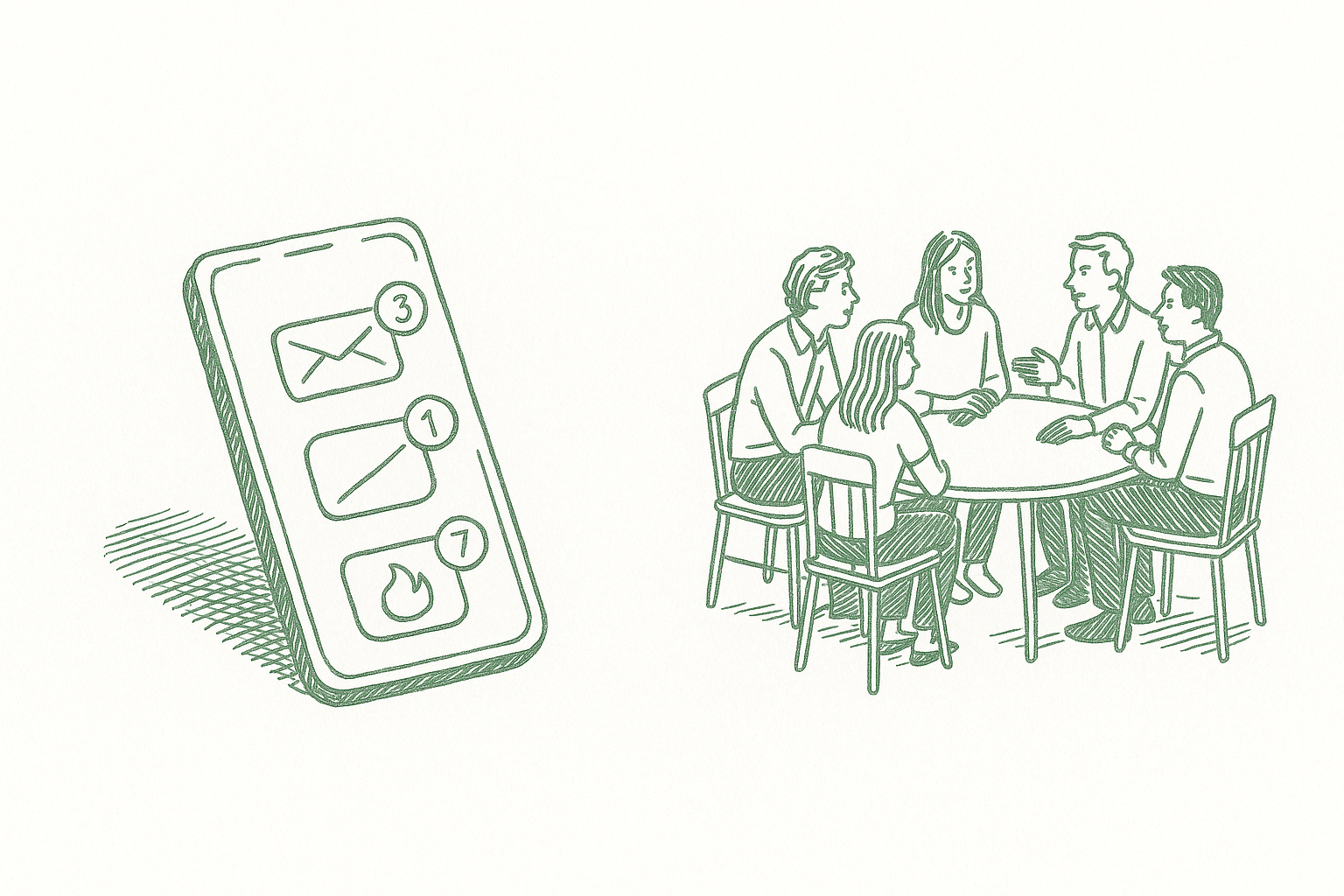
There are over 300 accountability and habit-tracking apps on the App Store right now. They have streak counters, push notifications, progress charts, gamification badges, and commitment contracts where you pay money if you fail. They are beautifully designed. They are backed by behavioral economics. And they almost universally do not work.
According to AppsFlyer data, the average app retains just 5.3% of iOS users by day 30. For health and fitness apps specifically, that number drops to 3-4%. A scoping review published across lifestyle and mental health apps found a median of 70% of users discontinue within the first 100 days, with the steepest abandonment curve in the first two weeks. These are not fringe apps. These are the ones people downloaded because they wanted to change.
The industry assumption is that the fix is better design. More gamification. Smarter notifications. AI-powered nudges. But the research points to something different: the problem is structural. Apps are trying to automate something that is fundamentally social.
The what-the-hell effect and why streaks backfire
Janet Polivy and C. Peter Herman identified a phenomenon in 2002 that they called the "what-the-hell effect." In dieting research, they found that a single perceived failure produces disinhibition — a psychological license to fail again. One slice of cake leads to eating the entire cake. One missed day leads to "well, I already broke the streak."
The structure generalizes far beyond dieting. Katarina Stawarz, Anna Cox, and Ann Blandford audited 115 habit-tracking apps in a 2015 study published at CHI. Their finding was damning: nearly all of them focus on reminders and self-tracking, while almost none scaffold the context-cue that behavioral research identifies as the actual load-bearing mechanism in habit formation. The apps measure compliance. The science says compliance is not the job.
Streak counters make this worse. Phillippa Lally's 2010 study in the European Journal of Social Psychology found that habit formation takes an average of 66 days, and critically, missing a single day does not disrupt the formation process. But streak-based apps treat a missed day as a reset. The streak breaks. Loss aversion kicks in. The user experiences it as failure rather than a normal fluctuation in a long process. And they quit — not because they failed, but because the app told them they did.
Why a notification is not accountability
The word "accountability" gets thrown around loosely in the app world. A push notification that says "Don't forget your goals" is not accountability. A chart showing your completion rate is not accountability. Even a financial penalty — losing $5 when you miss a workout — is a commitment device, not accountability.
Real accountability requires a person. Someone who knows what you committed to, who will notice if you do not follow through, and whose opinion you care about enough to feel the weight of their attention. A 2017 review in Clinical Psychology Review found that accountability is a missing construct in most models of adherence behavior — and that the social-evaluative component is what actually drives follow-through. It is not the tracking. It is not the reminder. It is the knowledge that someone specific is watching.
stickK, the commitment contract platform founded by Yale economists Dean Karlan and Ian Ayres, has its own data on this. Users who designated a referee — a real person who would monitor their progress — doubled their success rates compared to those who used financial penalties alone. The money mattered. But the person mattered more.
What peer groups get right that apps get wrong
A peer group does not send you a notification. It puts you in a room — virtual or physical — with people who said they would do something and now have to say whether they did. That is a fundamentally different mechanism. The app asks, "Did you complete your task?" and accepts a tap. The peer group asks, "Did you do the thing you said you would do last time?" and waits for you to answer out loud while five other people listen.
The difference is not motivation. It is social cost. Tapping "skip" on a notification costs nothing. Telling a group of peers that you did not follow through on what you committed to last month costs something real — not money, but reputation, identity, and the implicit promise you made to people who shared their own commitments with you. That is the Köhler effect in action: people work harder when they know their effort is visible to others and when falling short means letting the group down.
Harkin and colleagues confirmed this at scale. In a 2016 meta-analysis published in Psychological Bulletin covering 138 studies and 19,951 participants, they found that self-monitoring does improve outcomes — but the effect is significantly stronger when the monitoring is shared with others. Public commitment outperforms private tracking. Every time.
The convenience trap
Apps succeed in the market because they are convenient. Download, set up, start tracking. No coordination with other people. No vulnerability. No showing up at a specific time and admitting that you spent the last two weeks avoiding a hard decision.
But that convenience is precisely what makes them ineffective. Accountability works because it is inconvenient. Because you cannot swipe it away. Because a person is harder to dismiss than a push notification. The friction is not a bug. It is the mechanism.
The entire self-help industry has spent two decades trying to remove the social component from accountability and replace it with technology. Notifications instead of conversations. Algorithms instead of peers. Badges instead of relationships. And the retention data keeps saying the same thing: people do not change their behavior because an app told them to. They change because someone they respect is paying attention.
An accountability app is a to-do list that judges you. A peer group is a room where you cannot hide. One of these has a 95% abandonment rate. The other has been working since Ben Franklin started the Junto in 1727.