Most conversations about group performance focus on what goes wrong. Social loafing. Free riders. The Ringelmann effect, where every additional person in a group reduces individual effort. These are real problems and well-documented ones. But they are only half the story.
The other half starts in 1920s Berlin, with a German industrial psychologist named Otto Köhler and a rowing club full of men lifting heavy weights.
The experiment that flipped the script
Köhler was studying productivity. Specifically, he wanted to know whether groups produced more or less than the sum of their individual parts. The conventional answer, even in the 1920s, leaned pessimistic. But Köhler was not interested in conventional answers.
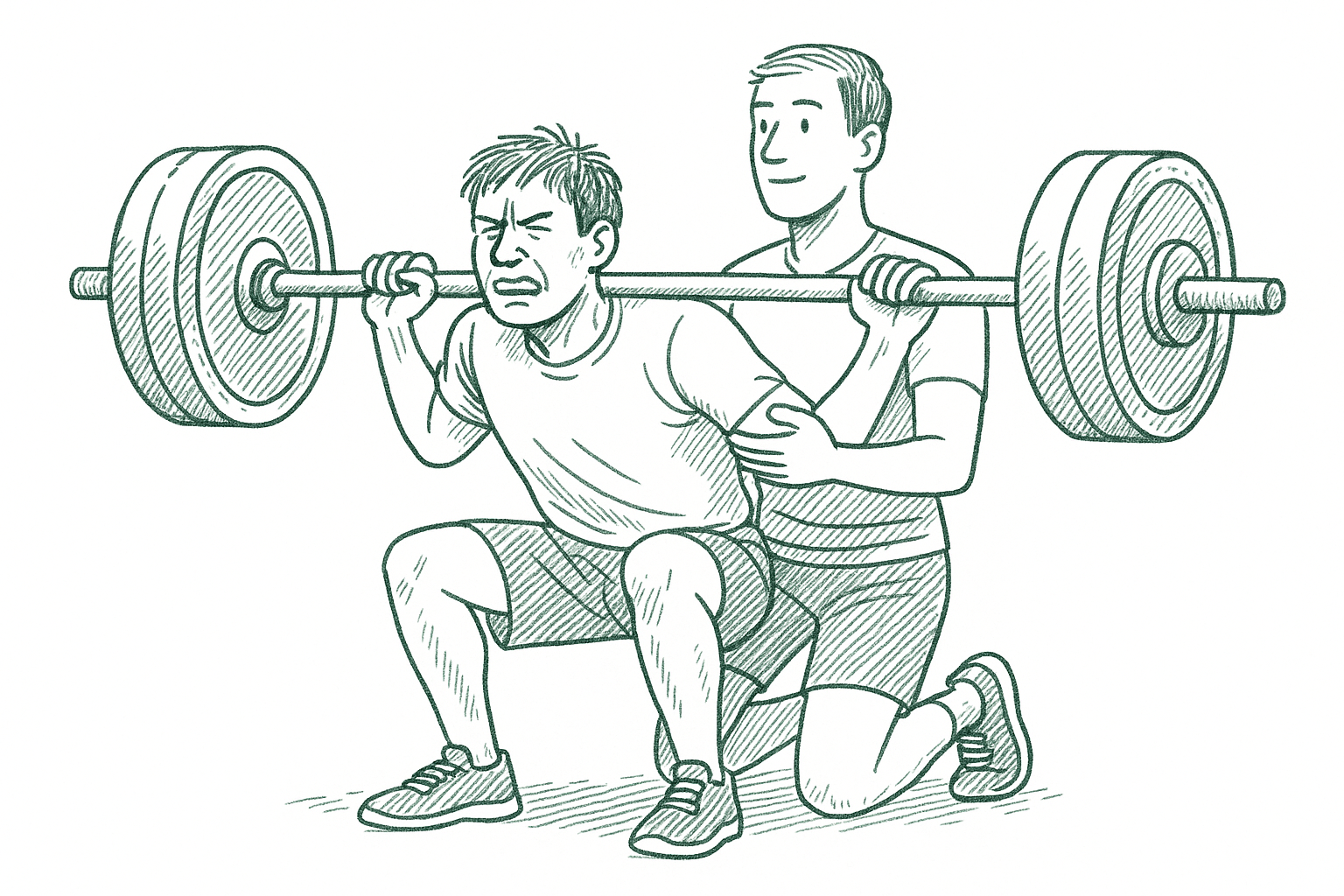
He recruited members of a Berlin rowing club and had them perform standing bicep curls with a 41-kilogram barbell — roughly 90 pounds — until they could not lift it one more time. First, each person curled alone. Their individual endurance was recorded. Then they were paired into groups of two and three, lifting a single bar weighted proportionally — twice as heavy for pairs, three times for trios. The bar only stayed up as long as the weakest person kept lifting.
Here is where it gets interesting. The weaker members of each group did not perform at their solo level. They exceeded it. Significantly. In some pairings, the less capable lifter persisted substantially longer when paired with a stronger partner than when curling alone. They did not match their partner. But they surpassed themselves.
Köhler published his findings in 1926 and 1927. The effect was clear, consistent, and ran directly counter to the social-loafing narrative. Under the right conditions, groups did not make people lazy. They made people better.
The two forces that drive it
The Köhler effect is not magic. It operates through two well-understood psychological mechanisms.
The first is social comparison. When you work alongside someone whose performance is visibly higher than yours, a competitive instinct kicks in. Not the kind that leads to sabotage. The kind that makes you refuse to quit first. Psychologists call this upward social comparison — the impulse to close the gap between your performance and someone you see as a reference point. You do not need to beat them. You just cannot let the distance become embarrassing.
The second is indispensability. In a conjunctive task — one where the group's output is determined by its weakest member — every person knows that their failure is the group's failure. There is no hiding behind the average. If you quit, everyone stops. That sense of being essential, of knowing your effort has direct and visible consequences for people who are counting on you, unlocks effort that purely internal motivation cannot reach.
These two forces reinforce each other. You compare upward, which raises your standard. And you feel indispensable, which raises your commitment. Together they produce effort that exceeds what any amount of self-discipline can generate in isolation. It is the Pygmalion effect operating laterally — the group's expectations become the invisible force that lifts individual performance beyond what any solo effort could reach.
A century of replication
Köhler's work was largely forgotten for decades, buried in German-language journals. Then, in the early 2000s, researchers rediscovered it and started testing whether the effect held up under modern conditions. It did.
In 2011, Deborah Feltz, Norbert Kerr, and Brandon Irwin at Michigan State University ran an experiment using isometric plank holds. Participants held a plank until failure, first alone, then alongside a partner who was visibly more capable. The result: individuals held the plank approximately 24% longer when exercising with a more capable partner than when working alone. Twenty-four percent more effort, extracted not by willpower or coaching or incentives, but by the mere presence of someone slightly better.
The researchers went further. They tested whether the effect required elaborate team scoring, where participants shared a group outcome, or whether simply being in the same room with a stronger performer was enough. The answer: just being there was sufficient. The social comparison alone — seeing someone hold longer — activated the motivation gain. The indispensability layer amplified it, but it was not strictly necessary to trigger the effect.
Subsequent research extended the Köhler effect beyond physical tasks. Studies on archival data from collegiate swim and high school track relays found that weaker team members showed significantly greater motivation gains compared to their stronger teammates when transitioning from individual to group competition. The effect held in final races versus preliminary ones, suggesting it intensifies under higher stakes.
Kerr and Hertel's 2011 comprehensive review established a critical boundary condition: the motivation gain is strongest when the ability gap between group members is moderate. Too small a gap and there is no upward comparison to drive effort. Too large a gap and the weaker member disengages — they cannot close the distance, so they stop trying. The sweet spot is a partner or group that is better than you, but not so much better that your effort feels irrelevant.
The Ringelmann problem and the Köhler solution
The Ringelmann effect and the Köhler effect are not contradictions. They are descriptions of two different group designs that produce two different outcomes.
Ringelmann studied additive tasks — tasks where everyone contributes to a collective pool and individual effort is invisible. Pull a rope. Clap your hands. Brainstorm in a group of twenty. In these structures, accountability is diffused, individual contribution is unmeasurable, and the natural response is to let others carry the load. The larger the group, the worse it gets.
Köhler studied conjunctive tasks — tasks where the group's outcome depends on its weakest member and every individual's contribution is visible. In these structures, accountability is concentrated, effort is identifiable, and the natural response is to rise to the occasion rather than let the group down.
The difference is not the people. It is the structure. Put the same person in an additive group and they loaf. Put them in a conjunctive group and they exceed their solo performance. The variable is not motivation or character or discipline. It is design. And the Ovsiankina effect adds a second layer: when those visible commitments go unfinished, the brain generates a compulsive need to complete them — turning group structure into a neurological accountability mechanism.
What this means for founders
Founders who work alone are operating without either of the Köhler mechanisms. There is no upward social comparison because there is no one to compare against. There is no indispensability because there is no group depending on their effort. The only accountability is internal — and decades of research suggest internal accountability is the weakest kind.
This is why accountability from an app or a journaling habit rarely sticks. It is additive-structure accountability — your contribution to your own goals is invisible to anyone but you, and the consequence of quitting is felt by no one else. The Köhler effect requires other humans. Specifically, it requires a small number of humans who are slightly ahead of you, who can see your effort, and whose outcomes are linked to your performance.
That is a description of a well-designed peer group.
Consider the practical implications. A founder joins a group of five people. Each person shares a goal at the start of the month. At the next meeting, each person reports on what they did. If one person did not follow through, everyone knows. Their failure is not private. It is visible to four people who showed up and did the work. The social comparison activates — you see peers executing and you refuse to be the one who stalled. The indispensability activates — you know the group's energy and trust depend on everyone pulling their weight. And the ability gap is moderate — these are people at your level, slightly ahead in some areas, slightly behind in others.
Every condition for the Köhler effect is met. Not by accident. By design.
The matching problem
The most underappreciated finding in Köhler research is the ability-gap constraint. Remember: the motivation gain is strongest when the gap between members is moderate. Too small and there is no aspiration. Too large and there is no hope.
This has direct implications for how peer groups are composed. A group of five founders where everyone is at exactly the same stage will produce camaraderie but not much stretch. A group where one person runs a $50M company and another is pre-revenue will produce intimidation, not motivation. The Köhler effect requires that members be different enough to create upward comparison but similar enough that the gap feels closable.
Dunbar's research tells us that humans can only maintain a limited number of meaningful relationships. The optimal-group-size research tells us that five to six people is the sweet spot for engagement and accountability. Köhler adds a third constraint: the members must be close enough in capability that the weaker ones are pulled up, not overwhelmed.
Matching, it turns out, is not a nice-to-have. It is the mechanism that activates the Köhler effect. Get the matching wrong and you get either a support group or a hierarchy. Get it right and you get a group where everyone is simultaneously the weaker member in some domain and the stronger member in another — a structure that activates the motivation gain for everyone, in different directions, at the same time. The protégé effect explains the other half of why this works: the person helping someone else think through a problem actually learns more deeply than the person receiving the help.
The design specification
Otto Köhler did not know he was writing a design specification for peer groups. He thought he was studying industrial productivity. But the principles he uncovered — and the century of research that followed — describe exactly what makes a group produce outcomes instead of conversation.
Keep it conjunctive. Structure the group so that every member's effort is visible and consequential. Regular check-ins where everyone reports on commitments create the indispensability that drives effort.
Keep the gap moderate. Match members who are close enough to inspire each other and different enough to challenge each other. This is the single largest determinant of whether a group activates the Köhler effect or collapses into social loafing.
Keep it small. Five people is not an arbitrary number. It is the size at which social comparison is personal, indispensability is real, and the Ringelmann effect cannot take hold.
Keep it recurring. The Köhler effect is not a one-time boost. It requires repeated exposure to the group. The social comparison recalibrates each session. The accountability compounds each cycle. A single meeting is a spark. A recurring group is a system.
The most productive groups in history — from Ben Franklin's Junto to the Inklings to the PayPal Mafia — met regularly, stayed small, and held each member to a visible standard. They did not use the language of the Köhler effect. But they engineered every condition for it.
You do not need more discipline. You need a room where quitting is not an option because four other people are watching, lifting, and counting on you to keep going.