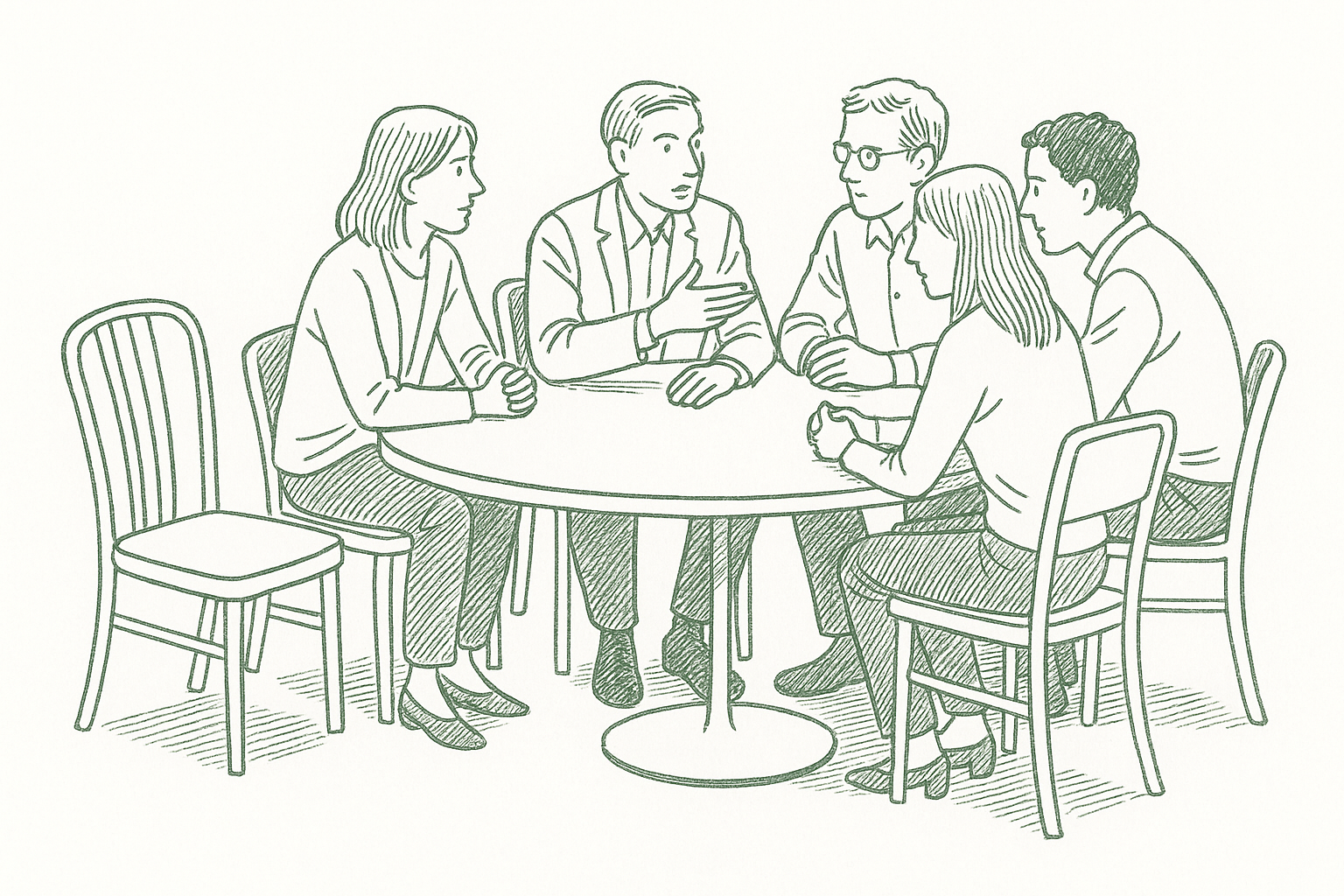
Everyone who has ever Googled "how to start a mastermind group" has pictured the same thing. A handful of sharp people sitting around a table, trading hard-won insights, challenging each other, leaving every meeting sharper than they arrived. Napoleon Hill described this dynamic in 1928 as "the coordination of knowledge and effort, in a spirit of harmony, between two or more people, for the attainment of a definite purpose." Nearly a century later, the definition still holds. The execution still fails.
The failure rate is not a mystery. The Success Alliance, one of the longest-running mastermind training organizations, identifies uncommitted members, lack of structure, and absence of facilitation as the top three reasons groups collapse. SCORE, the SBA-backed mentoring network, found that groups without documented ground rules lose half their members within the first quarter. The pattern is consistent: groups that feel their way forward die. Groups that design their structure in advance survive.
Here are the five decisions that separate the groups that last from the ones that don't.
1. Match by problem, not by profile
The conventional wisdom says to recruit people at your "level." Same revenue range. Same industry. Same stage. This sounds logical and produces mediocre groups.
Research from the National Bureau of Economic Research on entrepreneurial peer effects found that peer group composition affects firm outcomes independent of individual quality. The variable that matters is not whether members look alike on paper. It is whether they share the same active constraint. A SaaS founder wrestling with churn and a real estate agent losing top producers are working on the same problem: retention. A solo consultant trying to hire their first employee and a restaurant owner opening a second location are both navigating the same transition: from doing the work to building the team that does it. A salon owner stuck behind the chair and a contractor managing their first crew are solving the same scaling problem from different industries.
Most mastermind groups fail because they match by credentials and hope the chemistry follows. The groups that work match by the problem being solved and let the diversity of industry context make the conversation richer.
2. Cap it at five to six people
This is not a preference. It is a structural constraint backed by decades of research.
Robin Dunbar's work on social group layers found that humans maintain roughly five intimate relationships where deep trust and vulnerability are possible. Beyond that threshold, relationships become performative. You stop sharing the real problem and start sharing the version of the problem that makes you look competent.
The research on optimal group size converges on a narrow range. Below four, the perspectives are too limited and absences kill the meeting. Above eight, social loafing kicks in. People check out. Airtime becomes zero-sum. The person who most needs to talk stays quiet because there are too many voices ahead of them.
Five to six is the number where everyone speaks every meeting, trust builds naturally, and each person's absence is felt enough to enforce attendance without a rule.
3. Set a cadence and a format before the first meeting
The number one killer of informal mastermind groups is not conflict. It is scheduling drift. The first meeting happens with energy. The second gets pushed a week. By the fourth, two people have dropped and the remaining three are texting "let's find a time that works" into the void.
The fix is simple and non-negotiable: set a recurring calendar hold before anyone agrees to join. Weekly or biweekly. Same day, same time, every time. Treat it like a standing appointment with your accountant, not a casual coffee.
The format matters as much as the cadence. The hot seat model, where one person presents their current problem and the group works it for 30 to 45 minutes, is the most effective structure for peer advisory. It comes directly from the Vistage and YPO format that has been refined over decades. Rotate the hot seat so everyone gets a turn in every cycle. Structure the rest of the meeting around brief check-ins and accountability updates. Every meeting ends with each member stating one specific commitment for the next session.
Forbes contributor Sarah Peck, who has run mastermind groups for over a decade, recommends the "Rose, Bud, Thorn" framework for check-ins: one thing going well, one emerging opportunity, one active problem. It takes three minutes per person and surfaces the most important information immediately.
4. Write down three rules and enforce them
You do not need a charter. You do not need an NDA. You need three written agreements that every member explicitly accepts before the group begins.
Confidentiality. What is said in the group stays in the group. This is the foundation of psychological safety, and without psychological safety, nobody shares the real problem. They share the sanitized version. Google's Project Aristotle found that psychological safety was the single most important factor in high-performing teams. The same applies to peer groups. If a member cannot say "I am running out of money" or "I made a terrible hire" without worrying it will get repeated, the group is a performance, not a conversation.
Attendance. Define what acceptable attendance looks like. Two misses in a row triggers a conversation. Three and you are out. This sounds harsh. It is the difference between a group that lasts and a group that dies of attrition. Accountability only works when everyone shows up consistently enough to know each other's ongoing context.
No selling. Members do not pitch each other. They do not recruit each other's clients. They do not use the group as a lead generation channel. The moment someone starts treating the group as a networking opportunity, trust evaporates.
5. Assign a facilitator or the group will drift
Leaderless groups sound democratic. They are actually directionless. Without someone responsible for keeping time, managing the agenda, and drawing out the quiet members, the group defaults to whoever talks the most. That is not a mastermind. That is a monologue with witnesses.
The facilitator does not need to be a paid professional, though that model works well at organizations like Vistage, YPO, and EO. They need to be someone willing to interrupt the person who has been talking for 20 minutes, redirect a conversation that has gone off-topic, and ask the uncomfortable follow-up question that nobody else will ask.
Rotating facilitation works if you set explicit responsibilities: manage the clock, ensure everyone gets airtime, close each meeting with commitments. A rotating model also prevents the group from becoming one person's project, which is another common failure mode. If the organizer gets busy and stops scheduling, the whole thing collapses. When facilitation rotates, ownership is distributed and no single point of failure can kill the group.
The part nobody wants to hear
Starting a mastermind group is straightforward. Maintaining one is work. Real, ongoing, unsexy work. Sending the calendar invite. Prepping the agenda. Following up when someone misses. Having the conversation when a member is not pulling their weight.
The Köhler effect shows that people perform better when their effort is visible to the group and their contribution matters to the outcome. That is the engine that powers a good mastermind. But the engine needs maintenance. Someone has to check the oil.
The groups that survive past the 90-day mark share one quality that none of the how-to guides mention: the members want the group to work more than they want to be comfortable. They show up when it is inconvenient. They say the hard thing when it would be easier to nod. They hold each other to the commitments made at the previous meeting, even when the person squirming is their friend.
The peer effect research is unambiguous. The people around you shape your outcomes. But only if the structure around those people is designed to produce honesty, consistency, and mutual challenge.
That is the difference between a group that lasts six meetings and one that changes how you operate. Not the people. The design.