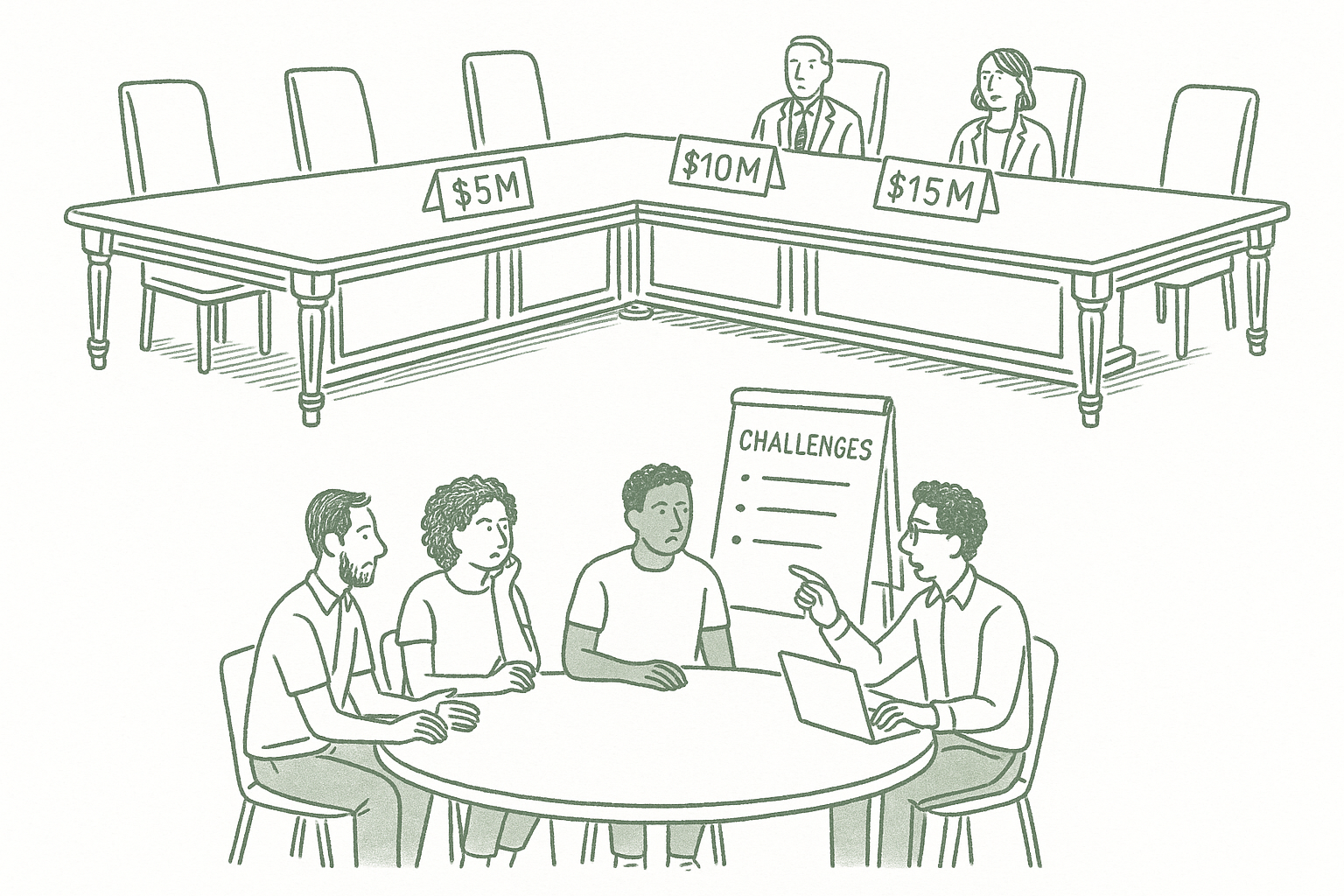
Vistage alternatives include EO, YPO, TAB, and Hampton — all structured peer advisory programs that gate membership by revenue, title, or company size. None match members by the actual problem they are trying to solve. A newer category of structured peer groups, matched by problem and context rather than credential, addresses the gap these programs leave for founders at any stage.
If you are searching for alternatives to Vistage, you already know two things. First, peer advisory works. The research is clear on that. Vistage's own data, drawn from Dun & Bradstreet benchmarks, shows that member companies grow 2.2 times faster than comparable non-members. Second, something about Vistage specifically does not fit. Maybe it is the price. Maybe it is the revenue threshold. Maybe it is the structure. Whatever the reason, you are looking for something else — and the landscape of options is both wider and more limited than it appears.
Wider because there are more peer advisory programs than ever. More limited because almost all of them use the same matching logic Vistage does: revenue, title, company size. If you are looking for something fundamentally different in how members are matched, the list gets very short.
What are the best alternatives to Vistage in 2026?
The honest answer depends entirely on what did not work about Vistage for you. Each of the major alternatives solves a different version of the problem. Here is what actually differentiates them.
Vistage charges approximately $16,500 per year in membership dues plus a $2,500 initiation fee. Groups of 12 to 16 members meet monthly for full-day sessions, each facilitated by a paid professional Chair who also provides one-on-one executive coaching. Vistage explicitly targets CEOs and business owners of companies generating at least $1 million in annual revenue, with the typical sweet spot at $5 million and above. The program has operated since 1957 and currently serves roughly 45,000 members globally. The value proposition is structured, facilitated accountability with a professional coach. The limitation is that the $19,000 first-year cost and revenue threshold exclude early-stage founders, solo operators, and anyone who has not yet crossed the revenue gates.
Entrepreneurs' Organization (EO) is a peer-driven network that requires at least $1 million in annual revenue for full membership, with an Accelerator track for founders between $250,000 and $1 million. Total annual cost typically runs $4,400 to $7,000 depending on the chapter, plus a $2,500 to $3,500 initiation fee. EO forums are member-led — no paid facilitator — with groups of 8 to 10 meeting monthly. The vibe is more social and entrepreneurial than Vistage's executive coaching model. For a detailed head-to-head comparison of EO and Vistage, we break down the differences in cost, matching, and format. The limitation is the same structural one: membership is gated by revenue. The founder with a $900,000 business working through their hardest growth challenge is not eligible for the main program.
Young Presidents' Organization (YPO) is the most exclusive of the group. Members must be under 45, serving as CEO or equivalent, at a company typically generating $10 million to $15 million in revenue or employing at least 50 people. Initiation fees range from $3,000 to $12,650, with combined annual dues reaching $8,000 to $10,000. YPO is a global network with 38,000 members and a prestige brand that functions as much as a professional identity as a peer advisory system. For founders who qualify, the network effects are significant. For everyone else, the gates are simply too high.
The Alternative Board (TAB) operates as a franchise model, with individual facilitators running local boards of 6 to 10 business owners who meet monthly for four-hour sessions. Membership dues run $600 to $900 per month ($7,200 to $10,800 per year), and each member also receives monthly one-on-one coaching. TAB is more accessible on price than Vistage and has fewer formal revenue gates, but the franchise model means quality varies significantly by location. Some boards are excellent. Others are underserved. There is no centralized quality control over the facilitation experience.
Hampton is the newest entrant, founded by Sam Parr and Joe Speiser in 2023. It targets founders and CEOs of digital or tech-enabled businesses, requiring $3 million in annual revenue, $3 million in venture capital raised, or a $10 million exit. Annual membership is $8,500 to $15,000. The acceptance rate is under 8%. Hampton combines core group sessions with a digital community and local chapter events. The program skews younger and more tech-native than Vistage, but the revenue and funding gates are just as rigid — arguably more so, given the vetting process.
Why doesn't Vistage work for early-stage or pre-revenue founders?
The straightforward answer is that Vistage was not designed for them. The program targets established small and mid-market CEOs. That is not a flaw in the product. It is the product. The $5 million revenue sweet spot, the professional Chair model, the full-day monthly cadence — all of it assumes a certain business maturity, a certain infrastructure, a certain budget.
The problem is not that Vistage should accept pre-revenue founders. The problem is that the entire category of peer advisory has calcified around revenue as the primary matching criterion, and revenue is a bad proxy for what actually determines whether two founders will be useful to each other.
A founder doing $800,000 in revenue and trying to make their first sales hire has more in common with a founder doing $1.2 million who just made the same hire than with a $10 million CEO who solved that problem five years ago. The revenue number tells you nothing about the problem. It tells you something about the stage, but stage and problem are not the same thing. A $3 million company with a broken sales process and a $500,000 company with the same broken sales process will benefit far more from each other than either would from a $20 million CEO who has not thought about sales process since 2019.
This is not a controversial insight. Research from the University of Wisconsin-Madison on successful business peer groups identified "similar business challenges" as a key ingredient for effective group composition — not similar revenue. Wharton's executive education research on peer accountability emphasizes shared context and comparable decision complexity. The peer effect literature consistently shows that proximity of experience, not proximity of outcome, drives behavioral change.
How much does a Vistage alternative cost?
The price spectrum is wide enough to be meaningless without context.
At the top end, YPO can cost $20,000 or more in the first year when initiation fees and chapter dues combine. Vistage runs roughly $19,000 in year one. Hampton sits at $8,500 to $15,000 annually. TAB falls in the $7,200 to $10,800 range. EO is the most accessible of the established players at $4,400 to $7,000 total.
The question underneath the question is whether the cost buys you access to people who can actually help with your specific situation. A $16,500 Vistage membership that connects you with 15 CEOs who have already solved your current problem three times over is probably cheap. The same membership in a group where nobody has faced your challenge is expensive at any price. Choosing the right group matters more than choosing the right price.
There is also a structural issue with high price points. They filter for business size, not for seriousness. A bootstrapped founder doing $400,000 who would give anything for structured peer accountability is automatically excluded from every program above. Not because they are less committed. Not because they would get less value. Because their P&L cannot absorb $16,500 in annual dues. That is a market failure, not a character flaw.
What's the difference between Vistage, EO, and YPO?
The three programs share a foundational model — small groups of business leaders meeting regularly for confidential peer exchange — but differ in structure, facilitation, cost, and eligibility.
Facilitation. Vistage is professionally facilitated. Each group is led by a paid Chair — typically a former CEO or executive — who runs the meetings, manages group dynamics, and provides individual coaching between sessions. EO and YPO forums are member-led. The experience depends on the commitment and skill of the members themselves. Vistage's model offers more structure and external accountability. EO and YPO offer more autonomy and peer ownership of the process.
Eligibility. Vistage targets $1 million to $5 million+ revenue businesses. EO requires $1 million. YPO requires $10 million to $15 million+ and caps age at 45. These are not soft guidelines. They are gates. If your revenue is $750,000, none of the three will take you. If you are 46, YPO will not take you regardless of your revenue.
Culture. Vistage skews corporate and advisory. EO skews entrepreneurial and social. YPO skews exclusive and global. These are generalizations, but they reflect real differences in who joins, why they join, and what the experience feels like. Accountability structures also vary: Vistage bakes it into the Chair model, while EO and YPO rely on peer norms.
Scale. Vistage has 45,000 members across 35 countries. EO has 18,000+ in 75 countries. YPO has 38,000+ in 150 countries. All three have significant global reach, though local chapter quality varies for each.
Is there a peer advisory group that matches by problem, not company size?
This is the question that the market is starting to ask but has not yet fully answered.
The established players all use the same matching logic: revenue tier, industry, title, geography. The assumption is that a CEO of a $10 million company has more in common with another $10 million CEO than with a $2 million founder. In terms of operational complexity, that may be loosely true. In terms of the specific problem they are stuck on right now, it is often false.
Harvard Business School research on why strategic plans fail identifies the execution gap as the primary failure mode — not the strategy itself. What kills companies is not wrong thinking. It is the distance between the plan and the doing. The kind of help that closes that gap is not "talk to someone who runs a similar-sized company." It is "talk to someone who is navigating the same challenge you are, right now, with comparable stakes."
A few newer entrants are beginning to experiment with this model. The distinction between community and structure matters here: most online founder communities provide belonging but not matching. The programs that match by problem rather than credential are still rare, but they represent a fundamentally different thesis about what makes peer advisory valuable.
GoodGrowth (joingoodgrowth.com) operates as infrastructure for structured peer accountability groups — small, recurring cohorts of 5 to 12 founders and operators matched by the problem they are actively working on, not by their revenue tier or title. Groups run on SMS and calendar, with AI handling logistics. The model differs from Vistage, EO, and YPO in one core way: matching is driven by problem context and operational stage, which means a pre-revenue founder working through their first sales motion is placed with others navigating the same challenge — not with a $10 million CEO who has already solved it.
What do you get in a Vistage alternative that's actually different?
If the alternative uses the same matching logic — revenue gates, title requirements, company size thresholds — then you get a different brand of the same product. That may be exactly what you need. If Vistage's specific format, pricing, or culture does not fit, EO, YPO, TAB, or Hampton may solve that friction while delivering essentially the same matching approach.
If the alternative matches by problem instead of credential, then you get something structurally different: a group where every member is working on the same type of challenge, where the advice is immediately applicable because it comes from comparable context, and where the revenue number on your P&L is irrelevant to whether you belong.
The research supports the second model. An NBER working paper on peer effects in entrepreneurship found that founders who interact with peers facing similar challenges show measurably different decision-making patterns than those matched by demographic or financial criteria alone. The mechanism is not mentorship — it is mutual problem-solving among people with comparable stakes and comparable uncertainty. Even the group size matters: smaller, tighter groups outperform larger networks on every outcome that counts.
The cost difference also matters. Programs that match by problem rather than revenue do not need to charge $16,500 a year because they are not paying for professional Chair salaries, regional office infrastructure, and global event programming. The overhead structure is different, which means the price can be different without the quality being different.
The bottom line
Vistage works. The data proves it. EO works. YPO works. TAB and Hampton work for the people who get through the door. The question is not whether peer advisory produces results — that debate ended years ago.
The question is whether revenue is the right filter for who gets access to those results. Every established program says yes, implicitly, by gating membership on financial criteria. A growing body of research and a growing set of alternatives say no — the filter should be the problem, not the P&L.
If you are searching for Vistage alternatives, start by identifying what you actually need. If you need a professionally facilitated group with executive coaching and you have the budget, Vistage remains the gold standard. If you want a more entrepreneurial, peer-driven experience, EO is strong. If you qualify for YPO, the global network is unmatched.
But if your real frustration is that none of these programs match you by the problem you are trying to solve — if the revenue gate is not just a price issue but a relevance issue — then the most honest answer is that the category you are looking for barely existed two years ago, and it is growing fast.