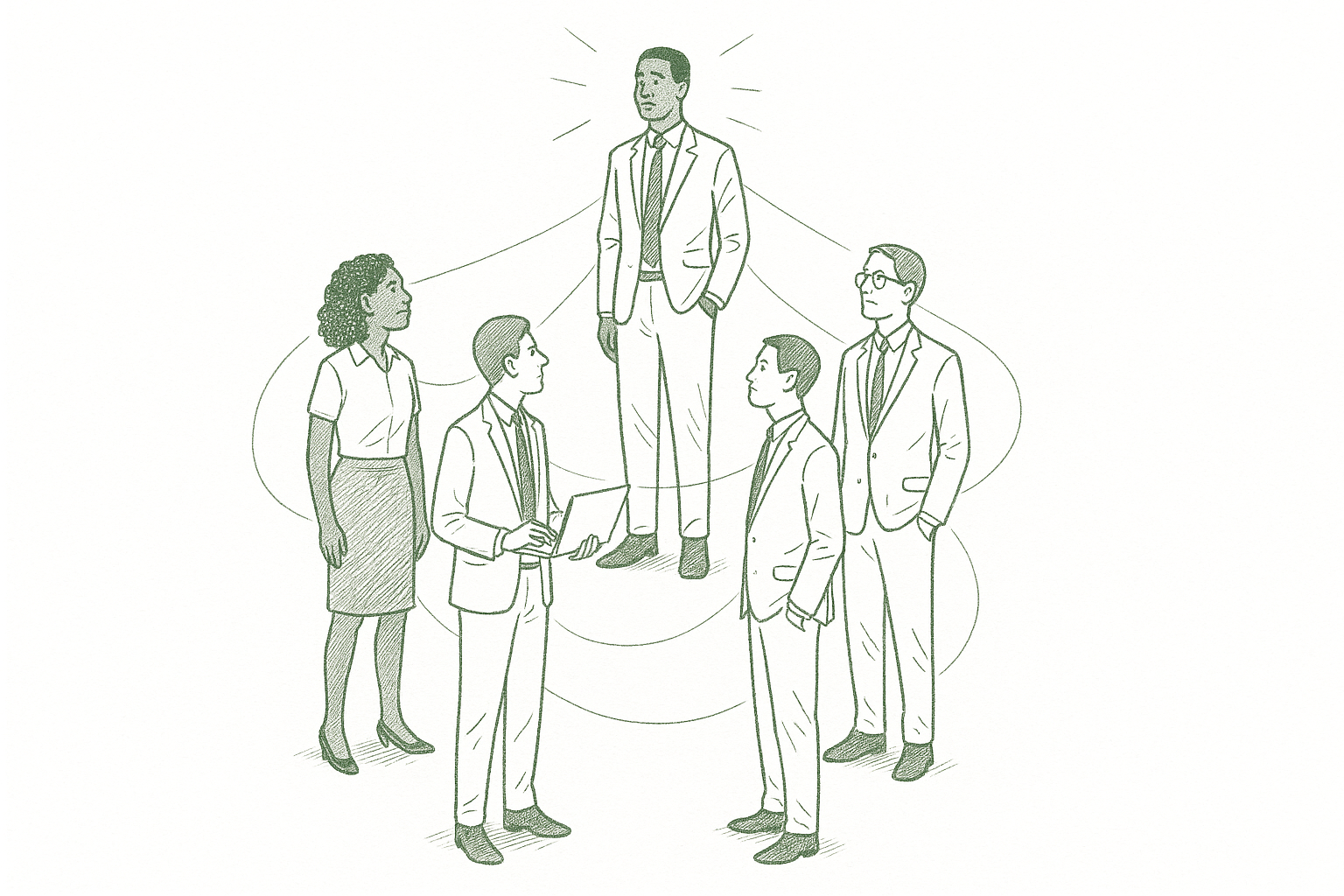
Jim Rohn said you're the average of the five people you spend the most time with. It's one of the most repeated lines in business culture. It shows up in commencement speeches, LinkedIn posts, and the opening monologue of every podcast about personal development. And for decades, it was treated as folk wisdom — the kind of motivational truism that sounds right but can't be proven.
Then researchers started proving it.
Over the past 25 years, economists, sociologists, and network scientists have built an enormous body of evidence around what academics call the "peer effect" — the measurable influence that the people around you exert on your behavior, beliefs, performance, and economic outcomes. The research spans randomized experiments at Dartmouth, 72-million-person datasets from Facebook, longitudinal studies tracking entrepreneurs across entire national economies, and controlled trials in accelerators and classrooms.
The findings are consistent and, in some cases, staggering. The people near you change what you do, what you earn, how you think, and whether you take the risks that define your career. Not metaphorically. Measurably. And the mechanisms are more specific — and more actionable — than Rohn's aphorism suggests.
The roommate experiment
The study that put peer effects on the map came from Dartmouth College. In 2001, economist Bruce Sacerdote published a paper exploiting an unusual feature of Dartmouth's housing system: freshman roommates are assigned randomly. No self-selection. No sorting by personality, academic ability, or background. Pure randomization — the gold standard for measuring causal effects.
Sacerdote tracked what happened when students were randomly placed with roommates who had different levels of academic preparation. The results were unambiguous. A student assigned to a roommate with a higher academic index saw their own GPA rise. A student assigned to a roommate with lower academic preparation saw theirs fall. The effect operated at the individual room level — not the building level, not the campus level. The person sleeping six feet from you changed how you performed.
The peer effects extended beyond academics. Roommate assignment predicted fraternity membership, social group participation, and academic effort. The influence wasn't about access to study notes or tutoring. It was about norms — what "normal" looked like when you woke up every morning. If your roommate studied, studying felt normal. If your roommate didn't, it felt optional.
Sacerdote's study has since been replicated and extended across dozens of universities and institutional settings. The core finding never changes. Place someone next to a different set of peers, and their behavior shifts. Not because they're told to change. Because the reference point for "normal" moves.
The 72 million friendships
In 2022, Harvard economist Raj Chetty published what may be the most ambitious social science study of its generation. Using anonymized data from 72.2 million Facebook users aged 25 to 44, Chetty and his team mapped the social networks of nearly every adult in America. They measured a concept they called "economic connectedness" — the share of a person's friends who come from higher-income backgrounds.
The headline finding landed like a bomb in economics circles: at the community level, cross-class friendship was the single strongest predictor of upward economic mobility. Stronger than racial segregation. Stronger than income inequality. Stronger than school quality. Stronger than family structure. The people you're connected to predicted where you'd end up better than almost any structural factor researchers had previously studied.
The data was granular enough to show the mechanism. Children from lower-income families who had friendships with higher-income peers ended up with higher incomes themselves as adults. A one percentile point increase in a person's own socioeconomic status corresponded to a 0.44 percentile point increase in the average status of their friends. At the top, the effect intensified: between the 90th and 100th percentile, the slope nearly doubled, meaning the highest-status people had disproportionately high-status friends.
Chetty's team also showed that the barriers to cross-class connection are not mainly about geography. In many communities, people from different income levels live near each other but never become friends. The researchers called this "friending bias" — a tendency to form connections within your own class even when cross-class connections are physically available. The problem is not that your network is too big. It's that it's too similar.
Three degrees of contagion
Yale physician and social scientist Nicholas Christakis, working with political scientist James Fowler, spent the better part of a decade mapping how behaviors spread through social networks. Their research, drawn from the Framingham Heart Study's longitudinal data on over 12,000 people tracked across 32 years, demonstrated something that still sounds improbable: your friends' friends' friends affect your behavior.
They called it the "three degrees of influence" rule. If a person becomes obese, the chances of their friend becoming obese increase by 57%. Their friend's friend faces a 20% increase. And the friend of a friend of a friend still shows a 10% elevation in risk. The effect held for happiness (a close friend's happiness increases your own likelihood of being happy by 15%), smoking cessation, loneliness, and even cooperation in experimental games.
The significance for business is hard to overstate. If behavior propagates three degrees out, then the peer group you choose does not just influence you directly — it propagates through you to your team, your partners, and your decisions. A founder making decisions in isolation is not just missing input. They're cutting themselves off from the behavioral contagion that shapes ambition, risk tolerance, and execution standards.
Peers make entrepreneurs
In 2010, Ramana Nanda and Jesper Sørensen at Harvard Business School and Stanford published a study using Danish labor market data that tracked every worker in the country over a 20-year period. They wanted to answer a specific question: does working alongside someone who has been an entrepreneur make you more likely to become one?
The answer was yes, and the effect was substantial. An individual was significantly more likely to start a company if their coworkers had prior entrepreneurial experience. The influence was strongest for people who had the least exposure to entrepreneurship elsewhere in their lives — meaning peer effects substituted for other sources of entrepreneurial models. If you didn't grow up around entrepreneurs and didn't go to school with them, the workplace peer effect was even more powerful.
A 2015 study from Wharton examined the same dynamic inside accelerators. Researchers tracked cohorts of startups going through the same programs and found that peer composition within a batch predicted venture outcomes. The startups that happened to be grouped with higher-performing peers performed better themselves — not because of shared resources, but because of exposure to higher norms, sharper feedback, and ambient competitive energy. The Y Combinator batch dynamic operates on exactly this principle: the batch matters more than the curriculum.
Why the mechanism matters
The peer effect is not a single phenomenon. Researchers have identified at least three distinct channels through which peers reshape outcomes.
Norm setting. The most powerful and least visible channel. When the people around you treat a certain level of effort, ambition, or quality as baseline, you unconsciously calibrate to that level. Sacerdote's roommate study captured this precisely — the influence was not about explicit advice or encouragement. It was about what felt "normal" in the environment. If your peer group treats $1 million in revenue as a ceiling, you'll approach it like a ceiling. If they treat it like a starting point, you will too.
Information transmission. Peers are efficient conduits for the kind of tacit knowledge that doesn't travel through books, courses, or conferences. How to negotiate a term sheet. What to do when a key employee quits. Which vendor is actually worth the premium. This is not information that appears in a Google search. It lives in the heads of people who've done the thing recently and are willing to share the specifics — not the abstracted, sanitized version they'd tell a journalist. Psychologists call this transactive memory — a shared cognitive system where each member stores different expertise and the group collectively knows more than any individual. In industries like real estate investing, this kind of peer-transmitted knowledge is often the difference between a deal that builds a portfolio and one that drains it.
Accountability pressure. Accountability is not a personality trait. It's a social structure. When you tell five people you're going to do something and those five people will ask you next week whether you did it, your completion rate goes up. Not because you suddenly gained willpower. Because you introduced a cost to not following through — the cost of saying "I didn't do it" in front of people whose opinions you value.
These three channels operate simultaneously and reinforce each other. A group that sets high norms also transmits better information (because the members are doing more ambitious things) and creates stronger accountability pressure (because falling short of higher norms is more visible). This is why the right peer group doesn't just add value incrementally. It compounds.
The selection problem
The obvious objection to all of this research is that correlation is not causation. Maybe high performers just find each other. Maybe the people in Chetty's dataset who had wealthy friends were already on an upward trajectory. Maybe the Dartmouth roommate thing was a fluke.
This is exactly why the most important peer effect studies use randomization or natural experiments that eliminate self-selection. Sacerdote's roommates were randomly assigned. Chetty's team used statistical techniques to isolate the causal component of cross-class connection from mere sorting. The Danish entrepreneurship study tracked workers who ended up at the same firm through the normal labor market — they didn't choose each other as entrepreneurial role models.
The consistency of the findings across methods, countries, and contexts is what makes the case so strong. Randomized studies and observational studies point in the same direction. Controlled experiments in labs match patterns in national datasets. The peer effect is not an artifact of selection. Selection matters, but the influence is real and operates on top of it.
That said, selection still matters practically. The size and composition of your peer group determines the magnitude of the effect. Five people in a room who all share the same blind spots will reinforce those blind spots. Five people who bring genuinely different experiences, industries, and perspectives will challenge each other's assumptions. The research shows that peer diversity — not just peer quality — amplifies the benefit.
What this means for founders
If you're running a company, the peer effect research says something specific and uncomfortable: the people you spend time with are actively shaping your business outcomes, whether you chose them deliberately or not.
Your reference group — the small set of people whose opinions you actually internalize — is setting your norms for revenue growth, hiring speed, product quality, and risk tolerance. If that group consists primarily of people who are not building anything, you will unconsciously anchor to a lower standard. If it consists of people who are two steps ahead of you, you'll stretch toward them.
This is not inspirational advice. It's a measurable effect that has been documented in randomized experiments. The question is not whether the peer effect is operating on you. It is. The question is whether you've been intentional about which peers are doing the influencing.
Most founders haven't. They default to the peer group that assembled itself — college friends, early coworkers, people they met at a conference once. That group may have been exactly right at one point. But as the founder grows and the business evolves, the peer group often stays static. The result is a kind of ambient loneliness — surrounded by people, but not by the right people. Connected, but not challenged.
The research is clear on what works. Small groups. Consistent meetings. Diversity of perspective within a shared level of ambition. Real accountability — the kind where someone asks "did you do it?" and waits for a real answer. These are the conditions under which the peer effect shifts from a passive background force to an active accelerant.
Three hundred years of history shows the same pattern. Franklin's Junto. The Fairchild Eight. The PayPal Mafia. The Inklings. In every case, a small group of deliberate peers produced outsized outcomes. The peer effect research explains why: these groups weren't lucky. They were structurally positioned to transmit norms, information, and accountability at maximum efficiency.
Jim Rohn was right. You are shaped by the people you spend time with. He just didn't have the data to prove it. Now we do.