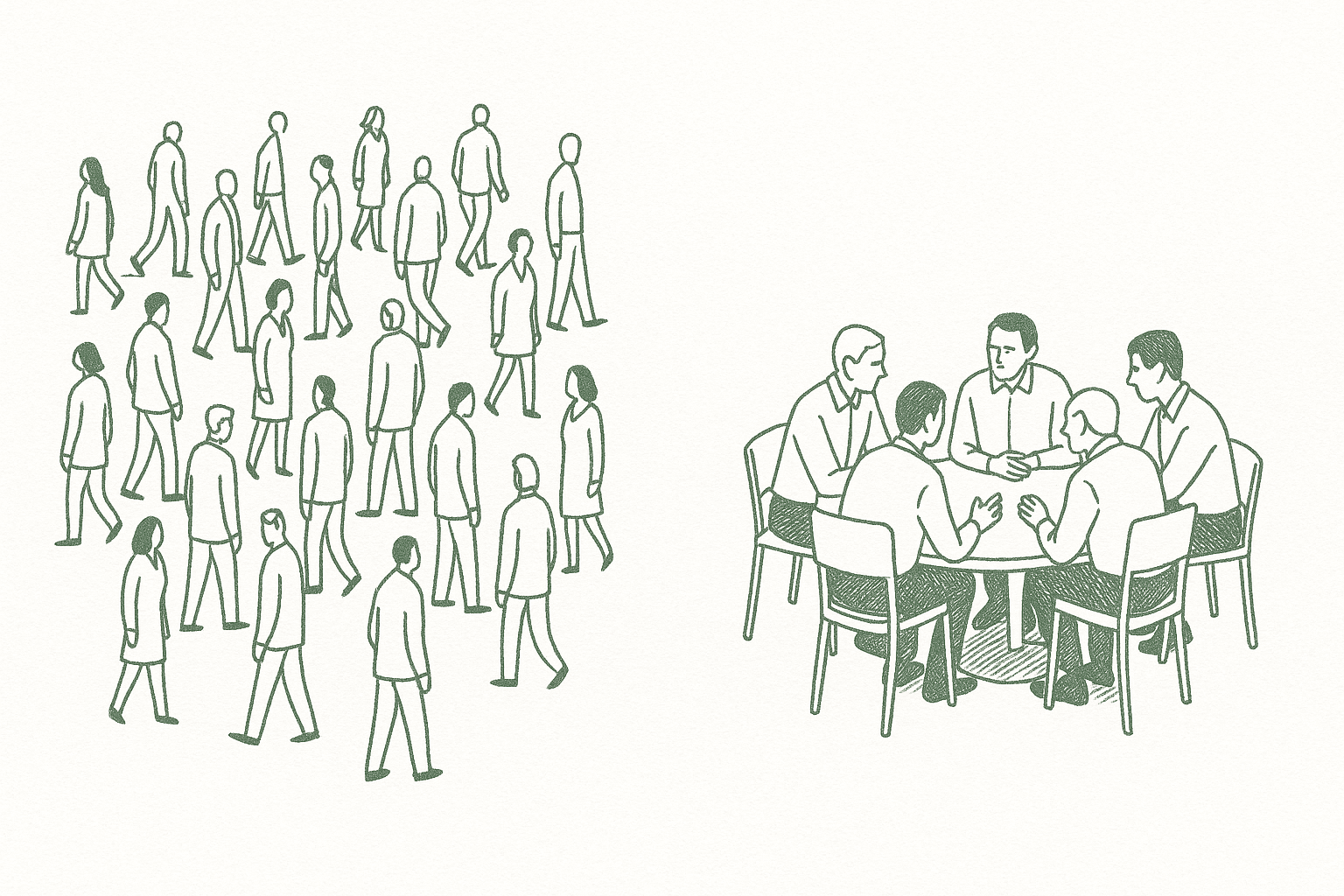
Community and structure are not the same thing. Community is a network you belong to. Structure is a system that makes specific demands on your time and behavior. Research on accountability and behavior change consistently shows that structure — not belonging — is what produces follow-through. You can be a member of a community and still do nothing.
The word "community" has done a lot of damage to a genuinely good idea.
Not because community is bad. Community — shared identity, shared context, the sense that other people understand what you're going through — is valuable. Humans are social animals. Belonging matters. The research on that is not ambiguous.
The damage comes from conflating community with structure. They are not the same thing. One is a feeling. The other is a mechanism. And the mechanism is what produces outcomes.
Right now, there are thousands of founder communities with active Slack channels, regular newsletters, occasional meetups, and sincere intentions. Most of their members are not meaningfully different from the day they joined. That's not a failure of community. It's a failure to understand what community alone can and cannot do.
What Community Actually Is
Community is identity. It's the knowledge that other people share your context — your industry, your stage, your problems. When a founder says "I finally found my people," they're describing community. When someone joins a Discord for bootstrapped SaaS founders or a Facebook group for agency owners, they're joining community.
This matters. The research on founder isolation is unambiguous: operating alone makes people worse at the most important parts of their job. The first thing a good community does is make founders feel less alone. That's worth something.
But feeling less alone and actually having someone in your corner are different things. Community provides the former. You need something else for the latter.
What Structure Actually Is
Structure is commitment made concrete. It's a fixed group, a consistent schedule, defined roles or format, and the social weight of mutual obligation. It's the difference between an open door and a standing appointment.
Benjamin Franklin's Junto Club, founded in Philadelphia in 1727, is the clearest historical model. Twelve members. Mandatory attendance. Each week, members came prepared to answer specific questions on morals, politics, and business — questions that Franklin wrote and distributed in advance. Miss too many meetings and you were out. The friction was not incidental. It was the design.
The YPO Forum works the same way. Groups of eight to ten CEOs meeting monthly with a structured protocol — the Gestalt method — that prohibits advice-giving and requires members to share from personal experience. Strict confidentiality. Required attendance. No guests. The YPO has grown to 38,000 members across 142 countries, and the forum — not the larger membership — is consistently cited as the most valuable part of the organization. Because the forum has structure. The membership is community.
Y Combinator operates on the same principle at a different scale. The accelerator's network of 11,000+ companies is community. The twelve-week batch — a small cohort of peers sharing metrics, sharing pressure, and watching each other's weekly growth — is structure. Ask YC alumni what the most valuable part of the program was. Most of them will say the batch, not the network. The structure outlasts the lessons.
Alcoholics Anonymous — which a 2020 Cochrane review found outperforms cognitive behavioral therapy for sustained abstinence — is not a community in the casual sense. It's a rigorously structured system: a sponsor relationship, mandatory step work, regular attendance at the same group with the same people over time. The "community" of AA is enormous. The structure is local, small, and consistent. The structure is what works.
The Mechanism: Why Structure Produces What Community Can't
Structure produces outcomes through three mechanisms that community — by design — cannot replicate.
First: repeated exposure builds context depth. Research by Richard Moreland on small group dynamics found that familiarity built through repeated interaction creates a form of "transactive memory" — group members develop accurate knowledge of each other's expertise, tendencies, and judgment over time. This is why advice from a peer who has known you for six months is categorically more useful than advice from a stranger in a forum. The stranger is pattern-matching your situation to their experience. The peer knows your history, your risk tolerance, the last three things you said you'd do and didn't. The advice lands differently.
Second: stated commitments to specific people increase follow-through. Gollwitzer and Brandstätter's 1997 research on implementation intentions found that stating a specific plan — when, where, and how you intend to act — dramatically increased follow-through rates. Later research found that the effect is compounded when the commitment is made to a specific person who will later ask about it. The accountability gap isn't a discipline problem. It's a witness problem. Commitments made to no one in particular are commitments made to no one.
Third: group cohesion requires time and consistency — it cannot be rushed. Irvin Yalom, whose eleven therapeutic factors remain the most cited framework in group psychology, identified cohesion as the foundational variable: the condition on which all other beneficial group outcomes depend. In his work, cohesion is not a personality fit or a shared interest — it's a product of accumulated shared experience, mutual disclosure, and the knowledge that the group will still exist next month. You cannot build cohesion in a group of 4,000 people with rotating membership. The research on optimal group size points to the same constraint: five to eight people is where cohesion becomes achievable and where individual accountability remains inescapable.
Why Structure Feels Unfriendly
The thing that makes community appealing is exactly what makes it ineffective: it's optional. Low friction to join, lower friction to leave. No cost to showing up inconsistently. No one notices when you go quiet.
Structure feels hostile by comparison. Fixed schedule. Required attendance. Commitments you'll be asked about. Some people read this as rigid. The better reading is that it's caring. A group designed around optional participation is a group designed to let you off the hook. A group designed around commitment is a group designed around the assumption that you'll actually show up — and that the other people will, too.
Robert Putnam's Bowling Alone drew a sharp distinction that still holds: passive membership generates almost no social capital. Clicking join, attending occasionally, reading the newsletter — these produce the feeling of belonging without the substance of it. Active participation — showing up to the same place with the same people on the same schedule — generates the kind of social capital that actually changes behavior. The form of participation matters as much as the fact of it.
Slack communities are passive membership by design. The format makes demanding structure nearly impossible. So are most networking events — optimized for breadth, not depth; for meeting people, not knowing them. Neither is a substitute for a room where five specific people will ask you next month whether you did what you said.
The One Test
There is a single question that tells you whether you have community or structure:
Will someone ask you in thirty days whether you did what you said you'd do?
Not "could someone, in theory" — but will someone, specifically, because it's on the agenda and they know what you said?
If the answer is yes, you have structure. That's the mechanism. (Here's what else to look for before you commit.) Everything else — the shared identity, the belonging, the sense that other people get it — is valuable context that makes the structure warmer. But the structure is doing the work.
If the answer is no, you have community. That's not nothing. But it's not what changes what you do Monday morning.
Most founders have plenty of community. They are members of things, followers of people, part of spaces. What most of them don't have is a small group that meets consistently, knows their actual situation, and will ask the uncomfortable question next month.
That's the gap. It's not a belonging problem. It's a structure problem.
GoodGrowth builds the structure. Groups of 3–5 founders, consistent meeting cadence, a single purpose: getting the things done that you've been avoiding. Not a community. A group.
GoodGrowth is infrastructure, not community. It powers structured peer accountability groups for founders — specific people, specific problems, specific commitments, tracked between sessions. The coordination layer runs on SMS and calendar. No community feed. No platform to manage. The structure is the product.