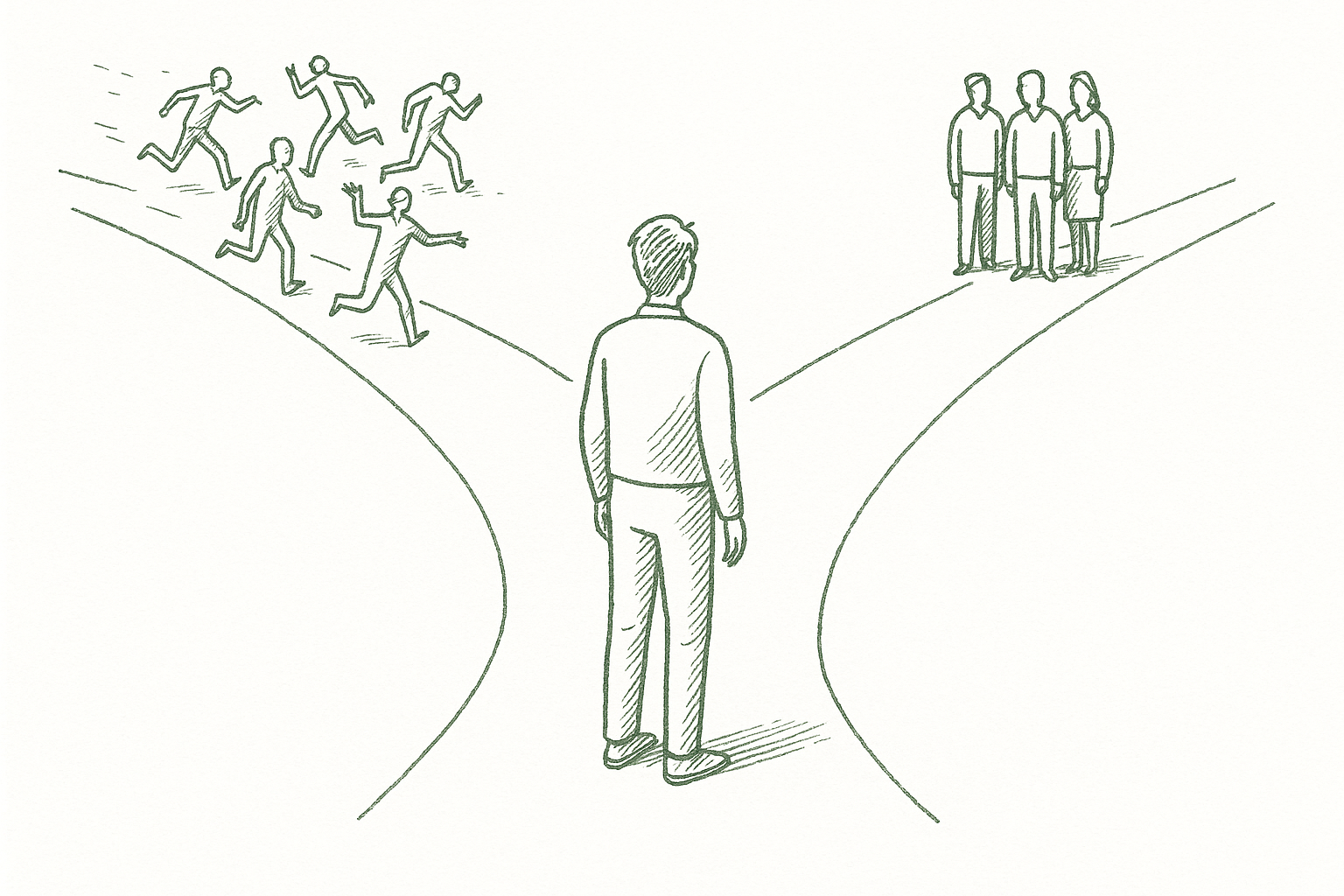
The concept is simple enough. A small group of peers meets on a regular cadence to help each other think through hard problems. The format has existed for at least 300 years, from Ben Franklin's Junto to YPO forums to the thousands of paid masterminds operating today. At their best, these groups produce decisions you wouldn't reach alone, relationships that outlast any single transaction, and a kind of accountability that no app or coach can replicate.
At their worst, they produce nothing. A year of polite conversations that never got uncomfortable enough to be useful. Thousands of dollars spent on what amounted to a recurring calendar event with nice people.
The difference between these two outcomes is not luck. It is selection. And most people get it wrong because they evaluate masterminds the way they evaluate conferences: by the branding, the price tag, and the celebrity of the facilitator. None of those things predict whether the group will actually help you.
Five things that actually matter
1. Composition over credentials. The single most important variable is who else is in the room. Not their titles. Not their revenue numbers. (If you are comparing specific programs, we wrote a full breakdown of Vistage alternatives and how they match members.) Whether they are close enough to your stage and situation that their feedback is relevant, and different enough in background that their perspective actually adds something. A Forbes Coaches Council survey of mastermind facilitators found the consistent factor in effective groups: "diverse in experience but aligned in values." A room full of people who are exactly like you produces an echo chamber. A room where nobody shares your context produces advice that doesn't apply. The sweet spot is narrow, and groups that don't curate for it are hoping to get lucky. (For a concrete example of how stage-matching changes outcomes, look at how architecture firm owners benefit from peers at similar practice sizes.)
2. Structure over vibes. The research on small group effectiveness is unambiguous on this point: groups that follow a defined meeting structure outperform unstructured ones — whether they meet online or in person. That means timed agendas, hot seats with defined problem statements, accountability check-ins, and clear rules about feedback. Community gives you the feeling of belonging. Structure gives you outcomes. If a group can't explain its meeting format in specific terms, it doesn't have one.
3. Size. The research converges on four to eight members as optimal. Google's Project Aristotle studied 180 teams and found that the best-performing groups were small enough for every member to contribute and be heard. Vistage, whose members stay an average of five years, caps its peer advisory boards at sixteen and considers the smaller forum groups more effective. The magic number keeps showing up across six decades of organizational research. If the group you are considering has more than ten members, you are not in a mastermind. You are in a seminar with a chat feature.
4. The facilitator's job description. There are two kinds of mastermind leaders: those who see themselves as the expert in the room and those who see themselves as the person keeping the room productive. The first kind gives you their advice. The second kind draws out the group's intelligence. The best facilitators talk less than any individual member. They redirect, they challenge, they enforce time. They do not lecture. If the facilitator is the star of the group, you are paying for a coaching program with an audience, not a peer advisory experience.
5. Commitment enforcement. Psychological safety doesn't mean comfort. It means you can be honest without social penalty. That requires trust. Trust requires consistent attendance, prepared participation, and consequences when people don't show up. The groups that work have explicit attendance policies. The groups that die have members who "couldn't make it this month" four months in a row and nobody said anything.
The red flags nobody warns you about
A bad mastermind is not always obvious. Some of the most expensive groups in the market — $25,000, $50,000 a year — are structurally broken. Here's what that looks like from the inside.
The coffee klatch. You meet every month. Conversations are friendly. Nobody leaves uncomfortable. And nothing changes between meetings because nobody was pushed to commit to anything specific. The group has become a social event that happens to discuss business. This is the most common failure mode, and it is the hardest to spot because it feels pleasant.
The one-way street. Two or three members get enormous value. The rest listen politely and wonder why they don't feel the same way. Good groups balance giving and receiving over time. If you are consistently giving more than you are getting — or vice versa — the composition is wrong.
The echo chamber. Everyone agrees with everyone. The whole point of a peer group is to get perspectives you can't generate on your own. If the group never produces a disagreement, it is not producing value. It is producing validation, and validation is the enemy of growth.
The guru show. The facilitator has become the center of gravity. Members defer to them. Hot seats become coaching sessions between the facilitator and one member while everyone else watches. The peer-to-peer dynamic — which is the entire mechanism — has been replaced by a one-to-many dynamic that costs ten times what a coaching session would.
The question to ask before you join anything
If you are starting your own group or evaluating an existing one, the same filter applies. Before you commit time and money to a mastermind, ask one question: Can I see the meeting format, and can I talk to two current members?
If the answer to either is no, walk. A group that won't show you how it runs is selling an experience, not a process. (Here's what a real mastermind meeting actually looks like.) A group that won't connect you with members doesn't trust its own product.
If the answer is yes, ask those members two things: What was the last hard decision you made differently because of this group? And what's one thing you wish the group did better?
The first question tests whether the group produces outcomes. The second tests whether the members are honest. If they can't answer the first, the group is a coffee klatch. If they won't answer the second, the group is a cult.
The right mastermind is not the one with the best website or the highest-profile members. It is not the one that feels the most like networking. It is the one where, after every meeting, you leave with something specific to do that you wouldn't have done on your own — and someone who is going to ask you next month whether you did it.
That's the whole test. Everything else is marketing.