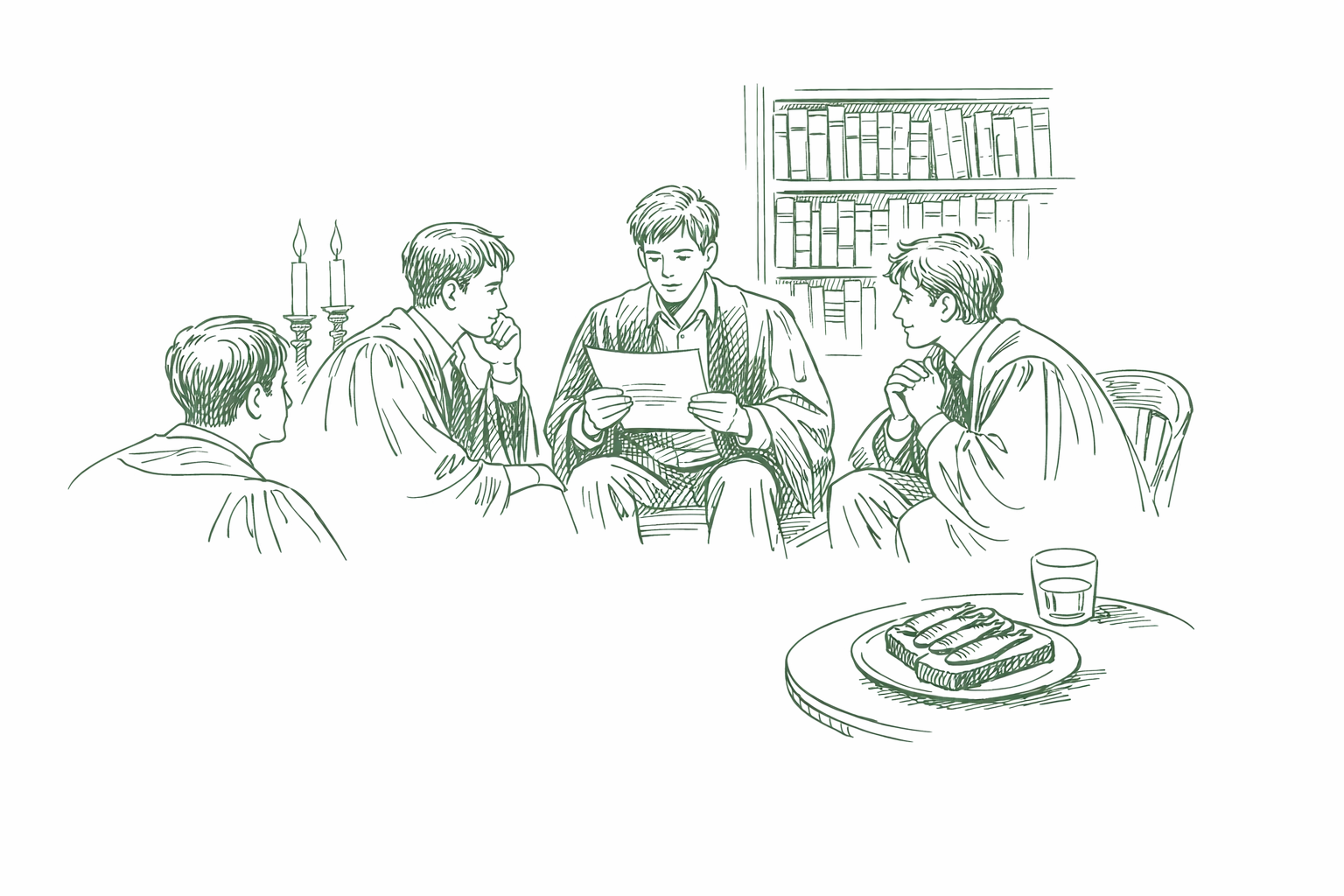
On a spring evening in 1820, a Cambridge undergraduate named George Tomlinson invited eleven friends to his rooms at St John's College. They were Tory, evangelical, mostly studying divinity. They did not know they were founding anything. They just wanted somewhere to argue.
Tomlinson proposed a standing Saturday night meeting — a "Conversazione Society" — where one member would present a paper on a chosen topic, then the group would debate it, then they would vote on a tangentially related question. Sardines on toast would be served. Coffee would flow. The proceedings would be secret.
The group capped itself at twelve members. Someone noticed the resemblance and gave the society its nickname: the Apostles. Tomlinson went on to become the first Bishop of Gibraltar. But the Saturday night meetings continued. They are still continuing now, more than two centuries later. And along the way, the Apostles produced one of the most extraordinary concentrations of talent in the history of Western thought.
The format that survived two centuries
What made the Apostles durable was not their members. It was their ritual. Every Saturday evening during Cambridge terms, the Apostles gathered in the rooms of whichever member was hosting that week. One member — chosen by lot the previous meeting — read a prepared paper on a philosophical, ethical, or political question. The paper could be serious or absurd, but it had to take a position.
Then the room argued. Not politely. Not diplomatically. The Apostles developed a culture of radical candor that made some members uncomfortable and made others into the sharpest thinkers of their generation. Ludwig Wittgenstein, already a difficult personality, was elected in 1912 and promptly resigned — he found the style of humor intolerable. He later returned in the 1920s, having apparently decided the intellectual pressure was worth the discomfort.
After the debate, the group voted on a question related to the paper's theme. Then lots were drawn for the next week's topic and speaker. The meeting closed. The sardines on toast — which the Apostles called "whales" — were finished. Everyone went home.
Two hundred years. The same format. Present, argue, vote, eat. It is the simplest possible structure for a peer group, and it has outlasted empires.
The Victorian Apostles: Tennyson, Hallam, and a friendship that shaped English poetry
The Apostles' first brush with lasting influence came in 1829, when a painfully shy undergraduate named Alfred Tennyson was invited to join. Tennyson had arrived at Trinity College carrying enormous potential and enormous self-doubt. The Apostles gave him both an audience and a peer he could not have found anywhere else: Arthur Henry Hallam.
Hallam was everything Tennyson was not — charismatic, socially confident, intellectually fluent in conversation. Their friendship, forged in Saturday night debates about poetry and ethics, became the most important relationship in Tennyson's life. They traveled across Europe together. Hallam became engaged to Tennyson's sister. They planned a lifelong companionship.
Hallam died suddenly in 1833, at twenty-two, of a cerebral hemorrhage in Vienna. Tennyson spent the next seventeen years writing In Memoriam A.H.H., the long elegy that would become one of the defining poems of the Victorian era and help make Tennyson the Poet Laureate of England. Queen Victoria herself said it was her consolation after the death of Prince Albert.
The point is not that the Apostles produced a great poet. Cambridge was full of talented writers. The point is that the Apostles produced a relationship between two people who sharpened each other — a relationship that would not have existed without a structured space for deep intellectual exchange. Tennyson did not find Hallam in a lecture hall. He found him at a Saturday night meeting where people were expected to say what they actually thought.
Moore, Russell, Keynes: the Saturday nights that rewired the 20th century
The Apostles' golden age arrived around the turn of the twentieth century, when the society drew from King's College and Trinity a cluster of minds that would reshape philosophy, economics, mathematics, and literature.
G.E. Moore was elected in 1894. Bertrand Russell joined around the same time. The two philosophers — Moore's moral philosophy and Russell's logic — would become foundation stones of twentieth-century analytic philosophy. But they did not develop their ideas in isolation. They argued them out, week after week, in a room full of people who were smart enough to challenge them and honest enough to tell them when they were wrong.
When Moore published Principia Ethica in 1903, it landed like a bomb — not in the philosophy departments, but among the younger Apostles. John Maynard Keynes, who had been elected in 1903, later wrote that the book's publication was "the opening of a new heaven on a new earth." Moore's argument — that the highest goods were aesthetic appreciation and personal friendship — became the intellectual framework for what would become the Bloomsbury Group.
That is not a coincidence. It is a pipeline. The Apostles were the incubator. Bloomsbury was the output. Keynes, Leonard Woolf, Lytton Strachey, E.M. Forster — they all met through the Apostles, absorbed Moore's philosophy through the Apostles, and carried the values they had debated on Saturday nights into the drawing rooms of Gordon Square where Bloomsbury took shape.
Keynes went on to invent modern macroeconomics. Woolf married Virginia Stephen and together they founded the Hogarth Press. Strachey reinvented biography with Eminent Victorians. Forster wrote A Passage to India and Howards End. Russell won the Nobel Prize in Literature. Every one of them traced their intellectual formation back to Saturday nights in a Cambridge room, eating sardines and arguing about whether truth was more important than beauty.
The Wittgenstein problem: what happens when the room is too honest
In 1912, Keynes and Russell recruited Ludwig Wittgenstein — a young Austrian engineering student who had come to Cambridge to study logic — into the Apostles. On paper, he was perfect: brilliant, original, obsessive about philosophical precision. In practice, it was a disaster.
Wittgenstein hated the Saturday night format. Not the intellectual rigor — he craved that. But the social conventions, the humor, the lighthearted debating style. He found it unbearable that people would mix serious philosophy with jokes. He resigned almost immediately.
But when he returned to Cambridge in 1929, after publishing the Tractatus Logico-Philosophicus and working as a schoolteacher and a gardener and a hospital porter, he rejoined the Apostles. Something had changed. Not the society — they were still eating whales and arguing on Saturday nights. Wittgenstein himself had changed. He had learned, through years of painful isolation, that the discomfort of being in a room with people who think differently from you is not a bug. It is the mechanism.
The Apostles' culture of candid debate was hard. It was supposed to be hard. The secrecy of the meetings existed specifically to encourage the kind of honesty that polite society does not permit. Members were sworn not to discuss what happened inside the room with outsiders — not to protect reputations, but to protect the quality of the argument. When you know nothing you say will leave the room, you say things you would never say in public. That is where the real thinking happens.
The "Angels" network: why graduation was not the end
One of the Apostles' most significant structural decisions was what happened to members after they left Cambridge. Former members were not cut off. They became "Angels" — permitted to attend meetings whenever they returned to Cambridge, and expected to maintain relationships with active members.
This created something rare: a small, deep network that stretched across decades and career stages. When Keynes needed intellectual sparring partners while writing The General Theory, he had them — people who had been arguing with him since they were twenty, who understood his thinking well enough to challenge it at the level it needed to be challenged.
The "Angels" tradition meant that every active Apostle was connected to a living network of former members who held positions across government, academia, publishing, and the arts. It was not a LinkedIn connection. It was a bond formed in a room where you had been forced to defend your worst ideas in front of the smartest people you knew. That kind of bond produces a different quality of relationship — one where you can pick up the phone twenty years later and have a conversation that starts at a level most people never reach.
G.H. Hardy, the great mathematician, was an Apostle. So was Alfred North Whitehead, Russell's collaborator on Principia Mathematica. So was the poet Rupert Brooke. So was Amartya Sen, the Nobel Prize-winning economist, who was elected in the 1950s. The society's influence stretched across two centuries because the network persisted. Saturday nights ended, but the relationships — and the standard of intellectual honesty they had established — did not.
The shadow side: when trust produces treachery
The Apostles' story has a darker chapter. In the 1930s, the society recruited a group of members who would become the most notorious spy ring in British history: the Cambridge Five. Guy Burgess, Anthony Blunt, and John Cairncross were all Apostles. They used the trust and secrecy the society had built — the same qualities that made the Saturday night debates so productive — to pass British secrets to the Soviet Union for decades.
The betrayal was devastating not because the spies were Apostles, but because the society's culture of radical trust made the espionage possible. When you build a group where people share their deepest convictions and are bound by secrecy, you create a space where genuine intellectual honesty can flourish. You also create a space where deception, if someone chooses it, can hide behind the same bonds that make honesty possible.
It is the fundamental risk of any small group built on trust and accountability. The same structure that produces Keynes can produce Burgess. The intimacy that allows breakthrough thinking also allows exploitation. The Apostles survived the spy scandal, but the lesson is worth noting: the power of a small group comes from its trust, and that trust is only as good as the people in the room.
Why the format works: structure over talent
Cambridge has always had brilliant students. The Apostles did not create talent. They created conditions — specific, repeatable conditions — under which talent could compound.
The conditions were simple. A fixed schedule — every Saturday night, no exceptions. A fixed format — one paper, one debate, one vote. A fixed size — small enough that everyone had to participate, large enough that there was real diversity of thought. Secrecy — so people would say what they actually believed instead of what sounded good. And continuity — the "Angels" system ensured that the network outlived anyone's time at Cambridge.
These are not exotic ingredients. They are the basic architecture of any functioning peer group. Regularity. Structure. Candor. Commitment. The Apostles did not succeed because they found twelve geniuses and put them in a room. They succeeded because they built a room that made twelve people sharper than they would have been alone. And then they kept running the room for two hundred years.
Keynes did not need the Apostles to be brilliant. He was brilliant anyway. But the Apostles gave him Moore's philosophy to argue about, Russell's logic to test his thinking against, and Strachey's literary intelligence to keep him honest. The group did not create Keynes. The group created the version of Keynes who could write The General Theory — the thinker who was not just smart but calibrated, challenged, refined.
That is what two centuries of Saturday nights produce. Not genius. Sharpened genius. The kind that only comes from being in a room where someone will tell you when your paper is weak, your argument is lazy, or your thinking is not as original as you believe it is. The kind that only comes from a structure that keeps showing up, keeps demanding something of you, and keeps refusing to let you settle for less than your best thinking.