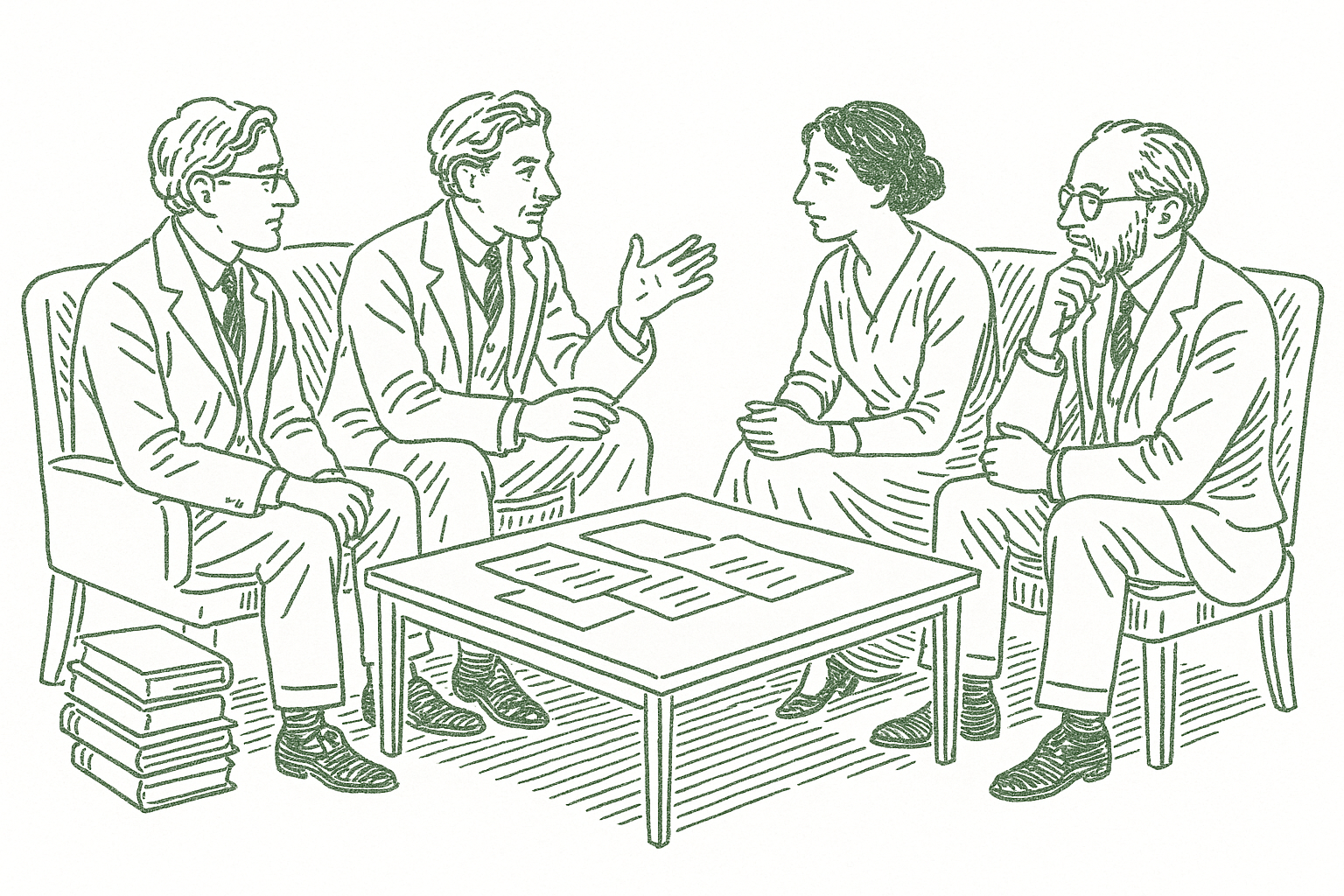
In 1905, a 26-year-old woman named Vanessa Stephen began hosting Thursday evening gatherings at 46 Gordon Square, Bloomsbury. Her sister Virginia came. Their brother Thoby brought his Cambridge friends — Lytton Strachey, Leonard Woolf, Clive Bell, Saxon Sydney-Turner. They drank cocoa, sat on the floor, and argued about philosophy, art, and what constituted the good life. There was no agenda. No formal membership. No dues.
Over the next thirty years, that drawing room gathering produced Virginia Woolf's Mrs Dalloway and To the Lighthouse. John Maynard Keynes' The General Theory of Employment, Interest and Money — the most influential work in 20th-century economics. E.M. Forster's A Passage to India. Lytton Strachey's Eminent Victorians, which dismantled the Victorian biographical tradition and invented a new one. Roger Fry's introduction of Post-Impressionism to Britain, which changed what British artists thought was possible. Vanessa Bell and Duncan Grant's contribution to modern British painting.
The Bloomsbury Group also shaped modern attitudes toward feminism, pacifism, and sexual identity — often decades before those conversations were considered respectable. Woolf's A Room of One's Own (1929) and Three Guineas (1938) remain foundational texts. Keynes' economic framework built the post-war welfare state. Strachey's frankness about homosexuality — in a country where it remained illegal until 1967 — helped shift what intellectual culture was willing to say out loud.
That is an absurd amount of output from one small group. The question worth asking is not what they produced. It's why — and how a cluster of ten people managed to reshape multiple fields simultaneously.
The answer has almost nothing to do with individual genius. It has almost everything to do with the structure and conditions of the group itself.
How they actually started
The story begins not at Gordon Square but at Cambridge, several years earlier. In 1899, Thoby Stephen arrived at Trinity College and befriended Lytton Strachey, Leonard Woolf, Saxon Sydney-Turner, and Clive Bell. Most of them were subsequently elected to the Cambridge Apostles — a semi-secret intellectual society founded in the 1820s whose alumni had included Tennyson, Alfred Hallam, and Bertrand Russell. The Apostles operated on a simple model: one member presented a paper on a serious question each week; the rest discussed it. It was structured, rigorous, and deeply committed to the idea that real conversation required genuine intellectual stakes.
When these Cambridge men came down to London and were introduced to Thoby's sisters — Vanessa and Virginia, both formidably intelligent, both living without the university education that had been available to their male counterparts — something unusual happened. The drawing room at Gordon Square became, in Leonard Woolf's phrase, "Cambridge in London." The Apostles' discipline of serious conversation found a new venue. And now it included women.
That detail matters. Victorian society had rigid norms about mixed intellectual company. Young women of Vanessa and Virginia's class were not expected to engage in philosophical argument with men. The Thursday evenings were transgressive by design — Woolf later described the early gatherings as a kind of liberation. "We were full of experiments and reforms," she wrote. "We were going to do without table napkins... we were going to paint, to write, to have coffee after dinner instead of tea at nine o'clock."
The informality was strategic. It lowered the cost of being wrong. You could advance a half-formed idea in a drawing room in a way you couldn't in a formal setting. Strachey, one of the group's most acerbic intellects, was notorious for the quality of his criticism — but because the context was a living room among friends, not a lecture hall, the feedback landed differently. It sharpened without wounding. The group built, over time, the rare capacity to be genuinely honest with each other.
The philosophy underneath everything
The Bloomsbury Group had a shared intellectual foundation that is easy to miss amid the biographical complexity of who was sleeping with whom and who owned which Sussex farmhouse. That foundation was G.E. Moore's Principia Ethica, published in 1903.
Moore's book was, in essence, an attempt to define what is actually good — not what Victorian morality said was good, but what was intrinsically valuable in human experience. His answer: "the pleasures of human intercourse and the enjoyment of beautiful objects." By which he meant love, art, honest friendship, and intellectual engagement. Not duty. Not social convention. Not religious obligation.
Keynes, who had read Moore at Cambridge, later wrote that Principia Ethica was "the beginning of a new renaissance, the opening of a new heaven on a new earth." He was not speaking hyperbolically. For the Bloomsbury Group, Moore's framework was a shared operating system — a common language that let people with very different interests (economics, fiction, painting, biography, philosophy) talk to each other productively across disciplines. They didn't agree on everything. But they agreed on what mattered.
This is a feature of the best peer groups that rarely gets articulated clearly. It's not enough to gather intelligent, ambitious people in a room. The depth of a peer relationship is not determined by how many people you know — it's determined by the quality of shared context. The Bloomsbury Group had shared context in abundance. They had read the same books, wrestled with the same questions, been shaped by the same intellectual environment. That common ground was load-bearing. It was what allowed Woolf and Keynes to have a genuinely productive conversation despite working in fields that had almost nothing superficially in common.
What made the group work
The Bloomsbury Group was not a formal institution. It had no officers, no membership cards, no governing rules. What it had was consistency, proximity, and genuine mutual investment.
Consistency first. The Thursday evenings ran for years. Not as occasional gatherings but as a standing commitment. The group also spent extended periods together at Charleston Farmhouse in Sussex, where Vanessa Bell and Duncan Grant eventually settled — weeks at a time, working in adjacent rooms, sharing meals, seeing each other's work in progress before it was finished. The regularity created a rhythm that allowed for longer conversations than any single evening could hold. Ideas could be introduced, dropped, picked up two months later, challenged, refined.
Proximity was deliberate. When Thoby died of typhoid fever in 1906 at the age of 26 — a death that devastated the group and paradoxically drew them closer together — Virginia and Vanessa moved to nearby houses in Fitzroy Square. Keynes lived at 46 Gordon Square for years. Leonard Woolf settled nearby after returning from Ceylon. They were not just socially acquainted. They were neighbors, in a period when living near someone meant seeing them constantly. The texture of daily proximity created a kind of shared reality — they knew what each other was actually working on, struggling with, afraid of.
Mutual investment was the third element. The Bloomsberries actively supported each other's careers and reputations in ways that were sometimes criticized as cliquish but were also simply practical. Virginia and Leonard founded the Hogarth Press in 1917, which published early Woolf manuscripts, T.S. Eliot's The Waste Land, the early writings of Freud in English translation, and works by Gertrude Stein. Keynes' patronage of the arts — he helped found the Arts Council of Great Britain and funded the Cambridge Arts Theatre — created infrastructure that benefited visual artists including Duncan Grant. Roger Fry organized exhibitions that gave Vanessa Bell's work a public platform. The group functioned as a mutual promotion network before the concept had a name.
Leonard Woolf described this dynamic explicitly: "The Bloomsberries promoted one another's work and careers just as the original Claphamites did." He meant this as a defense against critics who accused the group of nepotism. But it's also just an accurate description of how successful peer networks function: people who are genuinely invested in each other's success create conditions where more success is possible for all of them. This is what the PayPal Mafia figured out a century later — that staying connected after the original company meant you could keep leveraging the same network of trust, talent, and mutual investment across dozens of ventures.
The honesty premium
The Bloomsbury Group was famous — or infamous, depending on your perspective — for directness. Lytton Strachey's critical method, which he deployed on friends and strangers alike, was dissective to the point of cruelty. Virginia Woolf's diary, which she kept for most of her adult life, is full of sharp assessments of everyone in the group's work and character. The letters between members are bracingly honest — they criticized each other's books, questioned each other's decisions, and argued about ideas without the social softening that polite Victorian convention demanded.
This was not comfortable. Woolf's letters include accounts of the sting of Strachey's criticism and the challenge of Keynes' relentless questioning. But it produced work of an entirely different quality than what any of them had produced before the group formed. Woolf's early novels are technically accomplished but largely conventional. Her work after years inside Bloomsbury's critical culture — Mrs Dalloway, To the Lighthouse, The Waves — is experimental in ways that would not have been possible without peers willing to take the experiments seriously and push back on what wasn't working.
The mechanism here is well-documented by research on what makes groups actually produce great outcomes. Psychological safety — the capacity to take intellectual risks without fear of status loss — is the precondition for genuine creative output. The Bloomsbury Group had it not because everyone was unfailingly kind, but because the group's norms made honest engagement the baseline. The mutual commitment to Moore's framework — to the value of truth, beauty, and love — meant that criticism was understood as service, not attack. They were all pointed at the same thing. That made feedback survivable.
Keynes and the economics outlier
John Maynard Keynes is the member of the Bloomsbury Group most likely to surprise people unfamiliar with the group's full scope. He was not a writer or painter. He was an economist — and by the time of his death in 1946, the most influential one in the world. The framework he developed through the 1920s and 1930s, culminating in The General Theory (1936), fundamentally changed how governments understood their relationship to the economy. Every major Western government's response to recession since then has operated, at least partly, inside a Keynesian framework.
What was Keynes doing in a drawing room with novelists and painters? The answer says something important about how the best peer groups work. He wasn't there because their work was directly relevant to his. He was there because the quality of conversation was different from anything else available to him. In a room with Woolf and Strachey, Keynes encountered questions about value, beauty, human motivation, and what constitutes flourishing — questions that shaped the moral underpinnings of his economic thinking in ways that purely technical economics couldn't have produced.
His biographer Robert Skidelsky has argued that Keynes' economics cannot be fully understood without his Bloomsbury context — that his insistence on the human, non-mechanical dimension of economic life, his skepticism about purely mathematical models, his attention to uncertainty and animal spirits, all bear the marks of a man who spent decades arguing with people whose frames of reference were radically different from his own.
The cross-pollination was mutual. Virginia Woolf's A Room of One's Own was delivered as lectures at Cambridge in 1928. Its argument — that a woman must have money and a room of her own to write fiction — is partly an economic argument, one that reflects years of proximity to serious thinking about material conditions and their effects on human possibility. The conversation ran in both directions.
Why it eventually ended
The Bloomsbury Group's most intense period was roughly 1907 to 1930. By the early 1930s, as Britannica's history notes, it had "ceased to exist in its original form, having by that time merged with the general intellectual life of London, Oxford, and Cambridge." At Oxford, the Inklings were just getting started — a peer group that would use the same Thursday-evening format to produce The Lord of the Rings and The Chronicles of Narnia. The success was partly the cause of dissolution. When Woolf became one of the most celebrated novelists in England and Keynes an advisor to governments, they were no longer a small group of obscure Cambridge graduates arguing in a drawing room. They were public figures with the attendant demands on their time. The intimacy that had made the Thursday evenings generative was harder to sustain.
There were also fractures. The political crises of the 1930s — the rise of fascism, the Spanish Civil War, the coming of a second world war — created genuine disagreements about what Bloomsbury's values required in practice. Keynes, increasingly involved in policy, moved in a different world from the one he'd inhabited in the early group. Strachey died in 1932. Virginia Woolf's mental health deteriorated through the late 1930s; she died in 1941.
The end of the Bloomsbury Group is worth noting not as a failure but as a data point. Peer groups throughout history have a natural lifespan shaped by shared circumstances. What holds them together is often a combination of proximity, shared stakes, and a shared problem. When those conditions change — when circumstances diverge, when some members become much more successful than others, when external demands multiply — the original form becomes harder to sustain. The question is whether what was built lasts beyond the form.
In the case of Bloomsbury, it did. The work, the influence, the mutual promotion of each other's legacies — all of it persisted and compounded for decades after the Thursday evenings stopped.
What you can actually use
The Bloomsbury Group is not a template. You cannot replicate it by renting a drawing room in a fashionable neighborhood and inviting clever people over on Thursdays. But the structural conditions that made it work are not unique to early 20th-century London intellectuals.
A shared intellectual or philosophical framework — some common understanding of what matters and why. A commitment to consistency over time. Genuine proximity, physical or otherwise, that allows for context to accumulate between formal meetings. Honesty norms strong enough to make real feedback possible. Mutual investment in each other's outcomes, not just polite good wishes.
And critically: small size. The Bloomsbury Group had ten core members. Its most intense conversations happened in rooms of four or five. The research on group dynamics is consistent across cultures and centuries — the conditions for genuine trust, honest feedback, and real mutual investment require a room small enough for everyone to be fully known. Large networks produce weak connections. Small groups produce the kind of relationships where someone's honest assessment of your work, your thinking, or your decision-making can actually change what you do. This is precisely what separates a real mastermind from a networking event — not the people in the room, but the structure that brings them back.
Virginia Woolf did not produce her best work in isolation. Neither did Keynes make his best calls without the friction of people who thought differently. The output of the Bloomsbury Group was extraordinary. But it was a group output — shaped, refined, and made possible by the specific dynamics of a small number of people who committed to showing up for each other, honestly and consistently, for decades.
That is not an accident of history. It is the pattern. The Medici built the same kind of room in Renaissance Florence four centuries earlier — and produced the intellectual foundation of the modern West by gathering philosophers, poets, and artists at a villa in Careggi.
GoodGrowth places founders in structured peer groups of 3–5 people — vetted for non-competition, built for honest conversation, and designed to produce the conditions where real work gets better. Text (716) 590-9748 to learn more.