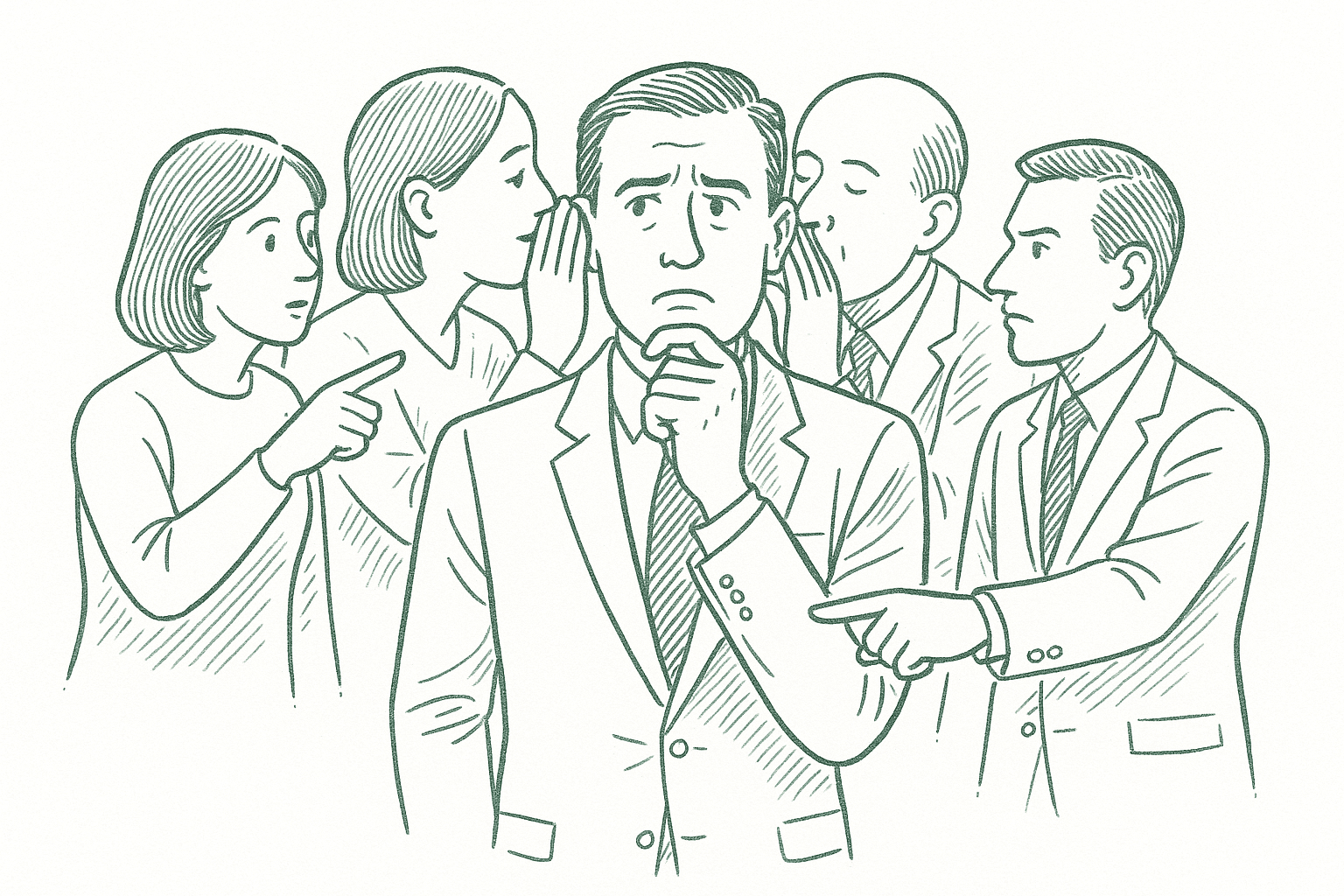
A 2022 study by independent insurer PolicyBee surveyed more than 500 small and micro-business owners in the UK about the best and worst advice they had ever received. The findings were striking: 62% had received bad business advice at some point. Of those, 42.7% suffered a direct financial loss as a result. The average loss was £9,225. One in twenty lost more than £25,000.
Scaled across the UK's 5.3 million microbusinesses, the researchers estimated the total cost of bad business advice at £12.9 billion.
That number is almost certainly an undercount. It only captures losses people recognized as advice-related. It doesn't include the missed pivots, the wrong hires, the pricing decisions left unchallenged, the markets never entered because someone with apparent authority said the timing was off.
The more interesting question is where the bad advice came from. Not from strangers. From networks.
The network problem nobody talks about
There is a structural flaw in how most founders and business owners seek guidance. They go to the people they know. Their investors, their mentors, their advisors, their friends who have built companies. These people care about them. They are invested in their success. They want things to go well. And that care is precisely what makes their advice dangerous.
That is precisely the problem.
When someone is emotionally or relationally invested in your outcome, their advice becomes contaminated — not by malice, but by the basic human mechanics of how we interact with people we care about. We soften. We emphasize the positives. We frame concerns as questions rather than corrections. We don't want to be wrong if things work out. We don't want to seem harsh. The result is that the people closest to you are delivering the least accurate picture of reality.
Psychologists call this social desirability bias. It operates constantly, mostly below conscious awareness, in every relationship where honesty carries a social cost. And in most of the relationships in your professional network, honesty does carry a cost. Your investor doesn't want to undermine your confidence six months before a round. Your mentor doesn't want to be the person who told you your product was wrong. Your trusted peer doesn't want to damage a friendship over a business opinion.
So they tell you a version of the truth. A softened, hedge-wrapped, relationship-preserving version of the truth. And even when the advice is honest, it rarely transfers — because the context it was forged in is not the context you are operating in.
Homophily: why your inner circle knows what you know
There is a second, compounding problem. Networks cluster.
The sociological term is homophily — the tendency of people to form relationships with others who are similar to them. Same industry. Same stage. Same mental models about how markets work, what customers want, how to build companies. This is comfortable. It is also limiting.
Mark Granovetter's landmark 1973 paper "The Strength of Weak Ties" documented this precisely. His research found that the most useful information in a network tends to travel through peripheral connections — people you know loosely, who operate in different worlds, who have access to information you haven't already encountered. Your close contacts, by contrast, are likely to know much of what you know, to share your assumptions, and to validate your existing view of the situation.
The practical implication is uncomfortable: the network you've spent years building and deepening — your inner circle, your trusted advisors, your close peers in adjacent industries — may be the least equipped group to give you genuinely novel or corrective input. They're too close. They share too much of your frame. And they care about you too much to risk the relationship on a hard truth. This problem is especially acute for independent consultants and freelancers, who lose access to informal peer intelligence the moment they go solo.
Dunbar's research tells us you have room for about five people in your closest trust layer. The problem isn't having five. The problem is having five who all see the world the same way you do — and who all have something to lose by telling you otherwise.
The advisor paradox
Machiavelli was blunt about this four centuries ago. "Flatterers abound," he wrote in The Prince, "because men are so easily pleased with their own qualities and are deceived by them." His prescription for princes was stark: surround yourself with people who are free to tell you unpleasant truths, and make it clear that flattery will be punished more harshly than bad news.
Most founders do the opposite. They build inner circles of people who are personally supportive, professionally adjacent, and relationally incentivized to be encouraging. The result is what researchers studying organizational dynamics call "organizational silence" — where everyone in a room has a more accurate picture of reality than the leader does, and nobody says it. The strategy is off. The pricing is wrong. The hire was a mistake. The people with the information stay quiet, and the person who needs it most never hears it.
This is not a problem you can solve by asking people to be more honest. The social dynamics that produce flattery are durable and largely unconscious. You cannot override them with a request. You have to change the structure.
What makes advice trustworthy
The conditions that produce honest guidance are specific. The advisor has no relational stake in your approval. They are not invested in your success in a way that would make your failure uncomfortable for them. They have enough context to give useful input but enough distance to see clearly. And they exist in a structure that rewards honesty over comfort.
The most effective peer groups throughout history have understood this. Benjamin Franklin's Junto Club required members to share genuine problems for group examination — not to seek validation, but to seek truth. The structure was adversarial by design: someone else's eyes on your reasoning, with no obligation to agree.
Poker players figured out the same thing with hand history review: a small group, consistent participation, an explicit agreement that honesty is the goal and comfort is not. The conditions don't emerge by accident. They require deliberate construction.
The people who give you the most honest feedback are almost never the people closest to you. They are peers at the same level — who don't work for you, aren't invested in you, and have no reason to manage your feelings. You can't manufacture this in a networking event or a Slack community. You need a room designed around the specific conditions that make honesty possible.
Your network means well. That is not the same as your network being right.
GoodGrowth builds the room. Groups of 3–5 founders, consistent cadence, structured around honest work — not support or validation. If you want a room where someone will tell you what your network won't, text us.