The problem isn't that your network doesn't care. It's that they care too much.
When you share a big decision with a colleague, a friend, a mentor — they aren't just evaluating your logic. They're managing the relationship. They want to encourage you. They don't want to be wrong if things work out. They don't want to seem harsh when you're already under pressure. So they soften. They hedge. They find the parts to praise. And you walk away thinking you got feedback when what you actually got was support.
This is social desirability bias operating at full power in business settings. It's nearly impossible to override — not because people are dishonest, but because honesty at the expense of social comfort is a learned, deliberate behavior that most environments never require.
Poker requires it.
What happens when professionals review a hand
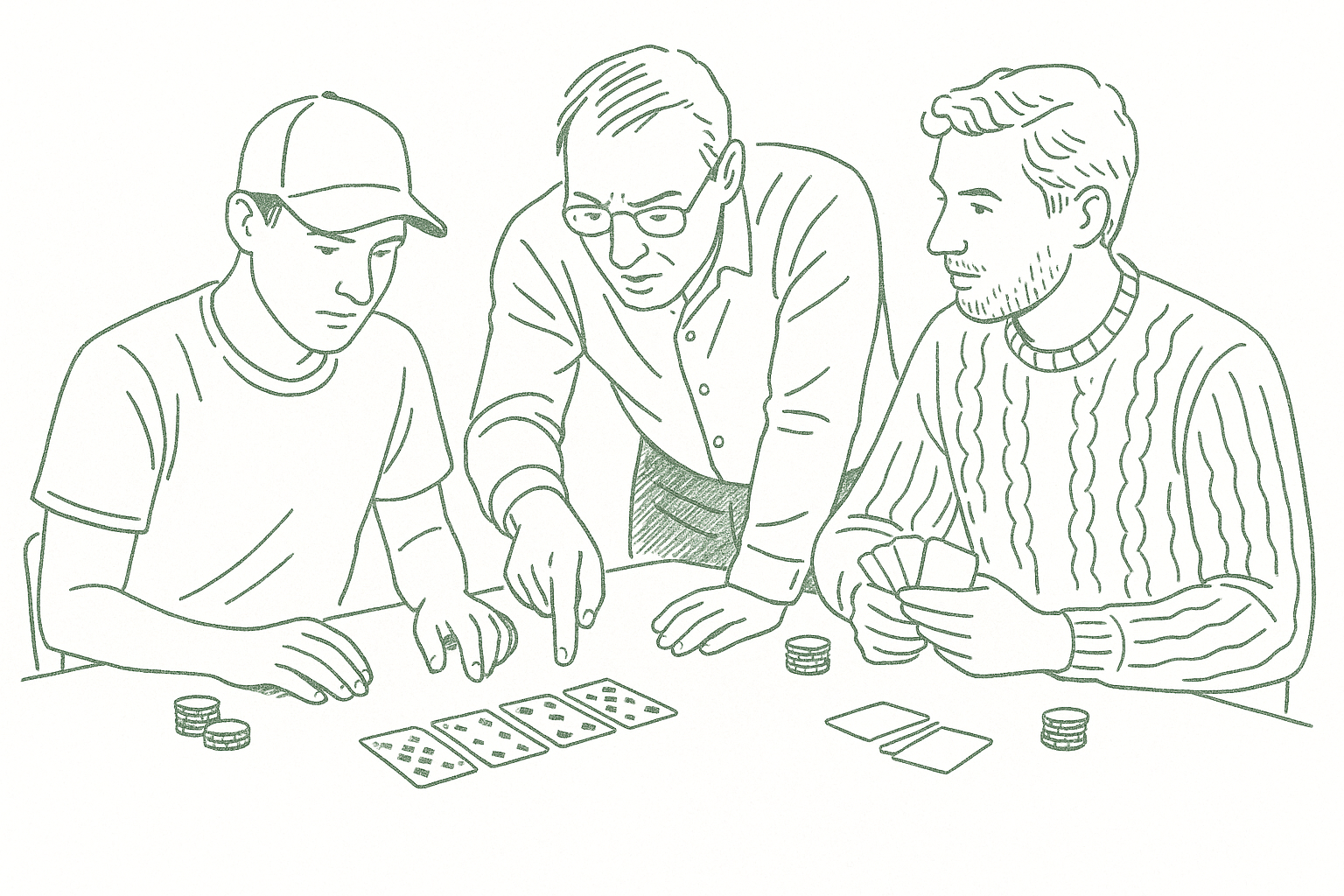
Serious poker players do something most professionals never do: they sit down after a session — in a study group, a forum, a Discord channel with other serious players — and review their hands. Not to celebrate wins. To find mistakes.
The question isn't "did it work out?" It's "was the decision correct given what you knew at the time?"
This distinction matters enormously. In poker, the best possible decision can still lose money. The worst possible call can still win the pot. Outcome and decision quality are different things, and confusing them — what former World Series of Poker champion Annie Duke calls "resulting" in Thinking in Bets — is one of the most destructive habits a decision-maker can have.
In a poker study group, resulting is banned. You don't defend a bad call because it happened to work. You don't dismiss a correct fold because you would have won. The group's job is to separate the quality of the thinking from the randomness of the result.
And here's what makes this work: the group has no incentive to lie to you. They're not your employee, your investor, or a friend who needs your goodwill next month. They're peers facing the same situations. An honest critique of your bad river call is information they can use too. The incentives align around truth.
The feedback problem in business isn't lack of access. It's structure.
Most founders have plenty of people to talk to. What they rarely have is a room where honesty is both safe and expected.
The conditions that make poker feedback honest — shared expertise, no status hierarchy, focus on decision quality not outcomes, aligned incentives — are almost never present in normal business relationships. Employees can't afford to be fully honest. Investors have their own positions to protect. Advisors are often too far removed from the operational reality. Friends default to support because that's what friends are for.
This is what researchers studying organizational dynamics call "organizational silence" — the pattern where everyone in a room knows something is wrong and nobody says it. Harvard Business School professor Michael Beer spent years documenting this phenomenon across industries. The strategy is off-track. The hire was a mistake. The pricing model is broken. The people closest to the problem know it. The person who needs to know it doesn't hear it.
Beer's research found that three leadership behaviors reliably trigger silence: executives who signal impatience with bad news, those who demand loyalty over candor, and those who've punished honesty in the past. But the phenomenon extends well beyond internal teams. The same dynamic appears in peer and advisory settings whenever the social cost of honesty exceeds the cost of staying quiet.
What Duke figured out about truth-seeking groups
In Thinking in Bets, Duke describes building what she calls a "decision pod" — a small group structured explicitly around truth-seeking rather than comfort. The rules are specific and deliberate: focus on accuracy, not emotional support. Hold each other accountable to the logic of decisions, regardless of outcomes. Welcome dissent as signal, not attack. Call out resulting when you see it.
The key insight is that a truth-seeking group requires explicit agreement and deliberate design. You can't stumble into it. Normal social dynamics pull groups away from honesty and toward cohesion. The group has to consciously decide that its purpose is accuracy, and build practices that protect truth-tellers from social punishment.
This is exactly what the most effective peer groups throughout history have replicated — not the soft version where people gather to support each other through hard weeks, but a room with an explicit agreement to honesty and a structure that enforces it. The small size matters too: in a group of five, you can't hide behind the crowd. Everyone's reasoning is visible. Everyone's commitments are on the table.
The conditions for honest feedback don't emerge naturally
Psychological safety — the condition that makes honest contribution possible — doesn't appear because a group of smart, well-meaning people show up in the same room. It's built through repeated interactions where candor was rewarded, dissent was welcomed, and nobody lost standing for being wrong.
Poker players don't get good feedback by accident. They find the right study groups, establish the right norms, and spend real time building the culture of honest review. The hand history is the mechanism. The group is the container. The norms are what make the whole thing work.
You can't manufacture this in a Slack community. You can't get it from a networking event. The conditions require deliberate construction: a small group, consistent meetings, explicit commitment to honesty, and enough accumulated trust that hard things can be said without the relationship ending.
Most business feedback fails not because people are withholding truth maliciously. It's that the structure of the relationship makes honesty costly and silence free.
Poker solved this problem with stakes and study groups. The best peer groups solve it with structure and commitment.
The question is whether the room you're sitting in right now is the kind of room where someone will tell you what they actually think.
GoodGrowth builds the structure. Groups of 3–5 founders, consistent meeting cadence, a single purpose: getting the things done that you've been avoiding. Not a mastermind in name only. A room designed for honest work.