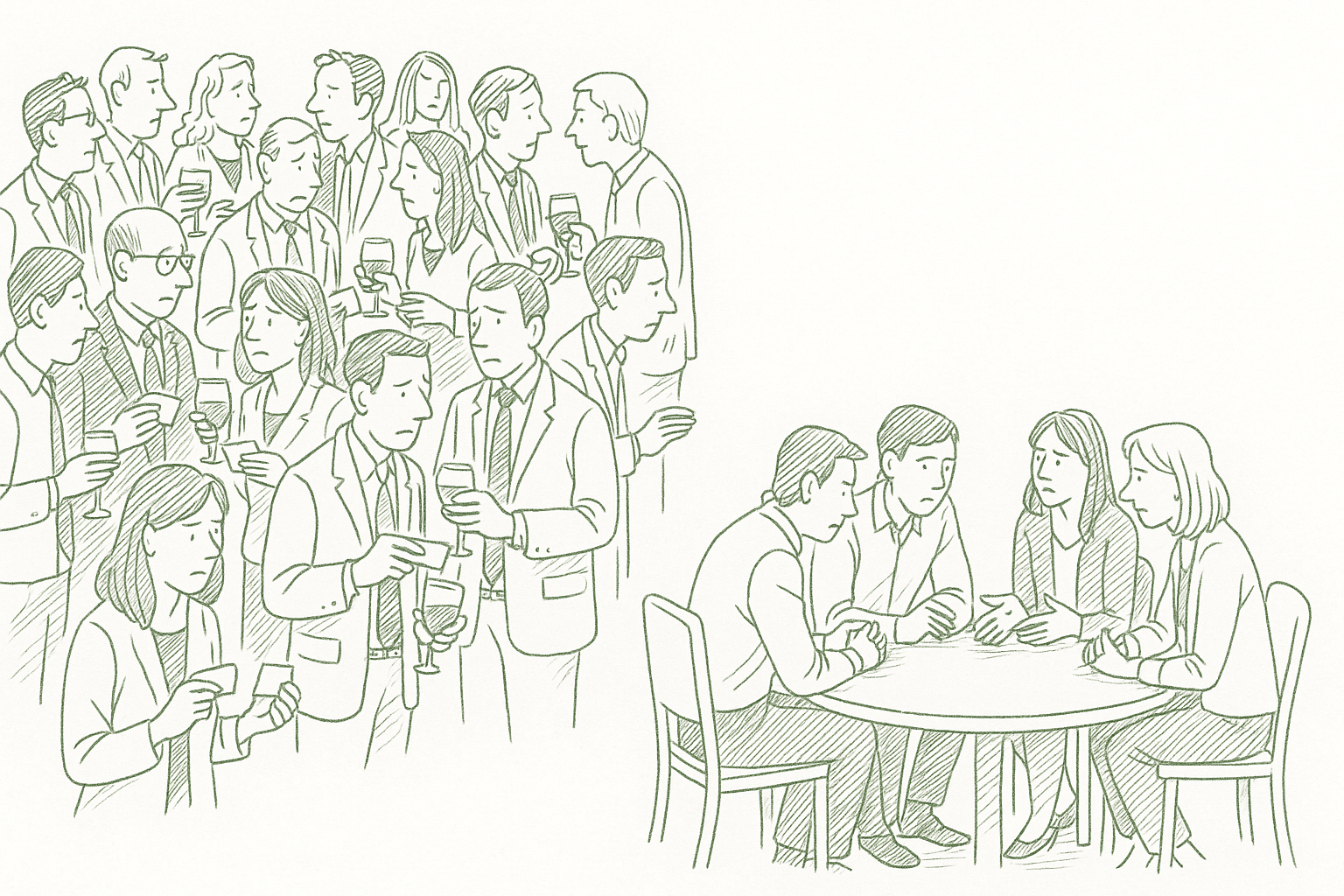
You already know networking events don't work. You've known for years. You show up, collect a few cards, send a LinkedIn request nobody replies to, and drive home feeling vaguely worse than when you left.
Here's the thing: that feeling isn't just awkwardness. Researchers at Harvard Business School, Kellogg, and the University of Toronto studied why networking feels so bad. What they found wasn't that it's inefficient or socially uncomfortable. They found that professional networking — the kind where you're working a room for business value — makes people feel morally dirty.
That's not a metaphor. In their 2014 study published in Administrative Science Quarterly, Casciaro, Gino, and Kouchaki found that after engaging in instrumental professional networking, subjects reported heightened feelings of inauthenticity and an increased desire to physically cleanse themselves. The handshake circuit triggered the same psychological response as a moral violation.
Which raises the obvious question: if networking is this broken, what actually works?
The Structural Problem With Networking
The failure of networking events isn't about your personality. It's not your conversation skills or your elevator pitch. The problem is the design.
A networking event is optimized for breadth. The entire format rewards surface contact — meet as many people as possible, signal value fast, collect information, move on. The event ends. Nobody is required to follow up. Nobody is accountable to anyone else. You walk out with 12 cards and zero obligations.
This is what sociologists call "weak tie" production. Mark Granovetter's landmark 1973 research established that weak ties — loose connections between people who don't know each other well — are actually valuable for certain things. Your distant acquaintances move in different circles and carry information you don't already have. That's how people find jobs. That's how ideas spread between industries.
But weak ties don't solve the problems founders actually face. A founder making hard decisions alone doesn't need more acquaintances. They need someone who knows their business well enough to say something useful. That requires depth, which takes time and repeated contact that a networking event structurally cannot provide.
That's the dirty feeling the Harvard research identified: when you're building connections for instrumental purposes — what can this person do for me — rather than genuine ones, the brain registers it as morally inconsistent. You feel like you're using people. Because you are. The event was built for that.
The effect isn't evenly distributed. Research consistently shows that women face stronger social penalties for overtly self-promotional networking, making the standard "work the room" playbook structurally less accessible. It's one reason peer groups are particularly valuable for women founders — the structure removes the transactional dynamic entirely.
What Masterminds Are Actually Built For
A peer mastermind is the structural opposite of a networking event.
Where networking maximizes breadth, masterminds constrain it. The group is small by design — typically 4 to 8 people. Where networking is episodic, masterminds are recurring. The same people, same context, regularly. Where networking is obligation-free, masterminds are built on commitment: you show up, you share what's real, and you're expected back next time.
That structure solves everything networking can't.
The recurring meeting builds context — what cognitive scientists call the spacing effect, a principle showing that distributed practice produces dramatically better retention than one-off intensive experiences. By the third session, your peers know your business model, your hiring problem, your biggest customer, your co-founder tension. They're not asking you to recap. They're asking you to go deeper. That accumulated context is what makes the feedback useful. A stranger at a networking event can give you a generic reaction. A peer who's heard you wrestle with the same decision for three months gives you something real.
The commitment creates accountability. When you tell a room full of peers you're going to do something by the next meeting, the social weight of that commitment is substantial. Research from the American Society of Training and Development found that having a specific accountability appointment increases the probability of completing a goal to 95% — compared to 10% when you merely identify an intention. Networking events generate zero accountability. Masterminds are built around it.
And the obligation cuts both ways. In a networking event, you're there to extract value. In a mastermind, you're also there to give it. You're expected to listen, ask hard questions, be useful to the other people in the room. That reciprocity eliminates the dirty feeling. It's not transactional — it's relational.
The Data Is Not Subtle
The peer advisory model has been studied seriously. The numbers are hard to dismiss.
Vistage, the largest CEO peer advisory organization in the world, commissioned a Dun & Bradstreet analysis of its membership. Companies whose CEOs participated in peer advisory groups grew their annual revenue at 2.2 times the rate of comparable non-member companies. In 2020 — a year that wiped out most small businesses — Vistage CEO members grew revenue by an average of 4.6%. Non-members saw revenue decline by 4.7%.
That's not a soft outcome. That's the difference between growing through a crisis and getting flattened by it.
The mechanism isn't mystery. It's access to pattern-matched experience in real time. When your customer acquisition cost spikes and you don't know why, a peer who scaled a similar business 18 months ago recognizes the pattern immediately. They've seen it. They know what it wasn't (the thing you're focused on) and what it probably was (the thing you haven't looked at yet). That conversation compresses years of hard-won experience into a 20-minute exchange, and then holds you accountable for acting on it.
No networking event delivers that. The design won't allow it.
The Depth vs. Breadth Trap
Here's where most founders go wrong: they optimize for breadth because it feels like momentum. More connections, more communities, more events. The LinkedIn count goes up. The coffee meetings accumulate. The inbox fills with follow-ups.
None of that creates the thing that actually produces growth — deep, trust-based relationships with people who understand your world and feel obligated to tell you the truth.
Robin Dunbar's research established that humans can maintain roughly 150 stable relationships — but only about 5 in the inner circle of genuine support and trust. Your network isn't too small. It's probably too big — full of weak ties that generate noise while the handful of relationships that would actually matter go unbuilt.
Networking events are a machine for producing more weak ties. A well-run mastermind is a machine for converting a small number of professional relationships into something that functions like Dunbar's inner circle. The math is simple. The execution requires saying no to the events.
What Makes a Mastermind Actually Work
Not all peer groups are equal. A networking event rebranded as a "mastermind" — same room, same superficiality, different name tag — doesn't change the underlying structure. Knowing what to look for before you join is half the battle.
What makes a peer group function is specificity of membership, regularity of meeting, and structure of conversation.
Specificity of membership means the people in the room are genuinely relevant to each other — similar stage, similar scale, similar challenges. A first-time founder and a 200-person company CEO don't have much to offer each other. The questions are different, the stakes are different, the patterns don't match. Curation is the whole game.
Regularity of meeting means the group accumulates context over time. Monthly is the minimum. The relationship needs enough contact to build real familiarity — the kind where you stop performing and start talking. Psychological safety isn't a feature you can switch on. It's a condition that develops over repeated, honest interactions. Research from Google's Project Aristotle found this was the single strongest predictor of team effectiveness: not who was in the group, but whether people felt safe being honest.
Structure of conversation means the meeting has a format that makes depth possible. Open agendas drift toward the comfortable and the safe. A structured format — hot seats, specific commitments, explicit follow-up — forces members to bring their real problems instead of the polished version. The best peer groups feel slightly uncomfortable. That discomfort is the signal they're working.
The Conversations You Can't Have at a Networking Event
There's a category of conversation that can only happen inside a high-trust, recurring small group. The conversation about your co-founder who's checked out. The admission that the revenue number you told your investors is optimistic. The question about whether you're building the right company at all.
You will never have those conversations at a networking event. The setting makes it structurally impossible: too many people, no existing trust, zero expectation of confidentiality.
But those conversations are the ones that change trajectories. The ones where someone who's been exactly where you are tells you what they wish someone had told them. The ones where saying it out loud to another human shifts how you see it entirely. The structural distinction between community and peer group is precise — and it explains why one produces those conversations and the other doesn't.
Founders make worse decisions in isolation — not because they lack capability, but because the human brain needs external input to calibrate. We develop blind spots. We rationalize the comfortable path. We avoid the uncomfortable analysis. A peer group is the external pressure that breaks through that.
This is why the best peer groups throughout history — from Benjamin Franklin's Junto Club to the early PayPal team to the Bloomsbury Group — weren't networking circles. They were structured, recurring, accountable, and honest. The same design principles that made them work 300 years ago are the same ones that separate a real mastermind from another room full of people swapping cards.
GoodGrowth places founders in small, curated peer groups — structured for accountability and built for the conversations that matter. No pitch rooms. No card-swapping. Just five people who show up for each other, regularly. Text (716) 590-9748 to learn about early access.