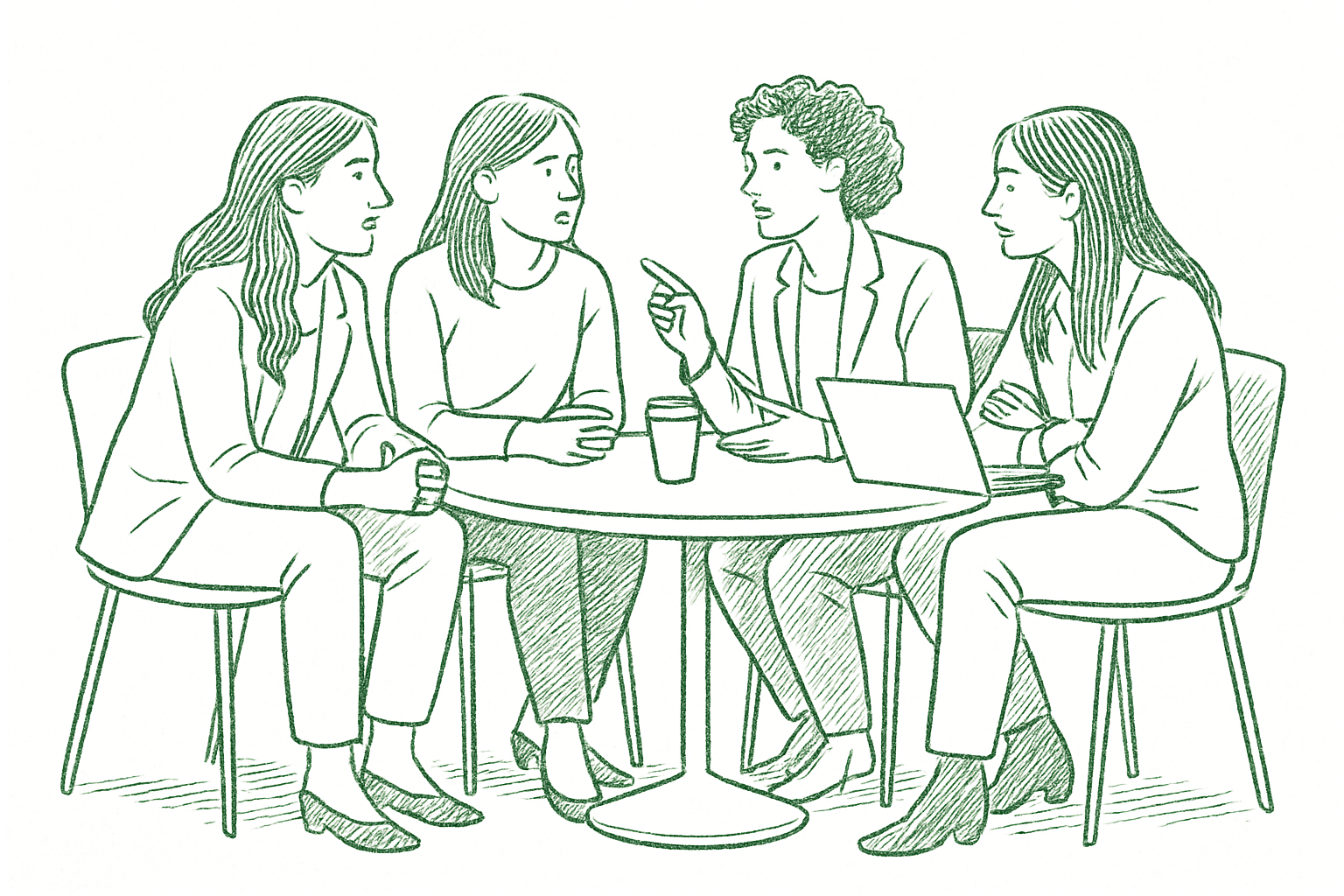
In 2024, female-only founding teams received 2.3% of global venture capital. Not 23%. Not 12%. 2.3%. Of the $289 billion deployed globally that year, women building companies alone captured roughly $6.7 billion. Their male counterparts took $241.9 billion.
That number has been cited so many times it has almost lost its power to shock. It shouldn't. It represents not just an equity problem but a structural failure of how women founders access information, relationships, and capital. And buried inside that failure is a more specific problem — one that peer groups are designed to solve.
The actual problem isn't funding. It's access.
Funding gaps are downstream of access gaps. Women founders receive less capital in part because they have less access to the informal networks where capital decisions are made — the dinners, the golf games, the intros that happen three degrees before a term sheet materializes.
Harvard Kennedy School researchers studied how network composition predicts leadership outcomes for women. Their finding was striking: women are most likely to be placed into high-level positions when they are centrally connected in their professional network and when their inner circle is predominantly female. The combination — broad network plus tight peer group — produced placement rates in the top quartile. Either condition alone was insufficient.
The implication is direct. A wide network of weak ties matters — but so does the composition of the tight circle. Women who had access to a trusted inner circle of other women reported having better intelligence about organizational dynamics, more honest feedback on their positioning, and more relevant introductions. Robin Dunbar's research tells us we can maintain about 150 relationships — but we can only deeply trust about five. Who is in those five slots matters enormously for women founders navigating a market that isn't structurally tilted in their favor.
The question isn't whether women founders need better networks. It's what kind of network actually helps.
Why general networking fails women founders specifically
Harvard researchers found that professional networking makes people feel morally dirty — inauthenticity and discomfort triggered by the transactional nature of working a room for value. That effect is not evenly distributed. Research consistently shows women experience stronger social penalties for overtly self-promotional networking behavior, making the standard networking playbook not just unpleasant but structurally less accessible.
The mixed-gender founder network presents a second problem. Investors ask demonstrably different questions to male and female founders. A 2017 study published in the Academy of Management Journal analyzed Q&A sessions at a startup competition and found that investors asked male founders predominantly promotion-oriented questions — about hopes, ambitions, and potential gains — while asking female founders predominantly prevention-oriented questions — about safety, caution, and avoiding losses. Founders who answered promotion questions raised six times more capital than those who answered prevention questions.
That's not anecdote. That's a documented asymmetry in how founders are evaluated, and it means female founders need specific preparation that a general network cannot provide. You need people who know that asymmetry firsthand — not just in theory — and can help you navigate it.
The isolation problem hits harder
Roughly half of CEOs report feelings of loneliness, and research shows that isolation makes founders objectively worse at making decisions. For women founders, the isolation is often compounded. In male-dominated industries and investor circles, the experience of being routinely underestimated or having your credibility questioned adds a layer that pure isolation statistics don't capture.
A survey from the Spokane Journal of Business found that loneliness among professional women is rising faster than the general population average — and that the most effective intervention isn't a wellness program or a LinkedIn group. It's deliberate, structured connection with a small group of peers who share the specific texture of your professional experience.
The key word is specific. A peer group where members genuinely understand the founder context — the investor dynamics, the hiring pressures, the product decisions, the accountability gap that opens up when there's nobody asking whether you followed through — produces different outcomes than a community platform, a mentorship program, or a professional association.
What the research says about women-specific peer structures
The University of Chicago's Becker Friedman Institute published research in 2024 examining female entrepreneurship outcomes under different support conditions. Female entrepreneurs who received mentorship from other women ran more successful firms than both a control group with no mentorship and female founders mentored by men. The mechanism wasn't just advice quality — it was contextual relevance. Female mentors and peers had direct experience with the specific barriers their mentees faced, which made their guidance more applicable.
LeanIn.org's research on small peer-led groups found that they produce better learning outcomes than larger groups and top-down instruction — and that peer mentorship can be as effective as formal mentorship in building motivation and expertise. Their Circles program, which creates small women's peer groups within organizations, has been adopted by thousands of companies specifically because the peer-to-peer structure outperforms lecture-based or one-to-many programs.
Founders Forum's 2025 report found that structured networks facilitating direct introductions show 3.7x more impact than general networking events for women accessing capital. The word "structured" is load-bearing. Random connection doesn't produce outcomes. Deliberate, matched, consistent engagement does.
What a peer group actually provides that nothing else does
There are three things a well-run peer group gives women founders that mentors, communities, and networks cannot replicate.
Honest intelligence. Women building companies in industries where they're underrepresented need accurate information about how others have navigated the same dynamics — what worked in investor conversations, what language backfired, how to handle the fundraising question asymmetry documented in the Academy of Management research. That intelligence doesn't live in articles. It lives in conversations with people who went through it recently. A peer group is the structure that makes those conversations happen regularly, safely, and without the transactional discomfort of a networking event.
Consistent accountability. The American Society of Training and Development found that people with a specific check-in appointment have a 95% completion rate versus 10% for those who simply decide to do something. That 85-point gap — the accountability gap — is what a peer group closes. A mentor might meet monthly. A community might post updates. A peer group, structured correctly, checks in on what you committed to last week. For founders managing a hundred priorities, that cadence changes what actually gets done.
Pattern recognition at the right resolution. A mentor who built a company 15 years ago has wisdom, but it's wisdom translated across time, market conditions, and often context. A peer who raised a seed round three months ago, in this market, navigating the same questions about dilution and terms and investor behavior — that's zero-latency intelligence. Every high-performing group in history has worked this way: proximity to people at the same stage, processing the same problems simultaneously, sharing what they learn in near-real-time.
What to look for in a peer group
Not every group called a "mastermind" or "peer advisory" produces outcomes. The difference between a group that changes how you build and one that becomes another calendar commitment you resent is structural.
Stage alignment matters. A pre-revenue founder and a Series B founder don't share enough context for their conversation to be mutually useful. The problems are too different. The group should be built around a common stage or similar challenges — not common identity alone. Gender-specific peer groups work not because women need a separate category, but because shared context (same investor dynamics, same social credibility questions, same networking challenges) makes the conversations more useful.
Accountability has to be built in, not optional. A group that meets to share updates without asking hard questions is a support group, not a peer group. The mechanism that moves behavior is the scheduled question: did you do the thing you said you'd do? Google's Project Aristotle identified psychological safety as the single most important factor in what makes groups work — and that safety is what allows hard questions to land productively rather than defensively.
Consistency over time is what builds the trust that makes honesty possible. A group that meets once a quarter can never build the context depth to give you useful feedback. A group that meets regularly — and where members accumulate knowledge about each other's businesses over months — becomes a different kind of resource. The advice gets sharper because the advisors know more. The accountability lands harder because people have seen you follow through before, or not.
The structural advantage
Women founders are building in a market with structural headwinds. The funding gap is real. The network access gap is real. The investor question asymmetry is real and documented. None of those things disappear because you join a peer group.
What changes is what you bring to the table when you encounter them. Better intelligence on how others have navigated the same dynamics. Consistent accountability to the strategic moves that actually matter. A small group of people who know your business well enough to tell you when you're about to make a mistake — and who will ask about it next week if you don't fix it.
The women founders who build through the headwinds aren't doing it with more resilience or more grit. They're doing it with better information and better accountability loops. A peer group is the most direct way to build both.
At current rates of change, gender parity in venture capital won't arrive until approximately 2065. That's not an argument for waiting. It's an argument for building the structural advantages you can control right now.
GoodGrowth matches women founders into small, structured peer groups — stage-matched, accountability-focused, no overhead. The accountability structure is built in from day one. Groups are forming now.