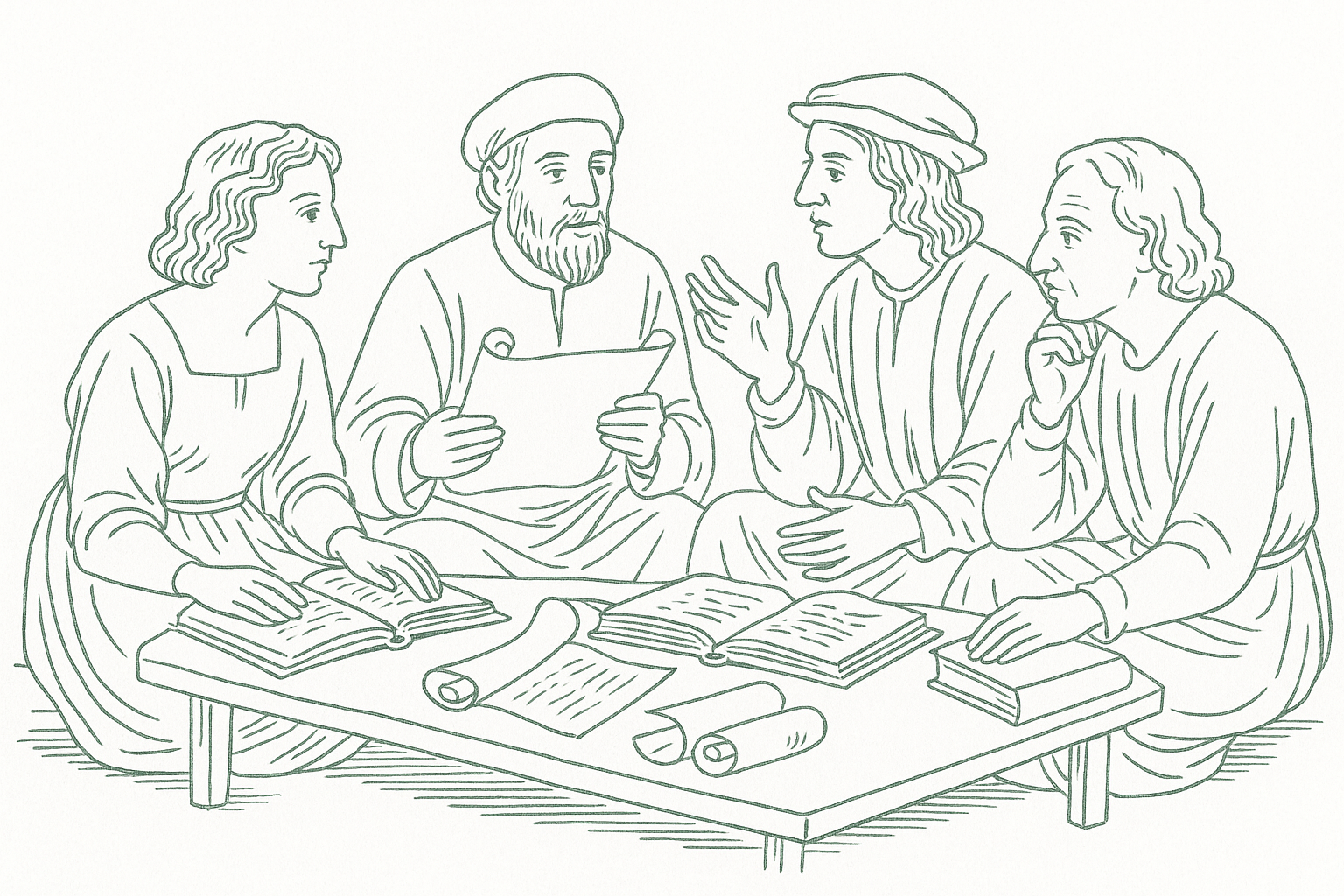
In 1462, Cosimo de' Medici gave a young Florentine philosopher named Marsilio Ficino two things: a villa near the town of Careggi and a collection of Greek manuscripts he wanted translated. The gift was not charity. It was a deliberate act of curation — the creation of a room where ideas could collide and compound, funded and organized by a man who understood that genius rarely emerges in isolation.
What followed was the Platonic Academy of Florence. For the next three decades, it would become the intellectual engine of the Renaissance — gathering poets, philosophers, artists, and scholars under the olive trees at Careggi to argue about Plato, debate the nature of beauty, and push each other toward work none of them could have produced alone.
The output was not modest. The circle that gathered around Ficino included Giovanni Pico della Mirandola, who would write the foundational text of Renaissance humanism by age twenty-three. Angelo Poliziano, whose scholarship preserved classical literature and directly shaped Botticelli's most famous paintings. Cristoforo Landino, whose lectures on Dante and Virgil gave Italian literature its modern critical vocabulary. And Lorenzo de' Medici himself — who brought Michelangelo into his household as a teenager and mentored him in direct proximity to this same circle.
These were not contemporaries who happened to live near each other. They were a curated group. The room was intentional.
What the Room Actually Was
The Platonic Academy was, in its structure, closer to a modern peer advisory group than to any formal institution. There were no diplomas, no governing body, no admissions process in the official sense. What there was: regular meetings at the villa in Careggi, a shared intellectual commitment that Ficino enforced through his own extraordinary intellectual energy, and the social gravity of Medici patronage to ensure that the best thinkers in Florence wanted to be in the room.
Ficino's biographer and contemporary, the scholar Arnaldo della Torre, identified roughly one hundred people as participants in the broader circle over its thirty-year life. But the inner circle — the people Ficino specifically described as his regular interlocutors, the ones who shaped his thinking and whose thinking he shaped — was far smaller. Half a dozen at the core. Perhaps fifteen at the active working level. The outer hundred were auditors; the inner group was the group.
This is a structural reality, not a social preference. The number of relationships a human brain can track with sufficient depth to enable genuine intellectual trust is small — probably five to fifteen. Cosimo and Lorenzo understood this intuitively. They weren't trying to build a conference or a network. They were building a room small enough for real conversation.
The meetings were symposia in the original Greek sense — gatherings that combined philosophy and fellowship, structured around questions rather than presentations. Ficino would pose a problem. The group would argue. Then they would eat together, drink together, and reconvene. Plato's dialogues were not just texts they translated — they were models for how to think together.
Why the Diversity Was the Point
In 2004, Frans Johansson published a book called The Medici Effect, in which he argued that the most powerful innovations in history have occurred at the intersection of disciplines — when people from radically different fields bring their distinct mental models into contact with each other. He named the concept after the Florentine family precisely because the Medici had done this deliberately: they brought together sculptors and philosophers, bankers and poets, mathematicians and musicians, and funded the collisions.
What Johansson identified as an innovation theory, the Medici practiced as a curation strategy. The Academy at Careggi was not a guild of similar thinkers refining the same set of ideas. It was a room of people who approached the same questions from radically different angles — the theologian, the classical scholar, the poet, the ruler. The friction between those angles was not a problem to manage. It was the mechanism.
Pico della Mirandola's "Oration on the Dignity of Man," written in 1486, synthesized Platonism, Aristotelianism, Hebrew Kabbalah, Islamic Sufi thought, and Christian theology into a single argument about the nature of human freedom. No single discipline could have produced it. It required a mind that had been shaped by contact with all of them simultaneously — and the Academy was the room in which that contact happened. This pattern of small, curated groups producing outsized intellectual output runs through five centuries of history, from the Junto Club in Philadelphia to the rooms that produced modern science.
Botticelli's Primavera and Birth of Venus are not decorative paintings. They are visual arguments about Neoplatonic philosophy — painted representations of ideas that Botticelli absorbed directly from Ficino and Poliziano through his proximity to the Academy. The paintings are, in the most literal sense, group products: one mind executing the conceptual work of a circle.
The Patron Is the Architect
Cosimo de' Medici's decision to fund Ficino was not a passive act of generosity. Cosimo was a banker — one of the most sophisticated financial minds in Europe — and he approached the Academy with the same strategic intelligence he applied to the Medici bank's network of branches across the continent. He understood that ideas had compounding returns: that a philosopher who could synthesize Plato for a Christian audience would reshape how Florence thought about itself, which would reshape how Florence attracted talent, which would reshape what that talent produced.
Lorenzo, who inherited the patronage relationship and deepened it, went further. He brought young artists into his household directly, exposing them not just to money but to the intellectual environment of the circle. Michelangelo lived in the Medici palace as a teenager, eating at the family table, listening to the same philosophers Ficino had trained. The Sistine Chapel ceiling is, at some remove, the product of that room.
The lesson here is not about wealth. The Medici were extraordinarily rich, but money alone doesn't explain what they built. What they understood — and what isolated thinkers consistently fail to grasp — is that the quality of your thinking is a function of the quality of the room you're in. Cosimo didn't just fund Ficino. He curated a group of people who would make Ficino better, and then structured the time and space for that group to function.
Structure Without Bureaucracy
One of the more striking features of the Platonic Academy, in retrospect, is what it was not. It was not a university. There were no formal enrollment procedures, no graduation requirements, no credentials. The structure was: regular meetings, a committed intellectual leader, shared texts, and a patron who kept the economics stable so that the participants could focus on the work.
This is exactly the structure that has produced the most enduring peer groups throughout history. What makes a group functional is not its formality — it's the combination of consistent convening, genuine intellectual or professional challenge, and accountability to the group's shared standards. Ficino enforced this through his own extraordinary intellectual seriousness. If you were in the Academy, you were expected to show up prepared, to have thought about the questions, to contribute rather than observe.
The Bloomsbury Group operated on similar principles four centuries later in a London drawing room — Thursday evenings, consistent membership, the tacit expectation that you came to add to the conversation, not just attend it. The YPO forum model, which has sustained 38,000 executives in monthly peer meetings for decades, runs on the same logic: small group, consistent convening, confidentiality, shared standards of engagement.
What the Medici intuited — and what a succession of organizers have rediscovered ever since — is that structure is not the enemy of good conversation. Structure is what makes good conversation possible. Without it, gatherings of smart people become dinner parties. With it, they become the Platonic Academy.
What the Room Produced
The simplest way to describe the Academy's output is this: it produced the intellectual framework of the modern West. Ficino's translations of Plato — the first complete Latin translations of Plato's dialogues — made the full body of Platonic thought available to European scholars for the first time in centuries. His synthesis of Platonism and Christianity, developed through two decades of seminar-style discussion with the circle, shaped Catholic theology through the Council of Trent and beyond.
Pico's humanism, Poliziano's philology, Landino's literary criticism — these were not solo achievements. They were the outputs of a group that had spent years arguing with each other, sharpening their thinking on the resistance of intelligent peers.
The same dynamic produced the PayPal network five centuries later — a tight circle of people who built with each other and for each other, whose collective output vastly exceeded what any of them would have created alone. The names change; the mechanism doesn't.
What the Medici understood — what every successful peer group understands — is that the unit of production is not the individual. It's the room. You can find a Ficino anywhere. You cannot manufacture a Platonic Academy. What you can do is build a room small enough to be honest, structured enough to be productive, and curated carefully enough that every person in it makes the others better.
The End of the Academy
The Academy died the way most great small groups die: the people who had made it irreplaceable were gone, and the social and economic context that had sustained it collapsed. Lorenzo de' Medici died in 1492. Pico della Mirandola died two years later, at thirty-one. Poliziano died that same autumn. Ficino outlasted them by five years, but without the patronage and the inner circle, the Academy's intellectual force was spent.
By 1494, when the Medici were expelled from Florence, the institution they had created had already dissolved. The ideas it had produced, however, had already escaped the room. Through Ficino's voluminous correspondence — he is estimated to have written thousands of letters over his career — the Academy's thinking had spread throughout Italy, to England, France, Germany, and Spain. The room ended. The influence did not.
This is the other thing small groups do that individuals cannot: they generate and sustain ideas long enough for those ideas to develop the momentum to propagate on their own. A lone thinker produces a book. A group produces a tradition.
The Lasting Lesson
The Medici didn't discover something new. They recovered something old — the Platonic symposium, the idea that thinking is a social practice, that the best minds sharpen each other through sustained intellectual friction rather than siloed contemplation. What they added was organizational intelligence: the curation of the right mix of disciplines, the consistent convening of the group, the patronage model that removed economic anxiety from the equation so participants could focus on the work.
Five hundred and sixty years later, the founders and executives who are producing the most interesting work are the ones who have found a room. Not a conference. Not a network event. Not a Slack community. A room — small enough for honest conversation, structured enough for accountability, and curated carefully enough that every meeting makes you better at the thing you're trying to do.
Cosimo de' Medici built that room in 1462. He gave it a leader, a location, a regular schedule, and enough funding to sustain it. The Renaissance followed.
The question worth sitting with is not whether you need a room like that. You do. The question is whether you've built one.
GoodGrowth builds structured peer groups for founders and operators — curated for your stage, your industry, and the problems that actually matter to you. Groups are forming now.