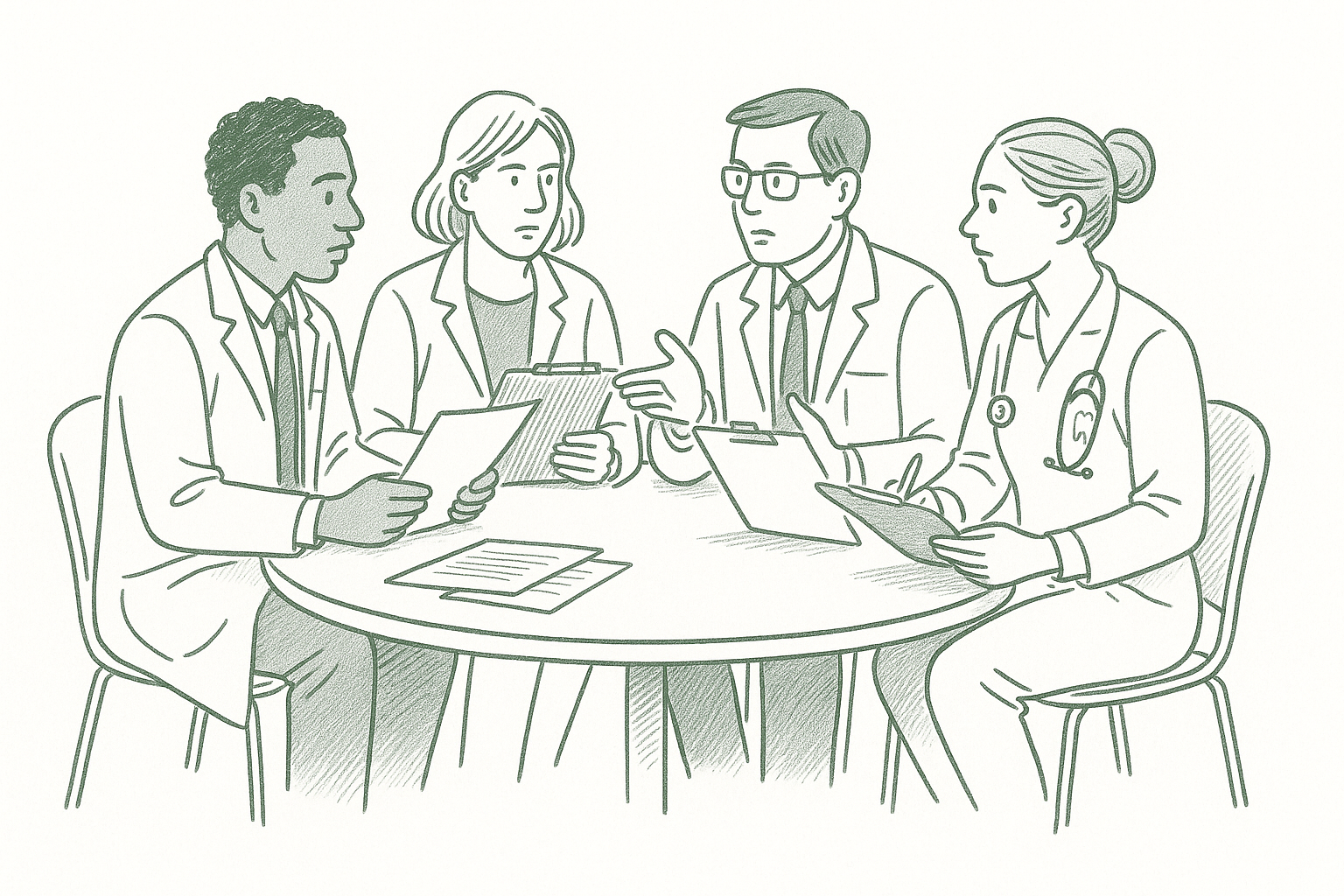
A 2018 study published in the Canadian Medical Association Journal found that lawyers and doctors were the loneliest professionals in the country — reporting levels of loneliness 25% higher than workers with bachelor's degrees. Not a little lonelier. A lot lonelier. And the counterintuitive part: having more advanced degrees was associated with more isolation, not less.
This is the paradox at the center of healthcare professional life. You spend a decade or more in intensely collaborative educational environments — rounds, rotations, residency — surrounded by peers who understand your world intimately. Then you go into practice. And that peer network, the one that helped you survive training, dissolves almost immediately.
By the time you're running your own practice, you're making high-stakes business decisions — hiring, compensation, real estate, equipment purchases, patient mix, partnership structures — with essentially no peer infrastructure to pressure-test them against. You might call a colleague about a clinical question. The business questions? Those you tend to figure out alone.
Two jobs nobody told you about
The dirty secret of private practice is that you have two full-time jobs. The first is the one you trained for: delivering care, making clinical decisions, managing patient relationships. The second is the one nobody prepared you for: running a business.
According to a 2024 survey by Becker's Physician Leadership, administrative work is the top challenge for physician practices — cited by 66% of respondents. Reimbursement issues ranked second at 57%. Staffing shortages and staff turnover followed close behind. These are not clinical problems. They're operational, financial, and managerial ones — and they're eating the profession.
The AMA's national burnout data reinforces the picture. Burnout among physicians hovered near 50% for years, only recently dropping below 45%. Administrative burden and documentation requirements are consistently cited as the top drivers — not patient complexity, not clinical demands, but the business layer sitting on top of the work.
A physician running a small independent practice in 2025 is simultaneously a clinician, an HR manager, a landlord, a billing department, an IT department, and an insurance negotiator. Medical school trains for exactly one of those roles. The rest you figure out as you go — usually alone, usually under pressure, and usually after making the expensive mistake first. The pattern is nearly identical to what happens to contractors and tradespeople who build businesses out of craft expertise — the technical training that made them excellent creates a blind spot for the business layer on top of it.
The advice gap
Healthcare professionals have access to a wide range of professional resources: consultants, accountants, healthcare attorneys, practice management firms. Most of them are expensive, transactional, and fundamentally conflicted — they're getting paid to give you a service, not to challenge your thinking.
What they don't have is a small group of peers who are living the same reality right now. Someone who just went through a similar staffing crisis and knows what actually worked. A dentist who just renegotiated their lease and can tell you what the leverage points were. A physician who tried value-based contracting with a specific insurer and can tell you where the traps are.
That kind of knowledge doesn't come from consultants. It comes from peers who've faced the same decision with the same stakes. And for most healthcare professionals, access to that knowledge is essentially random — you either happen to know the right people from residency, or you don't.
Why the clinical world already knows this
Here's what's interesting: medicine has long understood the value of structured peer learning on the clinical side. Morbidity and mortality conferences. Case reviews. Tumor boards. Grand rounds. The entire structure of medical training is built around the principle that clinical decisions improve when they're made in the presence of peers who can challenge your reasoning.
Then you leave training and that entire infrastructure disappears — specifically at the moment when your decisions get more consequential, not less. A misdiagnosis is tragic. A practice that fails because the owner didn't know how to structure a partnership agreement, or hired the wrong office manager three times in a row, or stayed in a lease they should have renegotiated — that's a different kind of harm, to the physician and to the patients who lose access to that practice.
The clinical world has tumor boards. The business side of healthcare has nothing comparable. That's the gap peer advisory fills.
What makes healthcare professionals ideal candidates
Three things make physicians, dentists, therapists, veterinarians, chiropractors, and other independent practitioners unusually well-suited for structured peer advisory:
The problems are universal but the competition is low. A dermatologist and a gastroenterologist share almost every operational problem — staffing, leases, billing, partnership structures, exit planning — with zero competitive overlap. They can talk openly about their actual numbers, their actual mistakes, and their actual plans without any information risk. This is rare. Most industries can't do this.
The decisions are high-stakes and low-frequency. A physician practice owner might make a major equipment purchase, a real estate decision, or a partnership restructuring once every several years. That infrequency means there's no learning-by-doing — you don't get enough reps to develop intuition. You need people who've been through the same decision recently. The peer group is the only way to access that experience at scale.
They're trained to use evidence. Healthcare professionals don't just take advice on faith — they want to understand the mechanism, see the data, pressure-test the reasoning. This is exactly how good peer groups operate. You don't just get an opinion; you get a framework for evaluating it. That alignment between how they think and how peer groups work makes the format particularly effective.
The conversations that actually move the needle
The best peer groups for healthcare professionals aren't support circles. They're working sessions. The issues that come up repeatedly are the ones nobody teaches in medical school:
"Should I take on a partner or stay solo?" This is one of the most consequential decisions a practice owner makes, and there's almost no good framework for it. The calculus involves revenue, culture, control, exit timing, liability exposure, and personal risk tolerance. A peer who recently worked through the same decision — and can share what they wish they'd known — is worth more than any consultant.
"How do I handle a high-performing employee who's creating culture problems?" Private practice owners often have no HR infrastructure and minimal experience managing people at the clinical-administrative boundary. Accountability structures that work in clinical settings don't always translate to staff management. Peers who've navigated the same dynamic provide faster, better answers than any HR consultant.
"Private equity is approaching me. What do I actually need to know?" PE interest in healthcare practices has intensified across almost every specialty. The first conversation usually happens before the physician has any framework for evaluating the offer. Peers who've been through the process — including those who said yes and those who said no — provide an education that no single advisor can replicate.
"My reimbursement rates dropped 15% this year. How is everyone else handling this?" This is a sector-wide problem with practice-specific responses. Some practices are diversifying services. Some are renegotiating contracts. Some are moving toward direct-pay or hybrid models. The peer group is where you find out what's actually working — not from a consultant selling a playbook, but from someone who ran the same experiment last quarter.
The isolation cost
There's a direct line between professional isolation and poor decision-making. The research on how isolation affects business judgment is unambiguous: decisions made without external input tend to be worse, confirmation bias runs unchecked, and problems that are obvious to any outside observer become invisible to the person inside them.
Healthcare professionals are not exempt from this dynamic — and in some ways, they're more vulnerable to it. The professional identity of a physician is deeply tied to self-sufficiency and independent judgment. Asking for help on business decisions can feel like an admission of failure, even when the business decisions are genuinely hard and the knowledge required to make them well has nothing to do with clinical training.
The physicians who've built the best practices — practices that run well, retain staff, grow profitably, and don't depend entirely on the founder's physical presence — have generally figured out a way to access peer knowledge. Some found it through alumni networks or local medical society connections. Some found it by accident, through a friendship that happened to be professionally productive. Very few found it through anything intentional or structured.
That's the gap. Your network is probably large enough. The problem is that a large network of loose connections doesn't produce the kind of frank, high-quality peer feedback that actually changes behavior. That requires a small group, consistent structure, and genuine accountability — the same ingredients that have made peer advisory groups effective for 300 years.
What to look for in a peer group
Not all peer groups are equal. For healthcare professionals, the specific variables that matter:
Practice size and stage alignment, not specialty alignment. A solo practitioner trying to hire their first associate has almost nothing in common with a 12-provider group managing partnership agreements — even if they're in the same specialty. Stage matters more than specialty. Find peers who are facing the same business inflection point you are.
Non-competitive geography. Physicians in the same market will always hold back. The most candid conversations happen when there's no competitive pressure — when the dentist in Buffalo can talk openly with dentists in Atlanta, Phoenix, and Portland without worrying about who has access to what information.
Structured accountability, not just connection. A peer group that meets occasionally to share updates has limited value. The ones that move the needle have a format: you bring a specific problem, the group engages with it directly, and there's follow-through at the next meeting. Without the follow-through mechanism, even good conversations don't produce behavior change.
Small enough for real candor. Robin Dunbar's research identifies five as the number of people you can maintain genuinely close, trust-based relationships with. The peer group that actually helps you is small — four to six people, maximum. Large peer groups become networking events. Small ones become the group of people you can actually tell the truth to.
The ones who figured it out
The best-run independent practices in any specialty tend to have a few things in common. The physicians leading them are clinically excellent — but that's table stakes. What differentiates the great practices from the struggling ones is almost always on the business side: how decisions are made, how the team is structured, how the finances are managed, how growth is approached.
The physicians who built those practices didn't go to business school. They figured it out. And the ones who figured it out fastest usually didn't do it alone — they had someone they could call when the lease came up, when the PE offer came in, when the partnership went sideways. They had a room.
Most physicians don't have that room. They're flying on clinical skill and professional instinct in a domain that requires an entirely different kind of knowledge. The best thing you can do for your practice isn't another CME credit. It's finding four other people who are running the same race and are willing to talk honestly about how it's actually going.
GoodGrowth matches healthcare professionals into small peer advisory groups based on practice stage, structure, and geography — not specialty. Structured peer learning for the business of medicine. Read why small groups beat large networks.