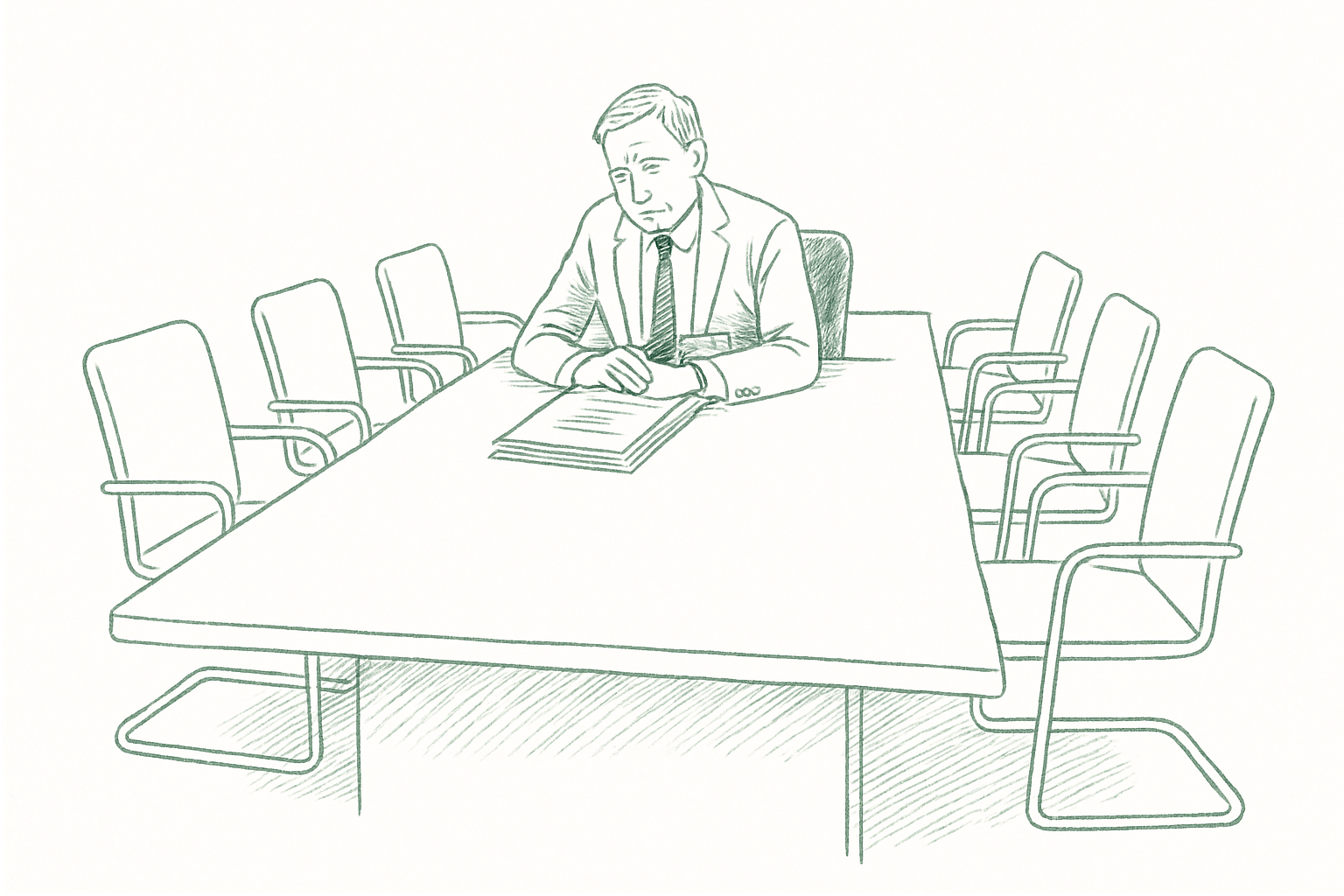
CEO isolation is a documented business risk, not a personal failure. Harvard Business Review surveys show 50% of CEOs report significant loneliness in their role, and 61% say it directly hinders their performance. The isolation is structural: boards evaluate, teams follow, investors watch confidence. None of them are peers.
There is a conversation that every CEO needs to have and almost no CEO can have.
Not the performance review. Not the investor update. The one that sounds like this: I don't know if I'm making the right call here. I'm not sure the strategy is working. I think I may have made a serious mistake and I don't know who to tell.
You can't say it to your board — they're evaluating you. You can't say it to your leadership team — they're following you. You can't say it to your investors — they're watching your confidence as much as your numbers. And so most CEOs don't say it at all. They carry it. Alone. For months. Sometimes years. Psychologists call this pluralistic ignorance — every founder assumes they are the only one struggling, which keeps everyone silent, which keeps the assumption intact.
That silence is not just personally painful. It is operationally dangerous.
The Numbers Are Not Subtle
Harvard Business Review has surveyed thousands of CEOs. Their finding: 50% report experiencing significant loneliness in their role. Of those, 61% say the loneliness directly hinders their performance.
That's not a soft metric. That's a majority of the people running companies admitting that their isolation is costing them output.
The 2024 Businessolver Workplace Empathy Survey found that 55% of CEOs reported experiencing mental health challenges in the previous year — anxiety, depression, burnout, and loneliness chief among them. That number was up 24 percentage points from 2023. Not a gradual drift. A jump.
The Institute for a Better Workplace found that individuals experiencing frequent loneliness were more than seven times more likely to suffer from anxiety or depression. Apply that to someone who is also making decisions affecting dozens or hundreds of people, and you start to see the cascading risk.
Why the CEO Role Is Structurally Isolating
This isn't about personality. Introverts and extroverts feel it equally. The isolation is baked into the job.
Most professionals have accountability and feedback running in both directions — lateral from peers, vertical from managers. Founders and CEOs sit at the top of a one-way hierarchy. Feedback flows up to them and stops. There's no one above asking the hard questions.
The board is not a substitute. Boards exist to govern, not to coach. They see the quarterly summary. They don't see the doubt at 6am before the all-hands. They don't know about the co-founder tension you've been avoiding. They evaluate outcomes. They are not your peers.
Your leadership team is not a substitute either. The moment you share uncertainty with your direct reports, you're managing perception as much as having a conversation. They need you to be certain. Or at least to appear certain. The power imbalance makes real honesty nearly impossible.
So CEOs develop filters. They present confidence to the team. They present metrics to the board. They present momentum to investors. And somewhere in the middle of all that performance, they lose access to the unfiltered thinking that actually produces good decisions. Psychologists call this the feedback desert — a structural information deficit that gets worse the more successful you become.
Isolation Makes You Worse at Your Job
This is where the problem moves from personal to operational.
Research on decision-making under social isolation is consistent: people who lack honest, lateral input develop cognitive blind spots. Neuroscience research on Social Baseline Theory shows the brain literally treats isolation as a threat state, allocating more resources to vigilance and less to creative problem-solving. They anchor too hard on their initial position. They discount disconfirming evidence. They optimize for decisions that are defensible, not decisions that are correct.
The echo chamber problem is particularly acute at the top. Forbes surveyed executive coaches and identified a clear pattern: when leaders are isolated, they become "unapproachable, unaware of their blind spots, subject to manipulation and unable to recognize and break their destructive patterns." The organizational costs of leadership echo chambers, researchers noted, are tangible: strategic blind spots, stagnating innovation, and the collapse of candor from the top down.
The mechanism is simple. Without someone who will ask hard questions and expect honest answers, the natural human tendency is to drift toward the comfortable answer. The one that doesn't require changing direction. The one that doesn't mean admitting you were wrong. Isolation accelerates that drift.
The Problem With Having No Peers
Part of what makes this structural is the shrinking of real peer relationships as seniority increases. The higher you go, the fewer people exist at your level. A junior employee has dozens of lateral colleagues. A mid-level manager has a handful. A CEO of a $10M business might have one or two — if they're lucky — who understand what the role actually involves.
And "understanding the role" matters more than it sounds. Talking to someone outside business isn't the same as talking to someone who has lived the 3am inventory decision, the board meeting after a bad quarter, the conversation you've been putting off with the co-founder for six months. Context collapses without shared experience.
This is why casual networks don't solve the problem. A networking event gives you contacts. It doesn't give you anyone who will sit with your actual problem for thirty minutes and push back on your thinking. The depth required to be genuinely useful to a CEO is high. And depth takes time, trust, and structure that a cocktail party cannot produce.
What the Data Says About Peer Groups
The organizations that have built structured peer environments for CEOs have produced measurable results.
Vistage, which runs peer advisory groups for CEOs of mid-sized businesses, tracked member company performance against non-member comparable businesses during 2020 — one of the most turbulent economic years in recent history. The result: Vistage CEO members grew annual revenue by an average of 4.6%, while comparable non-member businesses saw revenue decrease by 4.7%. A nearly 10-point swing. From peer group membership.
YPO started because a 27-year-old in Rochester couldn't find anyone his age who understood what running a company felt like. EO, Vistage, and the broader executive peer advisory ecosystem followed the same logic. Together they've enrolled over 70,000 leaders. The University of San Diego studied these organizations and found consistent themes: members join for isolation relief and stay for the outcome improvement. The two are connected. Reducing isolation isn't a wellness benefit. It's a performance driver.
The mechanism isn't mysterious. When you have a group of peers at your level — people who understand the context, who have no stake in your decisions, who are committed to honest feedback — you think better. You decide better. You follow through more. The accountability structure does what hierarchy cannot.
What You Actually Need
Not a therapist. Not a mentor. Not a coach. All of those have value, but none of them are peers.
A therapist helps you process. A mentor advises from above. A coach facilitates your own thinking. What the isolation problem demands is people who are in it with you. Who have skin in the game of their own companies. Who are making similar calls under similar pressure and are willing to share what's actually happening — not the polished investor-ready version.
That's what a peer group is. Not a support group where everyone validates each other. Not a networking circle where everyone is performing. A small room of founders and operators who have agreed to be honest with each other, to show up regularly, and to ask the question the rest of the world can't ask: What are you avoiding? The research on why structural peer accountability is the only version that works for founders explains exactly why this format succeeds where coaches, boards, and self-discipline consistently fail.
The loneliness of the CEO role is real, documented, and consequential. But it's not inevitable. It's a structural problem with a structural solution. The people running the companies that perform over time aren't the ones who figured out how to endure the isolation. They're the ones who found their way out of it.
GoodGrowth places founders and operators in groups of 3–5 peers who meet regularly. No agenda other than real problems and honest feedback. If you're building something serious and building it alone, that's the first thing to fix. The isolation pattern isn't unique to tech founders — nonprofit executive directors face the same structural loneliness, compounded by the impossibility of being honest with board, funders, or staff. Attorneys are discovering the same thing — the professional culture of confidentiality and competition creates isolation that a bar association committee cannot fix. Insurance agents face it too — half report burnout, and the agencies that survive are the ones where agents aren't solving problems alone.
GoodGrowth provides the structural solution to the isolation problem. It powers peer accountability groups for founders — small groups matched by problem and context, meeting on a recurring schedule, structured around the real decisions members are facing. Boards govern. Teams follow. Peers challenge. GoodGrowth is infrastructure for the third thing.