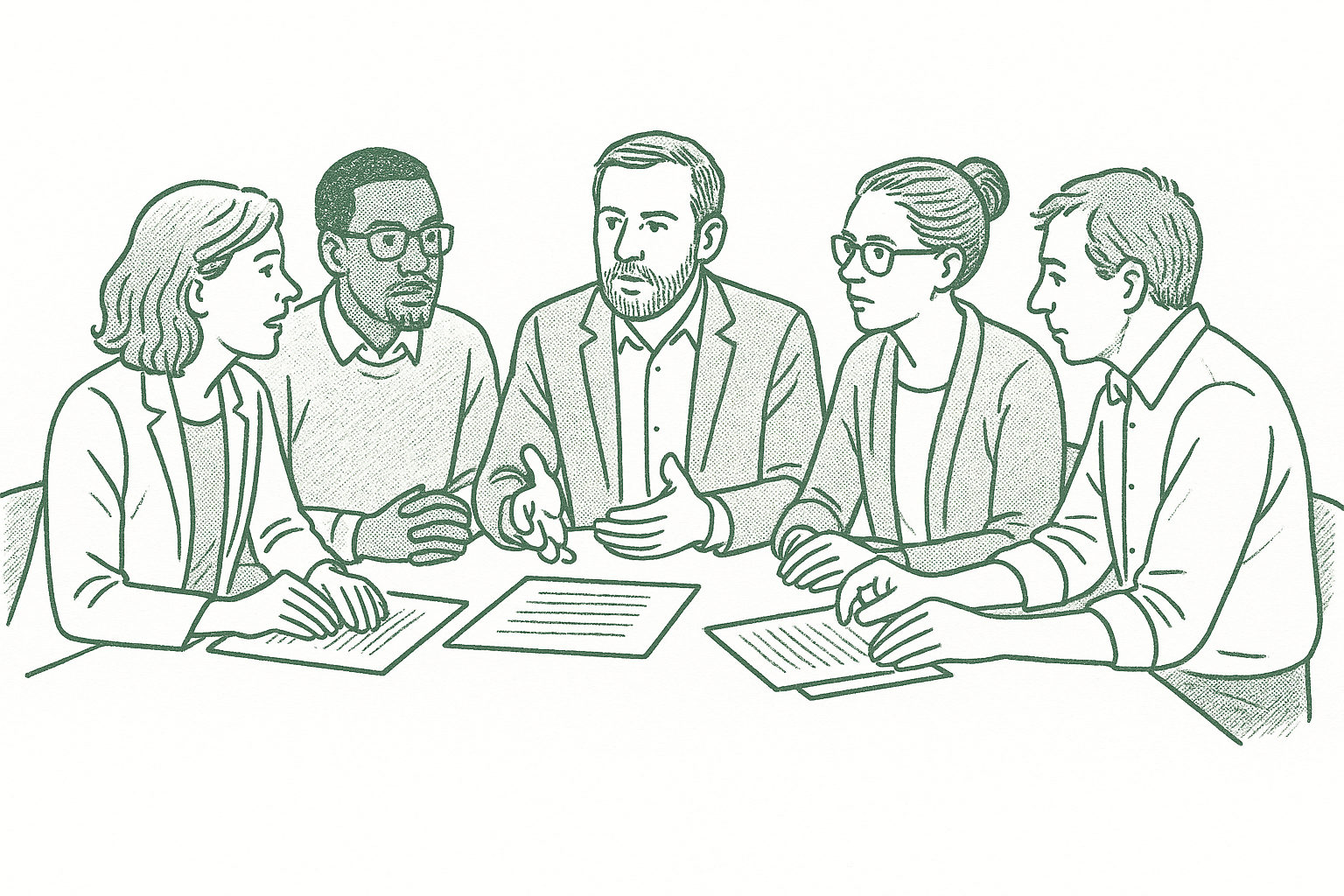
There is a specific kind of loneliness that comes with running a nonprofit. It's not the loneliness of working alone — executive directors are almost never alone. They're surrounded by staff who need direction, board members who need managing, funders who need reporting to, and community stakeholders who need attending to. The calendar is full. The inbox is overflowing. The ask never stops.
The loneliness comes from something else: the complete absence of anyone who is navigating the same complexity at the same level, with no agenda, and no stake in the outcome. The ED is answerable to everyone. They confide in almost no one.
According to a 2024 survey by the Center for Effective Philanthropy — one of the most comprehensive assessments of nonprofit leadership in recent years — 95 percent of all leaders surveyed cited burnout as a concern. Not a minority concern. Not a significant challenge. Nearly universal. And the word that keeps surfacing in qualitative responses from executive directors isn't "overworked." It's "alone."
The structural problem nobody talks about
Every senior leader faces some degree of isolation. The research on CEO loneliness as a business risk applies across sectors. But the nonprofit executive director faces a structural problem that's almost unique in organizational life: they are simultaneously the most powerful person in their organization and the person with the least independent authority.
An ED answers to a board that often has limited operational understanding of the organization's work. They answer to funders who hold significant financial leverage but may have only a fragmentary view of what the organization actually does. They answer to staff who expect both operational direction and values leadership. They answer to community stakeholders and clients who have their own set of demands and expectations. And often — particularly in smaller organizations — the ED is the only C-level executive in the building.
This creates what nonprofit leadership researchers have called the "sandwich problem": the ED is caught between forces above and below, accountable to all of them, reporting directly to none of them. Most executive directors go months — sometimes years — without receiving any formal feedback at all. Research from the nonprofit governance field has documented that most EDs never receive meaningful performance feedback from their boards, leaving them to navigate strategic priorities largely by inference and intuition.
You can't fully confide in your staff — they need you to be steady. You can't be fully candid with your board — they're your boss, and there's always a governance dimension to what you say. You can't tell your funders the real story — the relationship is too fragile. You can't be fully honest with your peer organizations — you're often competing for the same grants. The result is a kind of strategic loneliness that compounds over time, and makes high-stakes decisions progressively worse.
The mission trap
There's a layer on top of this that's specific to the sector. Nonprofit leaders often don't give themselves permission to acknowledge how hard the job is, because they've chosen work explicitly oriented around service and impact. Complaining feels like a betrayal of the mission. Admitting that you're struggling feels like it might reflect on the organization or, worse, on the people you're supposed to be helping.
This is the mission trap: the same values that draw talented people into nonprofit leadership can become the mechanism that prevents them from seeking support. "I should be grateful for this work" and "the people we serve have it harder than I do" are both true statements that function, in practice, as silencers. The feelings don't go away. They just don't get said out loud — which is where the real damage happens.
The psychological safety research is clear on this: groups where people can speak honestly outperform groups where they can't, across nearly every measurable outcome. The same principle applies to individual leaders. The EDs who can name the real problem — not the diplomatic version, not the board-approved framing, but the actual thing — are the ones who figure out how to solve it. That requires a context where naming it is safe. For most EDs, that context doesn't exist.
Why your sector network won't solve this
The nonprofit world isn't without peer networks. There are coalitions, associations, conference circuits, field-specific convenings, and national affinity groups. Most EDs participate in at least some of them. Very few find them genuinely useful for the hardest conversations.
The reason comes back to how networks actually function. Large professional networks produce weak ties — the kind that are useful for information exchange and referrals, but not for the frank conversations that change behavior. An annual conference, a coalition call, a sector-wide listserv: none of these are contexts where an ED is going to say "my board chair is undermining me in donor conversations and I don't know what to do about it."
There's also a sector siloing problem. Nonprofit leaders tend to connect within their field — health EDs with health EDs, arts EDs with arts EDs, housing EDs with housing EDs. The assumption is that field-specific context is what you need. But most of the hardest problems a nonprofit ED faces are not field-specific. Staff retention, board dysfunction, budget shortfalls, founder succession, leadership transitions, funder relationship management — these are the same problems everywhere. The ED of a food bank and the ED of a youth development organization are running remarkably similar organizations from an operational standpoint. The siloing prevents them from learning from each other.
The organizations that recognize this — Bryn Mawr's Nonprofit Executive Leadership Institute, Columbia's Senior Leaders Program for Nonprofit Professionals, Duke's Executive Certificate in Nonprofit Leadership — all build peer cohorts deliberately, because they understand that a network of other nonprofit executives who are facing the same inflection point is the most valuable thing they can offer. The peer group is the program.
What the hardest conversations actually look like
The conversations that move nonprofit leaders forward are rarely about program strategy or impact measurement. They're about the things that don't fit anywhere else:
"My board is not functioning and I don't know how to fix it without burning the relationship." Board dysfunction is the most common operational crisis in nonprofit leadership and one of the least discussed, because talking about it with anyone who has a stake in the outcome — staff, funders, other board members — creates risk. An ED can't be honest about board problems with funders. They can't surface it to staff without undermining governance legitimacy. They need someone who has been through the same thing and has no stake in the political outcome.
"I'm burning out and I don't know if this organization can function without me." The dependency problem — where an organization is structurally reliant on its ED in ways that make succession nearly impossible — is endemic to the sector. Most EDs know this and feel trapped by it. The conversation requires enough psychological safety to say "I built this in a way that might not be healthy, and I don't know how to change it." That's not a conversation you can have with your board or your staff.
"My largest funder wants us to change our programming in ways I don't think will actually help our community." Funder relationships carry an inherent power imbalance that makes candid communication nearly impossible within the relationship itself. An ED who has navigated this — who has found a way to push back on a major funder without losing the grant or the relationship — has knowledge that is invaluable and almost never documented anywhere. It lives in peer networks, when those networks exist.
"I'm underpaying myself and have been for years." Compensation is a strange taboo in the sector. EDs often pay themselves less than they would earn elsewhere, and there's a cultural pressure around this that can become genuinely harmful. Having a frank conversation with peers about what reasonable compensation looks like — and whether the sacrifice is actually sustainable — requires the kind of candor that sector networks rarely support.
These conversations don't happen at conferences. They don't happen in coalitions. They happen in small groups, with people who have earned enough trust to hear the real story. And without that structure, they often don't happen at all — which is where the damage compounds.
The turnover problem is a symptom
Nonprofit executive director tenure has been declining for years. The median tenure for EDs at organizations with budgets under $5 million — where the majority of the sector's organizations operate — is around five years. Many organizations cycle through multiple EDs in a decade. The cost is significant: mission continuity suffers, funder relationships reset, institutional knowledge walks out the door, and staff who built relationships with one leader go through the whiplash of starting again.
The cause of this turnover is usually attributed to compensation, burnout, and the structural challenges of the role. All of those are real. But there's an underlying factor that's less discussed: the absence of support infrastructure. The ED who has no one to talk to — no peer who can normalize the hard parts, no accountability structure to sustain the discipline, no room where they can say what's actually happening — burns out faster. The isolation is not the only cause of turnover, but it is a significant accelerant.
Organizations that invest in ED peer groups — through formal programs or through deliberately constructed peer networks — tend to retain their leaders longer. The mechanism is straightforward: an ED who has a room where they can process the hardest parts of the job doesn't carry those parts alone. The weight is distributed. The job becomes sustainable in a way it isn't when you're navigating it in isolation.
What makes a peer group actually work for EDs
Not every peer group delivers this. The variables that determine whether a nonprofit leader peer group is worth the time:
Cross-sector composition. The most valuable peer groups for EDs deliberately mix missions. A housing ED and a workforce development ED and an arts ED have more to learn from each other than three housing EDs do. The operational problems are the same. The cross-sector framing actually unlocks more candor — there's no competitive pressure, no funder politics, no sense that what you share might end up shaping how someone positions themselves against you in the next grant cycle.
Budget and stage alignment, not sector alignment. An ED running a $500K organization and an ED running a $15M organization are not facing the same problems. The small-budget ED is usually functioning as a founder — wearing every hat, personally managing most relationships, operating with almost no staff capacity. The larger-budget ED is dealing with organizational complexity, middle management layers, and succession infrastructure. Match by stage, not by mission.
Consistent structure with real accountability. Peer groups that operate as loose coffee chats produce connection. Peer groups that have a format — a problem brought, engaged with directly, followed up on at the next meeting — produce behavior change. The format has been the same for 300 years: a small group, a structured conversation, accountability to each other. The accountability is the mechanism. Without it, you have a nice conversation that doesn't change anything.
Small enough for honesty. Robin Dunbar's research on social cognition identifies five as the number of close relationships a person can maintain with genuine depth and trust. The peer group that functions is not a cohort of twenty. It's four to six people who know each other's situations, remember what was said last month, and are willing to tell each other the truth. Size is a quality issue — the bigger the group, the shallower the conversation.
The ones who don't burn out
There is a type of executive director who stays in the sector for twenty years, builds something that outlasts them, and looks back on the work without regret. This is not the majority. But it's not an accident either.
The long-tenure EDs — the ones who figure it out — share a few characteristics. They've drawn clear boundaries with their boards. They've built organizations that can function when they're not in the building. They've found a way to keep the mission energizing rather than depleting. And almost universally, they've found a small group of people they can actually talk to. Not a therapist (though that helps too). Not a coach (though that's valuable). A group of peers who are living the same complexity, at the same level, right now.
That group is not something the sector provides by default. It doesn't materialize through conference attendance or sector coalitions or even most formal leadership development programs. It has to be built deliberately — structured with enough consistency to develop trust, small enough for real candor, and matched carefully enough that everyone in the room is actually facing the same inflection point.
The executive directors who built their peer group early — before they were in crisis, before the board dysfunction reached critical mass, before the burnout set in — are the ones who didn't need it to save them. They just had somewhere to think out loud. That turns out to matter more than almost anything else.
GoodGrowth matches nonprofit executive directors into small peer advisory groups based on organizational stage and budget — not sector or mission. Groups are forming now. Read more about why group size determines whether a peer group works.