It was a July afternoon in Coleman, Texas. The temperature was 104 degrees. The air conditioning was broken. Jerry Harvey, his wife, and his in-laws were sitting on the porch, playing dominoes, drinking lemonade, and doing exactly what sensible people do in that kind of heat — nothing.
Then Harvey's father-in-law suggested they drive to Abilene for dinner.
The drive was 53 miles one way. The car had no air conditioning. The dust was blowing. The diner, when they arrived, served mediocre food. The drive back was exactly as miserable as the drive there. Four people. 106 miles round trip. In July. In Texas.
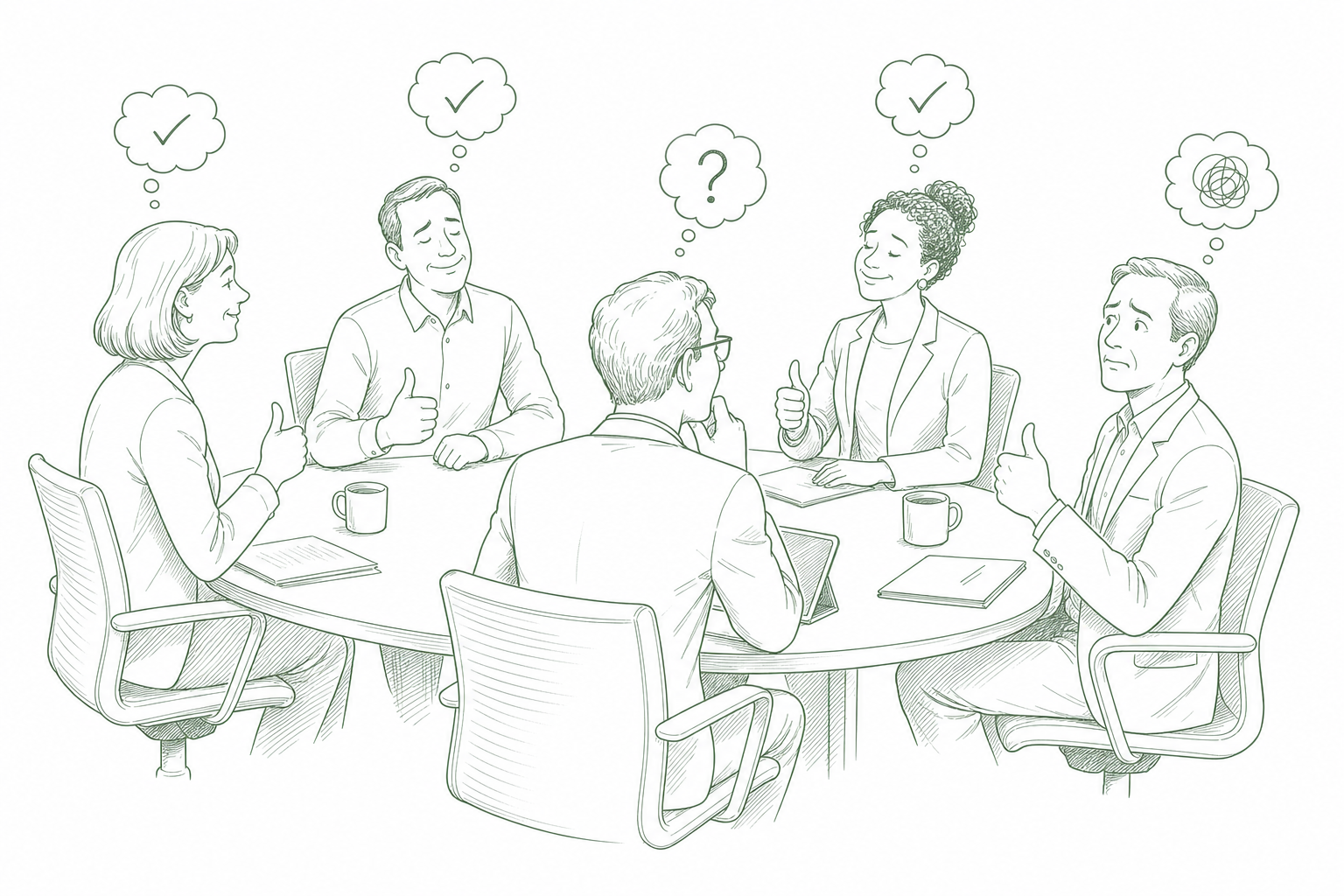
When they got home, exhausted and irritable, someone finally said what everyone had been thinking: "That was a terrible idea." And one by one, each person admitted they had never wanted to go. Harvey had agreed because he thought his wife and in-laws wanted to. His wife had agreed because she thought everyone else did. His mother-in-law said the same. Even his father-in-law — the man who suggested it — admitted he had only brought it up because he thought the others were bored.
Four people. Not one of them wanted to go to Abilene. All four went to Abilene. And the only reason they went was because each person assumed, incorrectly, that everyone else wanted to.
A failure to manage agreement
Harvey published this story in 1974 in the journal Organizational Dynamics under the title "The Abilene Paradox: The Management of Agreement." The paper became one of the most cited pieces in management literature — not because it was methodologically rigorous in the traditional sense, but because every reader immediately recognized the dynamic from their own life.
Harvey's central argument was counterintuitive: the biggest threat to organizations is not conflict but false agreement. Management theory had spent decades teaching leaders how to handle disagreement — how to mediate, negotiate, build consensus. Harvey argued that the real problem was the opposite. Groups routinely agree on actions that no individual member actually supports, and they do so because the mechanisms for surfacing genuine opinion are either absent or actively suppressed.
He identified four symptoms that drive the paradox:
Action anxiety. Each person feels privately that the proposed action is wrong but fears the consequences of saying so. They imagine what will happen if they dissent — conflict, social exclusion, being seen as difficult — and the imagined consequences feel worse than going along. So they go along.
Negative fantasies. These are not based on evidence. Nobody has actually been punished for disagreeing. But each person constructs a vivid internal scenario of how badly it would go if they spoke up. The fantasy is treated as fact. The objection is swallowed.
Real risk of separation. In any group — a family, a board, a founding team — there is a genuine cost to being the person who disrupts consensus. Harvey acknowledged this. The fear is not irrational. But it is almost always disproportionate to the actual risk, and when everyone in the group has the same disproportionate fear, the result is collective paralysis disguised as collective agreement.
Blame and recrimination after the fact. When the trip to Abilene turns out badly — when the product launch fails, the hire does not work out, the strategic pivot goes nowhere — the group does not recognize the agreement failure. Instead, members blame each other for the bad outcome. "You said we should do this." "No, you suggested it." The cycle becomes self-reinforcing: the blame from the last Abilene trip becomes the action anxiety that fuels the next one.
This is not groupthink
People confuse the Abilene paradox with groupthink. They are different phenomena with different mechanisms and different solutions.
Groupthink, described by psychologist Irving Janis in 1972, occurs when a group's desire for harmony causes members to suppress their doubts and conform to a perceived consensus. The critical word is "perceived." In groupthink, there usually is a dominant opinion — held by the leader, or by a vocal majority — and individuals suppress their dissent to align with it. They may even convince themselves they agree. Janis documented this in the Bay of Pigs invasion, the Challenger disaster, and a series of catastrophic policy decisions where advisors knew the plan was flawed but chose cohesion over candor.
The Abilene paradox is structurally different. In an Abilene situation, there is no dominant opinion. There is no leader pushing a bad idea that everyone goes along with. Instead, every single person privately disagrees with the action, and every single person publicly supports it because they assume — incorrectly — that everyone else genuinely wants it. The consensus is not suppressed dissent. It is manufactured agreement that does not exist anywhere except in each person's misreading of everyone else.
This distinction matters because the solutions are different. Groupthink is addressed by creating structures for dissent — assigning a devil's advocate, encouraging criticism, insulating decision-makers from conformity pressure. The Abilene paradox is addressed by creating structures for honesty — making it safe and routine for people to state what they actually think, especially when they believe they are the only one who thinks it.
That is a harder problem. And it is everywhere.
Where founders drive to Abilene
The Abilene paradox is the default mode of most professional groups that lack structured candor. And it is particularly destructive in founder-led companies because the stakes are high, the social bonds are tight, and the decision-making loops are small.
Consider a founding team debating whether to pursue a new market segment. The CEO mentions it in a meeting. The CTO thinks it is a distraction but assumes the CEO has conviction, so they nod. The VP of Sales privately agrees with the CTO but does not want to be the only dissenter, so they say "We could make it work." The CEO reads the room — everyone seems supportive — and greenlights the initiative. Three months later, the segment has produced nothing, and the team burns a quarter asking each other whose idea it was.
Nobody wanted to go to Abilene. They all went anyway.
Research supports how common this is. A 2024 study by Mark Murphy of Leadership IQ, analyzing survey data from over 27,000 executives and employees, found that only 15 percent of employees feel their company's meetings consistently surface honest opinions. The rest report some degree of agreement conformity — saying what they think others want to hear rather than what they actually believe. Forbes covered the finding under the headline "The Abilene Paradox Is Why Overly Polite Teams Make Terrible Decisions."
The dynamic is amplified in founder relationships because the social cost of disagreement feels existential. Co-founders are not just colleagues. They are often friends, former roommates, people who quit jobs together. The isolation of founder decision-making creates pressure to maintain alignment at all costs — and "all costs" often includes swallowing genuine objections to preserve the relationship.
Pluralistic ignorance: the engine under the hood
The psychological mechanism underneath the Abilene paradox has a name: pluralistic ignorance. It was first described by Floyd Allport in 1924 and refers to a situation where the majority of a group privately rejects a norm or decision but goes along with it because each individual incorrectly believes they are in the minority.
We have written about pluralistic ignorance in the context of founder isolation — the finding that most founders believe they are the only one struggling when, in fact, nearly all of them are. The Abilene paradox is pluralistic ignorance in action: not just feeling alone in your doubt, but acting on that false belief by suppressing the doubt entirely.
A 1993 study by Deborah Prentice and Dale Miller at Princeton demonstrated the mechanism precisely. They surveyed incoming students about their comfort with the campus drinking culture. Privately, most students were uncomfortable with excessive drinking. But each student believed their peers were genuinely comfortable with it, so they went along. The result was a campus norm that almost nobody actually supported — maintained entirely by each person's incorrect model of everyone else's preferences.
Replace "campus drinking culture" with "our go-to-market strategy" or "the decision to raise a Series A" and the dynamic is identical. Each founder privately has doubts. Each founder assumes the others do not. Each founder conforms to the imagined consensus. The company drives to Abilene.
Why most advisory settings fail to prevent it
The obvious solution is: just ask people what they actually think. But anyone who has sat in a boardroom, an all-hands, a strategic offsite, or even a family dinner knows that "just being honest" is not a viable intervention.
Honesty requires structural support. It needs to be the norm, not the exception. It needs to be expected, not courageous. And most professional settings actively discourage it.
The feedback desert — the finding that the higher you climb in an organization, the less honest feedback you receive — is one manifestation. Board meetings are another. Networking events, conferences, Slack communities, advisory boards — all of these settings have implicit rules against genuine dissent. You can share "feedback," but you cannot say "I think this strategy is fundamentally wrong and here is why." The social penalty is too high. The structure does not support it.
This is why most founders' advisory structures are Abilene machines. Everyone nods. Everyone affirms. Nobody says the thing that actually needs to be said. Not because they are dishonest people, but because the structure does not create the conditions for honesty.
Harvey himself was clear about this in the original paper: "The inability to manage agreement, not the inability to manage conflict, is the single most pressing issue of modern organizational life." He published that in 1974. Fifty years later, most organizations still do not have a reliable mechanism for surfacing genuine agreement — or the absence of it.
How structured peer groups break the pattern
The Abilene paradox is not a character flaw. It is a structural failure. People do not suppress their opinions because they are weak. They suppress them because the environment makes suppression the rational choice. Change the environment and the behavior changes.
A well-designed peer group changes the environment in three specific ways:
Structured candor as the default. In a hot seat format, the protocol requires honest assessment. You are not volunteering criticism in an environment that rewards harmony. You are fulfilling a structural role. The expectation is candor. Withholding your real opinion is the norm violation, not sharing it. This inverts the Abilene dynamic entirely.
No power hierarchy. The Abilene paradox is amplified by status differences. When the CEO speaks first, confirmation bias and deference shape every subsequent response. Peer groups, by definition, have no authority gradient. Nobody in the room signs your checks or controls your equity. That structural equality removes the most common trigger for action anxiety — the fear that dissent will have professional consequences.
Recurring relationship with accountability. One-off advice sessions — mentors, advisors, conference conversations — have no mechanism for follow-through. You nod, you agree, you drive to Abilene. A recurring peer group creates accountability over time. Your peers saw what you committed to last month. They know what you said you were going to do. They will ask about it this month. That continuity makes false agreement expensive — because the consequences of agreeing to something you do not intend to follow through on will surface within weeks, not months.
Amy Edmondson's research on psychological safety at Harvard Business School has documented the mechanism at scale. Teams with high psychological safety — where members believe they can raise concerns without fear of punishment — consistently outperform teams without it. Not because they are smarter. Not because they have better data. Because they surface genuine opinions instead of performing false agreement. They do not drive to Abilene.
The test: can you say it in the room?
Harvey offered a simple diagnostic for the Abilene paradox. He called it the "organizational diagnosis." Ask each member of a team, privately and separately, what they think the group should do. Then compare their private answers to the group's public decision. If the private answers diverge significantly from the public decision, the organization is in Abilene.
Most founding teams have never run this test. Most would be surprised by the results.
The peer group equivalent is even simpler: Is there something you believe about your business that you have not said out loud in any professional context? If the answer is yes — and it almost always is — then you are carrying a private opinion that may be the most important insight in your entire strategy. You are just not saying it because you assume nobody else would agree.
You are probably wrong. They probably agree. They are just not saying it either.
That is the Abilene paradox. That is what it costs. And the only reliable cure is a structure that makes honesty the default rather than the exception.