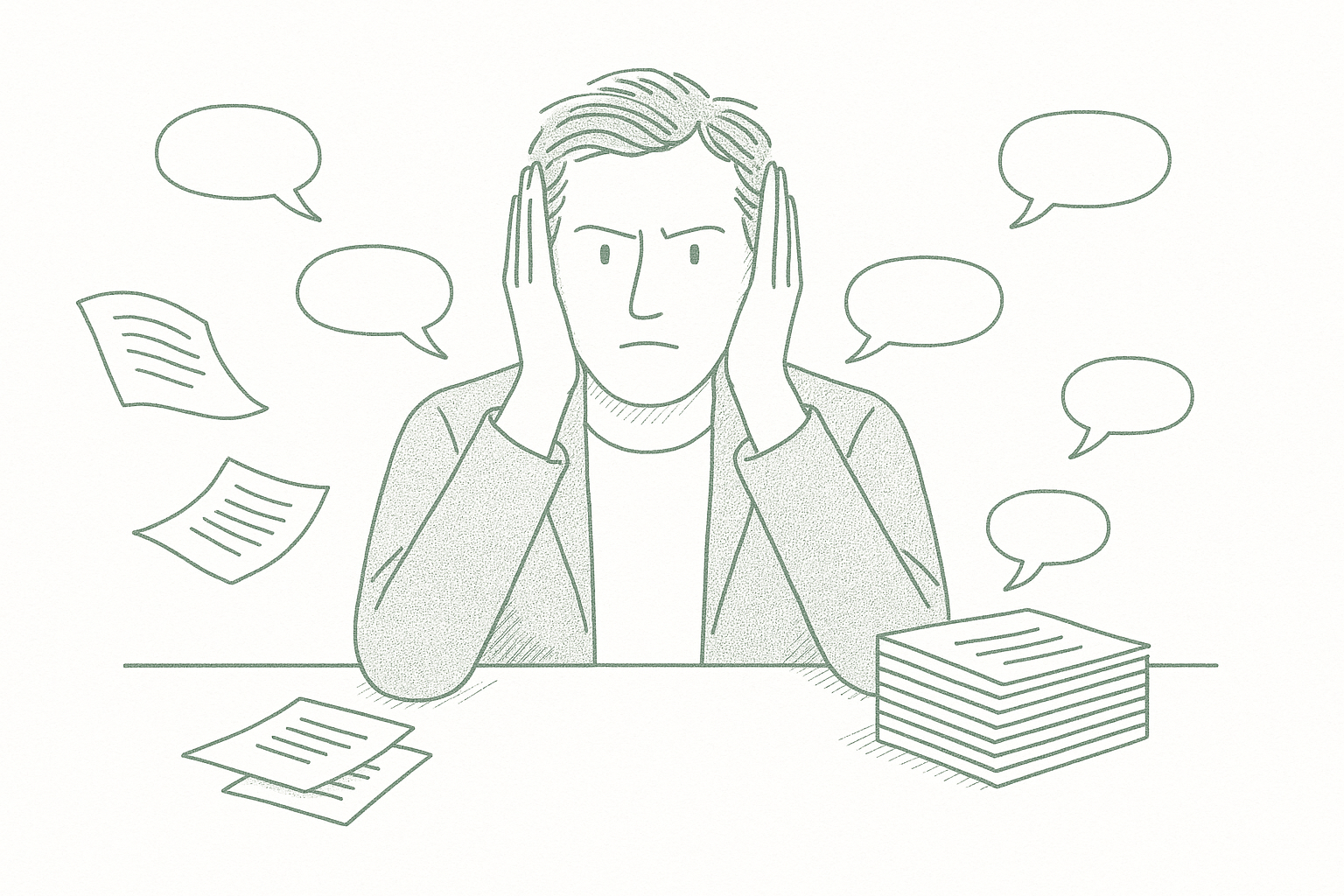
In 1960, a cognitive psychologist named Peter Wason gave subjects a deceptively simple task. He presented them with the number sequence 2, 4, 6 and asked them to discover the underlying rule by proposing their own sequences. The actual rule was "any ascending sequence." But subjects overwhelmingly guessed the rule was "increasing by two" — and then tested only sequences that confirmed their guess: 8, 10, 12. Yes. 14, 16, 18. Yes. They declared the rule discovered without ever testing a sequence that might disprove their hypothesis.
Wason called this confirmation bias — the systematic tendency to seek, interpret, and remember information that confirms what you already believe, while ignoring or discounting information that contradicts it. Sixty-five years of subsequent research has confirmed that this is not a bug in occasional reasoning. It is the default operating mode of the human brain.
And founders, it turns out, have it worse than almost everyone else.
Why entrepreneurs are uniquely vulnerable
Busenitz and Barney published a landmark study in Strategic Management Journal in 1997 comparing the decision-making processes of entrepreneurs and managers in large organizations. Their finding was stark: entrepreneurs relied significantly more on heuristic-based thinking — cognitive shortcuts that trade accuracy for speed. They were faster decision-makers, but the speed came at a cost. Heuristic thinking is the exact substrate on which confirmation bias thrives.
The connection is not accidental. Baron, writing in the Journal of Business Venturing in 2004, explained the mechanism: entrepreneurs exist in environments of extreme information overload, time pressure, and emotional investment. These are precisely the conditions under which the brain defaults to confirmatory processing. When you are overwhelmed with data, you filter for what fits. When you are under time pressure, you skip disconfirming evidence. When you are emotionally invested in an outcome, you interpret ambiguous signals as supportive.
Hmieleski and Baron published a follow-up in Strategic Entrepreneurship Journal in 2009 demonstrating that entrepreneurs as a group exhibit significantly higher optimism and positive affect than non-entrepreneurs. This is usually framed as an asset — the optimistic founder who persists when others quit. But the researchers showed the dark side: high optimism amplifies confirmation bias by making founders disproportionately receptive to positive information and disproportionately dismissive of negative signals. The very trait that makes founders start companies is the same trait that makes them unable to see when those companies are failing.
The three faces of the bias
Nickerson published the definitive review of confirmation bias in Review of General Psychology in 1998, cataloging decades of research into a unified framework. He identified three distinct mechanisms through which the bias operates — and each one shows up in founder decision-making.
Selective exposure. Founders preferentially seek out information that confirms their existing beliefs. You read the blog post that validates your go-to-market strategy. You attend the conference where speakers agree with your approach. You ask your early customers — the ones who already bought — whether they like the product. You do not seek out the people who evaluated your product and chose a competitor. You do not read the case study about the identical strategy that failed. The information diet is curated before the decision is ever made.
Biased assimilation. When disconfirming evidence does arrive, founders process it differently than confirming evidence. Lord, Ross, and Lepper demonstrated this in a now-classic 1979 study at Stanford: participants who held strong positions on an issue evaluated pro-attitudinal evidence as more convincing and methodologically rigorous than anti-attitudinal evidence — even when the research designs were identical. Founders do the same thing with market signals. The customer who says "I love this" is treated as valid data. The customer who says "this does not solve my problem" is treated as an outlier, a bad fit, someone who "doesn't get it."
Biased recall. Memory itself is not neutral. Research by Sanitioso, Kunda, and Fong published in Journal of Personality and Social Psychology in 1990 showed that people recall information consistent with their current beliefs more easily and more frequently than inconsistent information. A founder remembering their last ten customer conversations will disproportionately recall the enthusiastic ones. Not because they are dishonest. Because the brain stores and retrieves information in a way that favors the existing narrative. The feedback desert is not just about what others fail to tell you. It is about what your own memory fails to retrieve.
The real-world damage
Wasserman and Anderson, in a Harvard Business School background note published in 2011, argued that the same cognitive biases that provide early benefits to founders — the conviction to start, the optimism to persist, the pattern recognition that spots opportunities — become weaknesses as the business matures. Confirmation bias is the clearest example. In the earliest stages, a founder's unwavering conviction is necessary: without it, nothing gets built. But as the company grows, that same conviction becomes a filter that blocks the market signals the founder most needs to hear.
The pattern shows up everywhere. A founder who has spent six months building a feature interprets lukewarm user engagement as a discovery problem rather than a product problem — because acknowledging the product problem would mean the six months were wasted. A CEO who promoted their college friend into a leadership role interprets team dysfunction as growing pains rather than a hiring mistake — because acknowledging the mistake would implicate their own judgment. A founder who chose a pricing strategy based on competitive analysis interprets declining conversion as a messaging problem rather than a pricing problem — because the pricing decision felt right at the time, and the brain protects decisions that felt right.
Carr and Blettner, in a longitudinal study of 163 small firm founders presented at Babson College's Frontiers of Entrepreneurship Research, found that experience actually made the problem worse, not better. Founders with more experience exhibited higher illusion of control and greater reliance on confirming evidence. The more decisions you have made, the more templates your brain has for processing new information through existing frameworks. Experience does not debias. It deepens the grooves.
Why self-awareness does not fix it
The most common advice given to founders about cognitive bias is some version of "just be aware of it." Know your biases. Question your assumptions. Be more open-minded. This advice sounds reasonable. The research says it does not work.
Lilienfeld, Ammirati, and David published a comprehensive review in Perspectives on Psychological Science in 2009 examining the efficacy of debiasing techniques against confirmation bias. Their conclusion was sobering: awareness-based interventions — simply telling people about the bias — produced minimal and inconsistent effects. Knowing about confirmation bias does not stop it from operating, any more than knowing about optical illusions stops you from seeing them.
A 2023 registered report published in Comprehensive Results in Social Psychology tested three specific debiasing techniques: consider-the-opposite prompts, psychoeducation about bias, and social norms manipulation. Of the three, only social norms intervention — essentially changing the social expectations about what kind of information seeking is normal — produced significant reductions in selective exposure. Consider-the-opposite and psychoeducation showed little evidence of effectiveness. The bias was not responsive to internal correction. It was responsive to external social pressure.
This finding maps directly onto what the accountability gap looks like in practice. You cannot hold yourself accountable for a bias you cannot see operating in real time. The bias is invisible to the person it is affecting — that is what makes it a bias. The only reliable correction comes from outside the biased system.
The group debiasing effect
In 2002, Schulz-Hardt, Frey, Lüthgens, and Moscovici published a study in Organizational Behavior and Human Decision Processes that demonstrated something remarkable about how groups interact with confirmation bias. They ran three experiments comparing information search behavior in homogeneous groups (where all members agreed on a decision beforehand) and heterogeneous groups (where members held different initial preferences).
Homogeneous groups amplified confirmation bias beyond what individual bias alone would predict. When everyone in the group already agreed, the group's collective information search was even more biased toward confirming evidence than the sum of its individual members' biases. Agreement did not just fail to correct the bias. It made it worse.
Heterogeneous groups showed the opposite pattern. When the group contained genuine dissent — at least one member who held a different view — the group's information search was less biased than the statistical sum of its members' individual biases. Dissent did not just reduce the group-level bias. It reduced it below what you would expect from the individuals acting alone. The presence of a different perspective triggered a group-level debiasing process that was more powerful than any individual debiasing technique.
The researchers called this the "genuine dissent" effect, and it has a critical qualifier: the dissent has to be real. When they tested "devil's advocacy" — assigning someone to argue the opposing position without actually holding it — the debiasing effect was smaller and less consistent. The group could tell the difference between someone who genuinely saw the situation differently and someone who was performing disagreement. Genuine dissent from people who are actually in the room with you, who actually believe something different, is the mechanism that breaks confirmation bias at the group level.
Why peer groups work where willpower does not
The Schulz-Hardt findings explain why a well-structured peer group is the most effective tool against confirmation bias that currently exists in the research literature. It is not because peer groups are motivating or supportive, though they can be both. It is because of three structural features that no amount of self-reflection can replicate.
Heterogeneity of perspective. In a peer group matched by problem rather than by industry, the members are working on similar challenges from different vantage points. A SaaS founder, a services company owner, and an ecommerce operator all dealing with the same growth plateau will see different things — because their confirmation biases are trained on different data sets. The SaaS founder's bias filters for product-market fit signals. The services owner's bias filters for operational capacity signals. The ecommerce operator's bias filters for unit economics signals. When all three examine the same strategic question, the collective information search covers terrain that no individual could reach alone.
Recurring exposure. Confirmation bias is not a one-time event. It operates continuously, reshaping every decision, every day. A single coaching session or advisory board meeting cannot counteract a bias that is running in the background twenty-four hours a day. But a recurring peer group — the kind that meets every week or two — creates regular interruptions to the confirmatory cycle. The spacing effect means that frequent, distributed exposure to disconfirming perspectives is dramatically more effective than occasional intensive ones. Twelve structured conversations over six months will debias your decision-making more than a single week-long retreat.
Social norms around honesty. The 2023 debiasing study found that social norms intervention was the only technique that reliably reduced selective exposure. A peer group with established norms of reciprocal vulnerability and honest feedback creates exactly this kind of normative environment. When the social expectation in the room is that you will share real numbers, real problems, and real failures — and that others will challenge your interpretation of those numbers — the confirmation bias has nowhere to hide. The group norm overrides the individual bias because the social pressure to seek accurate information becomes stronger than the cognitive pressure to seek confirming information.
The question your peers are asking that you cannot ask yourself
Von Bergen and Bressler, in their analysis of confirmation bias in entrepreneurship published in the Journal of Management Policy and Practice, argued that the most effective single technique for mitigating confirmation bias is what Baron called "active open-mindedness" — the deliberate practice of considering arguments on multiple sides of an issue. The problem, they noted, is that active open-mindedness is extraordinarily difficult to practice alone. You cannot earnestly argue against a position you are emotionally invested in. You cannot authentically seek disconfirming evidence for a decision you have already committed to. The bias prevents its own correction.
But you can sit in a room where someone else does it for you. Not a devil's advocate performing opposition. A real peer who genuinely sees the situation differently because they are looking at it from a different position, with different experiences, and different biases of their own. Their biases cancel yours — not perfectly, not completely, but enough. Enough to surface the customer feedback you have been discounting. Enough to reframe the market signal you have been ignoring. Enough to ask the question your brain will not let you ask: what if you are wrong?
That question — what if you are wrong — is the single most valuable question in founder decision-making. And it is the one question that confirmation bias is specifically designed to prevent you from asking. You cannot think your way out of a thinking error. You need someone outside the error to point at it.
This is why most mastermind groups fail, incidentally. Groups composed entirely of people who think alike — same industry, same stage, same worldview — amplify confirmation bias instead of correcting it. The Schulz-Hardt research is explicit: homogeneous groups make the bias worse. The debiasing effect comes from genuine diversity of perspective, not from the mere act of gathering people in a room.
Wason's subjects in 1960 never tested the sequence 1, 3, 5. They never tried 10, 20, 47. They were so certain of their hypothesis that they only ever tested evidence that could confirm it. They left the experiment convinced they had discovered the rule — and they were wrong. Every founder reading this has made the same mistake. Not in a lab. In their business. With real money, real customers, and real consequences.
The question is not whether confirmation bias is affecting your decisions. The research settled that decades ago. The question is whether you have anyone in your life whose job it is to test the sequences you refuse to try.