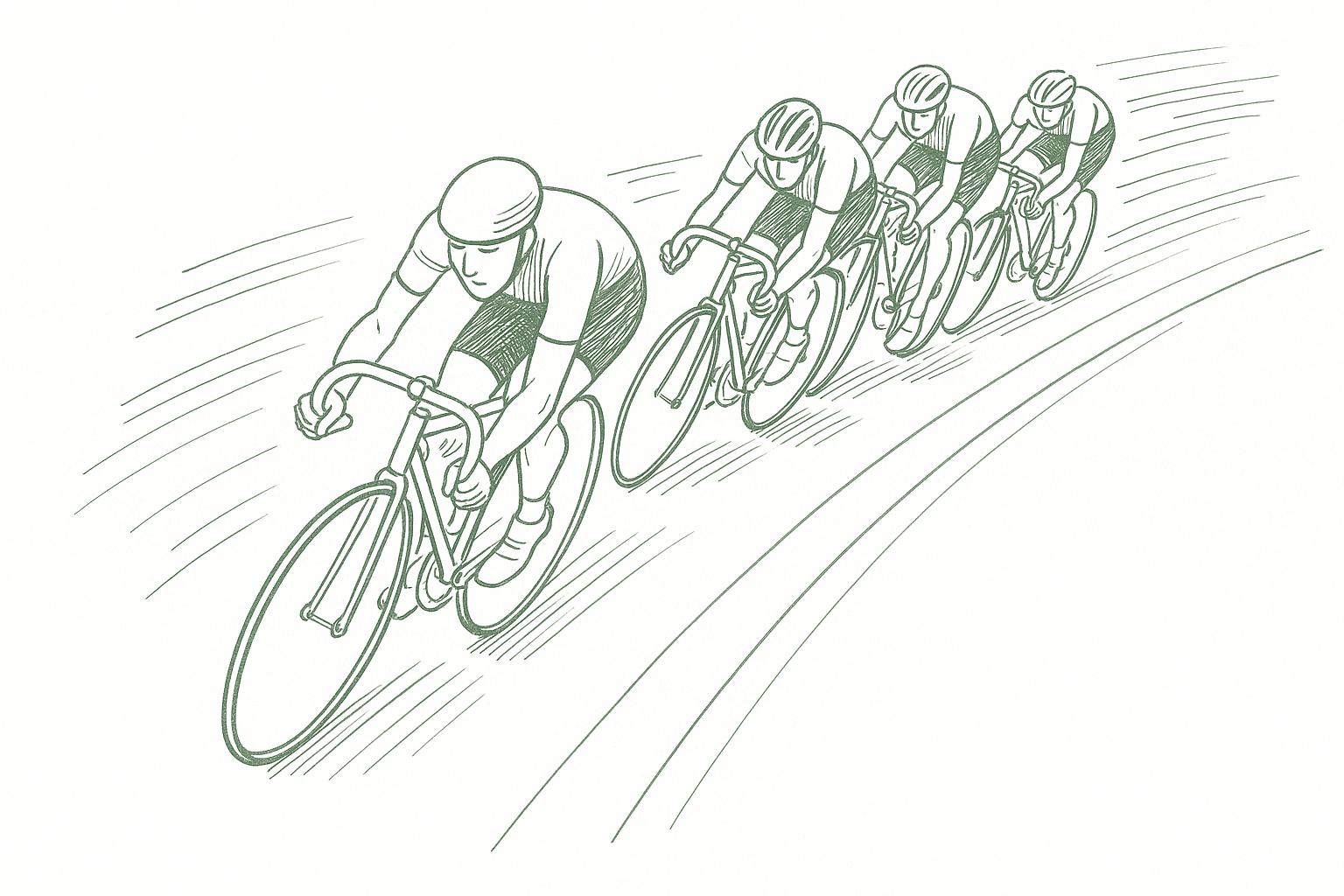
Norman Triplett was not looking for a grand theory of human behavior. He was looking at bicycle racing records. Specifically, he wanted to know why cyclists who raced against other riders consistently posted faster times than cyclists who rode the same course alone. The gap was not trivial. In his analysis of Racing Board records, paced riders were roughly 20-30 seconds faster per mile than unpaced solo riders over the same distance.
In 1898, Triplett designed what is widely considered the first experimental study in social psychology. He gave 40 children a simple task — winding a fishing reel as fast as possible — and had them do it alone and side-by-side with another child. Roughly half wound the reel significantly faster when another person was working next to them. Not competing. Not cooperating. Just present.
That finding launched an entire field. The phenomenon now has a name: social facilitation. And 125 years of research have made the case overwhelming. The presence of other people changes how you perform. Not sometimes. As a rule.
The paradox that took 67 years to solve
For decades after Triplett, the research was a mess. Some studies showed that people performed better in the presence of others. Other studies showed they performed worse. There was no coherent explanation for why it went one way or the other.
In 1965, Robert Zajonc published a paper in Science that cut through the confusion. His insight was elegant: the presence of others increases physiological arousal, which amplifies whatever response is dominant. If the task is well-practiced or simple — something you already know how to do — that heightened arousal makes you do it faster and better. If the task is complex or unfamiliar, the same arousal makes you worse. The presence of others does not make you generally better. It makes your strongest response stronger.
Zajonc's paper has been cited over 1,400 times. It remains one of the most influential findings in social psychology, because it resolved a paradox and replaced it with a mechanism. The presence of others is not noise. It is a signal your body responds to whether you want it to or not.
241 studies, one conclusion
In 1983, Charles Bond and Linda Titus did what individual studies could not: they ran a meta-analysis covering 241 social facilitation studies involving nearly 24,000 participants. The results confirmed Zajonc's theory at scale. The presence of others increases the speed of simple task performance and decreases the speed of complex task performance. It slightly improves accuracy on simple tasks and impairs accuracy on complex ones.
One of their more interesting findings was that social facilitation effects were surprisingly unrelated to evaluation apprehension — the fear of being judged. It was not about whether the other people were watching. It was about whether they were there at all. Even a passive, non-evaluative presence changed performance. The mere fact of not being alone was doing the work.
A more recent systematic review by van Meurs, Greve, and Strauss, published in the International Review of Sport and Exercise Psychology in 2022, analyzed 82 human studies spanning 100 years and 7,008 participants. Their conclusion held: condition-based tasks — things you have trained for — are facilitated by the presence of others. Coordination-based tasks under time pressure can be inhibited. The pattern has not shifted in a century of replication.
What this means for founders who work alone
Here is where it gets interesting for anyone building a business. Running a company is a mix of practiced tasks and novel ones. Strategy, sales calls, hiring decisions, financial modeling — these are skills founders develop over time. They become dominant responses. And the research is unambiguous: those are exactly the tasks that get better when other people are in the room.
This is not about collaboration or brainstorming. Social facilitation does not require interaction. It requires presence. A founder making decisions in complete isolation is operating at a measurably lower performance level on their core competencies than a founder making the same decisions with peers in the room.
The coworking research confirms it. A 2026 Experience Sampling study published in Ergonomics by Lukeš and colleagues found that remote workers reported significantly higher well-being, productivity, and work engagement when working from a coworking space compared to working from home — even when they were not directly collaborating with anyone. The presence itself was the variable.
But coworking spaces only capture part of the effect. They provide passive co-presence with strangers. A structured peer group goes further: it provides co-presence with people who are working on the same type of problems, who know your commitments, and who will be there next time to ask what happened. That is not just social facilitation. It is social facilitation stacked on top of accountability and the Köhler motivation gain.
The distinction most people miss
Social facilitation is not the same as social loafing. They are nearly opposite phenomena, and confusing them is common. Social loafing is what happens in large groups when individual contributions are not identifiable — people coast because no one can tell who did what. Harkins demonstrated in 1987 that when outputs are individually evaluable, pairs outperform solo workers even with group size held constant. The key variable is whether your contribution is visible.
This is why group size matters. In a group of 50, you can hide. In a group of 5, you cannot. Social facilitation happens. Social loafing does not. Every person's presence is felt. Every person's contribution is visible. The group is small enough to generate arousal and specific enough to generate accountability. That is the structural reason why five people is the magic number for a working peer group.
Triplett's children wound the reel faster because someone was next to them. Zajonc explained why. Bond and Titus proved it held across thousands of subjects. And what it means is this: if you are a founder working on well-practiced problems — the problems you actually know how to solve — you are leaving performance on the table every hour you work alone.
Ben Franklin knew this in 1727. The research just took 170 years to catch up.